

What the 2026 Refrigerant Rules Mean for Homeowners Right Now
How AC refrigerant changes affect homeowners is one of the most searched HVAC questions of 2026 — and for good reason. Here is a quick summary before we dive deeper:
Key ways the 2026 refrigerant rules affect homeowners:
- No forced replacement — You can keep using your existing R-410A system as long as it runs
- Higher repair costs ahead — R-410A supply shrinks every year, pushing prices up significantly
- No retrofitting — New A2L refrigerants (R-454B, R-32) cannot be swapped into old systems
- New systems cost more — Equipment built for A2L refrigerants runs 20–30% higher than older R-410A models
- Safety features are built in — New systems include Refrigerant Detection Systems (RDS) for added protection
- Big incentives are available — Federal tax credits and utility rebates can offset upgrade costs
If you have an air conditioner or heat pump in your Northern New Jersey home, the refrigerant inside it is quietly becoming a bigger deal. Since January 1, 2025, manufacturers have been banned from producing new R-410A — the refrigerant found in virtually every residential AC system installed over the past 15 years. As of January 1, 2026, technicians can no longer install any new cooling system that uses R-410A at all.
This is not a distant regulation. It is already reshaping what equipment is available, what repairs cost, and what homeowners should plan for this summer and beyond.
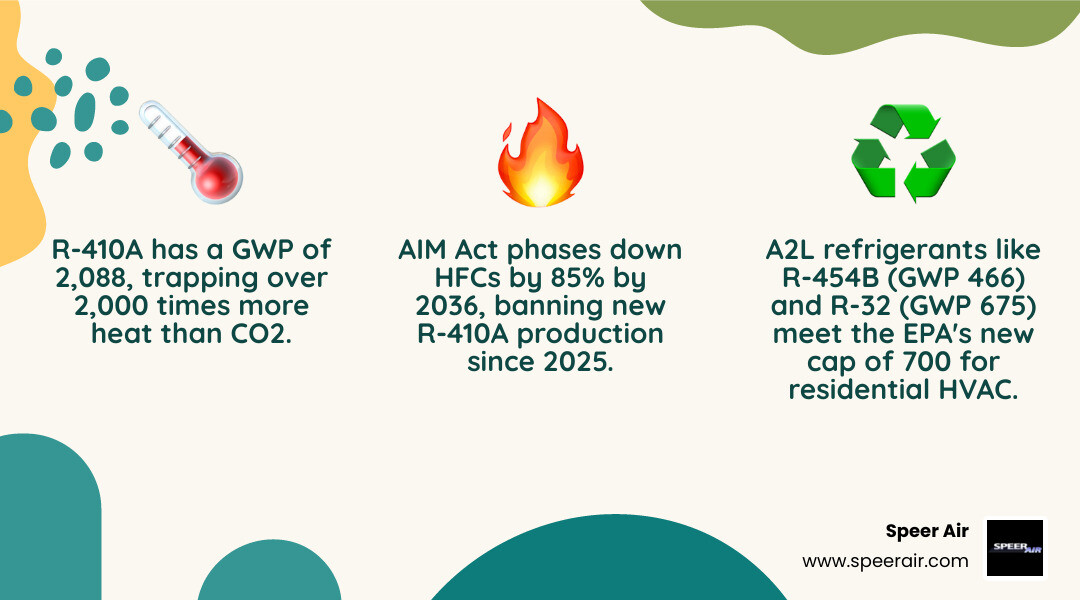
The change is driven by the American Innovation and Manufacturing (AIM) Act of 2020, which gave the EPA authority to phase down hydrofluorocarbons (HFCs) — a class of refrigerants with extremely high global warming potential. R-410A has a GWP of 2,088, meaning it traps over 2,000 times more heat than carbon dioxide. The EPA’s new threshold caps GWP at 700 for new HVAC systems, pushing the industry toward lower-impact alternatives like R-454B (GWP 466) and R-32 (GWP 675).
For homeowners, this transition means navigating higher equipment prices, changing service costs for older systems, new safety technology, and real financial incentives that are worth understanding now — not after your AC breaks down on a hot July afternoon.
The Shift from R-410A: Understanding the AIM Act

The transition we are currently experiencing is part of a multi-decade effort to reduce the environmental impact of cooling technology. If you remember the phase-out of R-22 (often called Freon) about 15 years ago, this process will feel familiar. The AIM Act of 2020 is the legislative backbone of this current shift, mandating an 85% reduction in HFC production and consumption by 2036.
The primary metric used here is Global Warming Potential (GWP). As mentioned, R-410A has a GWP of 2,088. To put that into perspective, the EPA’s new mandate requires all new residential air conditioning systems to use refrigerants with a GWP under 700. This is a massive reduction in potential greenhouse gas impact.
However, these lower-GWP refrigerants operate differently. They require updated equipment designs, new safety sensors, and different handling procedures for technicians. This is why you may have noticed that Ac Refrigerant Leak Issues In Your Home are becoming more complex to resolve. In the past, a simple “top-off” might have been the go-to for some, but with the rising scarcity of R-410A and the strict requirements of the AIM Act, finding and fixing leaks is now the only sustainable path forward.
How AC refrigerant changes affect homeowners and their current systems
One of the biggest misconceptions we hear at Speer Air is that homeowners are being “forced” to buy new units. This is not true. If your current R-410A system is cooling your home effectively, you are perfectly fine to keep using it. The 2026 deadline applies to the installation of new equipment, not the operation of existing units.
However, how ac refrigerant changes affect homeowners becomes very real when a repair is needed. Because R-410A is no longer being manufactured for new systems, the available supply is dwindling. Most of the R-410A used for repairs now comes from “reclaimed” or recycled sources. As the supply drops, the price for a pound of R-410A rises, often quite sharply.
How ac refrigerant changes affect homeowners with older units
If your system was installed before 2010, it likely uses R-22. If it was installed between 2010 and 2024, it almost certainly uses R-410A. For those with these older units, the main challenge is serviceability. While reclaimed refrigerant will be available for years—just as R-22 is still available today—it is becoming a “boutique” product. A major leak in an older R-410A system could lead to a repair bill that rivals the cost of a significant down payment on a new, more efficient unit.
Why how ac refrigerant changes affect homeowners requires professional leak detection
Refrigerant is not like gasoline in a car; it isn’t “burned” or “used up.” It circulates in a sealed, pressurized loop. If your system is low on refrigerant, you have a leak.
With the new regulations, professional leak detection is more critical than ever. New A2L systems are designed with tighter tolerances. If a technician simply adds refrigerant without fixing the source of the leak, they are essentially venting expensive, regulated chemicals into the atmosphere and putting your compressor at risk. Our NATE-certified technicians use electronic leak detectors and specialized tools to ensure the integrity of these sealed loops, protecting both your wallet and your system’s lifespan.
Signs your system uses legacy R-410A refrigerant:
- The outdoor unit was manufactured between 2010 and 2024.
- The nameplate on the condenser specifically lists “R-410A” or trade names like “Puron.”
- The system does not have a “Refrigerant Detection System” (RDS) sensor installed.
- You haven’t had a full system replacement since 2024.
Safety and Technology: The Rise of A2L Refrigerants
The refrigerants replacing R-410A, such as R-454B and R-32, are classified by ASHRAE as A2L. This is a technical designation that means they are “mildly flammable.”
While the word “flammable” can sound intimidating, these refrigerants are incredibly difficult to ignite and are already used safely in millions of cars and window AC units. To ensure total safety in a home environment, manufacturers like Carrier have redesigned their 2025 and 2026 models with integrated Refrigerant Detection Systems (RDS).
If these sensors detect even a tiny concentration of refrigerant where it shouldn’t be, they automatically shut down the compressor and turn on the indoor blower fan. This dilutes the refrigerant and prevents it from reaching a concentration where it could become a hazard. If you ever notice your indoor fan running even though the thermostat is set to “off,” it could be your RDS doing its job. This level of safety technology is one of the reasons new systems carry a higher initial price tag but offer much greater peace of mind.
Environmental Impact: GWP vs. PFAS Forever Chemicals
The primary goal of the 2026 transition is to lower our collective carbon footprint. By moving from R-410A to R-454B or R-32, the HVAC industry is drastically reducing the potential for global warming if a leak occurs.
| Refrigerant | GWP (Global Warming Potential) | Flammability Class | Standard Use |
|---|---|---|---|
| R-410A | 2,088 | A1 (Non-flammable) | Legacy Systems (Pre-2025) |
| R-32 | 675 | A2L (Mildly Flammable) | Ductless & Some Central AC |
| R-454B | 466 | A2L (Mildly Flammable) | New Standard for Central AC |
There is a nuanced debate in the industry regarding “forever chemicals” or PFAS. Some lower-GWP refrigerants like R-454B contain components (like R-1234yf) that are more chemically stable and stay in the atmosphere longer. However, the immediate benefit of a 75% reduction in GWP is the priority for current EPA regulations. For homeowners in Northern New Jersey and Eastern Pennsylvania, the focus remains on high-efficiency equipment that reduces energy consumption, which is the most direct way to lower your home’s environmental impact.
Financial Incentives for Upgrading to Compliant Systems
While new A2L-compliant systems represent a larger investment, there has never been a better time to take advantage of financial incentives. The Inflation Reduction Act (IRA) has made substantial tax credits available for homeowners who upgrade to energy-efficient cooling and heating solutions.
- 25C Tax Credit: Homeowners can claim up to 30% of the cost of qualifying air conditioners (up to $600) and heat pumps (up to $2,000) every year.
- Utility Rebates: Many local utility providers in New Jersey and Pennsylvania offer instant rebates for installing ENERGY STAR-certified equipment.
- High-Efficiency Savings: Modern A2L systems are often significantly more efficient than the 10-to-15-year-old units they replace. This can lead to noticeable reductions in your monthly cooling bills, helping the system pay for itself over time.
At Speer Air, we help our clients navigate these credits and rebates to ensure they get the maximum value out of their transition to a 2026-compliant system.
Frequently Asked Questions about the 2026 Refrigerant Transition
Can my existing R-410A system be retrofitted for new refrigerants?
No. This is a very important point for homeowners to understand. You cannot simply “drain” R-410A and “refill” it with R-454B or R-32. The new A2L refrigerants operate at different pressures and require different oils and safety components (like the RDS sensors mentioned earlier). Attempting to retrofit an old system would not only be dangerous but would likely destroy the compressor and void any warranties.
Are A2L refrigerants safe for residential use?
Yes, they are very safe. The “mildly flammable” classification means they are difficult to ignite and have a very slow flame speed. When combined with the mandatory safety sensors and automatic ventilation features built into new HVAC units, the risk to a homeowner is virtually non-existent. These refrigerants are already the standard in many other parts of the world and in the automotive industry.
When is the best time to replace an aging air conditioner?
If your system is over 12 years old and uses R-410A, the best time to consider replacement is before a major failure occurs. Waiting until a heatwave in July often leads to “panic buying,” where you might not have the time to research the best incentives or wait for specific high-efficiency models to be in stock. Planning an upgrade during the shoulder seasons (spring or fall) allows for a more thoughtful installation and ensures you are ready for the summer heat.
Conclusion
The 2026 refrigerant transition is a major milestone for the HVAC industry and for homeowners across Northern New Jersey and the Poconos. While the rules may seem complex, the goal is simple: more efficient, environmentally friendly, and safer cooling for your home.
Whether you are in Rockaway, Denville, or anywhere in Morris County, Speer Air is here to help you navigate these changes. As a Carrier Factory Authorized Dealer with over 120 years of experience, we have seen many refrigerant transitions come and go. We have the expertise to maintain your legacy R-410A system for as long as possible or help you transition to a new, compliant system when the time is right.
Don’t let a refrigerant leak catch you off guard this summer. Schedule your professional AC repair and inspection today to ensure your home stays comfortable and compliant with the latest standards.