

What Homeowners and Contractors Need to Know About R410A vs R454B Refrigerant
If you’re researching r410a vs r454b refrigerant what you need to know, here’s the short version: R-410A is the refrigerant that has powered residential air conditioners for over two decades, but as of January 1, 2025, manufacturers can no longer produce new residential HVAC equipment using it. R-454B is its designated replacement — a lower-GWP, mildly flammable blend that is now the standard in all new systems.
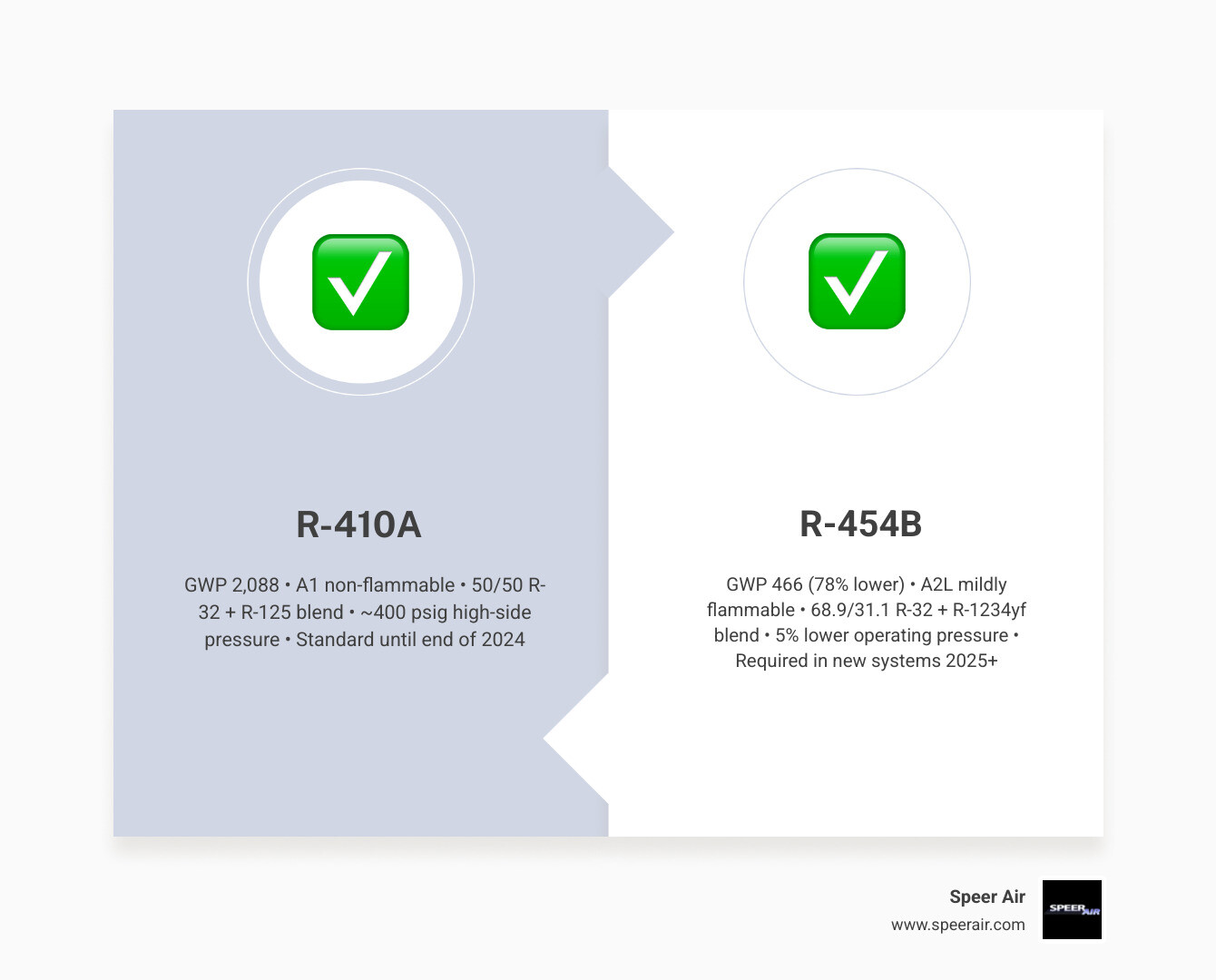
Quick Comparison: R-410A vs R-454B
| Feature | R-410A | R-454B |
|---|---|---|
| GWP | 2,088 | 466 (78% lower) |
| ASHRAE Safety Class | A1 (non-flammable) | A2L (mildly flammable) |
| Chemical Blend | R-32 + R-125 (50/50) | R-32 + R-1234yf (68.9/31.1) |
| Operating Pressure | ~400 psig high side | ~370–288 psig high side |
| Energy Efficiency (COP) | Baseline | 3–5% higher |
| Drop-in Replacement? | — | No |
| New Equipment (2025+) | No longer manufactured | Current standard |
| Ozone Depletion Potential | 0 | 0 |
The HVAC industry is going through its biggest refrigerant change since R-22 was phased out — and if you own a home or business in Northern New Jersey, this transition affects every new air conditioner or heat pump you consider buying. It also affects how much it may cost to service your existing system over the coming years.
This guide breaks down exactly what is different between the two refrigerants, what the regulations mean for you right now in 2026, and what you should factor in before your next HVAC decision.
R410A vs R454B Refrigerant: What You Need to Know About the Transition
To understand why this shift is happening, we have to look at the federal laws guiding climate action. The primary driver behind this massive industry transition is the Environmental Protection Agency (EPA) AIM (American Innovation and Manufacturing) Act. Enacted by Congress, this mandate directs the EPA to phase down the production and consumption of high-Global Warming Potential (GWP) hydrofluorocarbons (HFCs) by 85% over a 15-year timeline.
As part of this phasedown, the EPA instituted a strict manufacturing and import ban on new residential and light commercial air conditioning systems using refrigerants with a GWP of 700 or higher, which went into effect on January 1, 2025. Because R-410A has a GWP of 2,088, it was the primary target of this rule.
Now that we are in 2026, the transition is fully realized. If you walk into an appliance store or consult with us for a new heating and cooling system, the brand-new units rolling off the factory lines are engineered around low-GWP alternatives. For major manufacturers like Carrier, the clear winner and designated successor is R-454B (commercially branded as Opteon™ XL41).
Transitioning to these modern systems is a cornerstone of our commitment to delivering Green HVAC Solutions Northern NJ. While older units can still be repaired and maintained, the industry has firmly embraced R-454B as the sustainable path forward.
Key Differences: Chemical Properties and Environmental Impact
To grasp the practical differences between r410a vs r454b refrigerant what you need to know, it helps to look at their chemical DNA. Refrigerants are chemical compounds designed to shift easily from a liquid to a gas and back again, absorbing and releasing heat in the process. However, different chemical combinations yield vastly different environmental impacts.
R410A vs R454B Refrigerant: What You Need to Know About Environmental Impact
The single most important reason for this industry-wide transition is environmental preservation.
- Global Warming Potential (GWP): GWP measures how much energy the emissions of 1 ton of a gas will absorb over a given period, relative to 1 ton of carbon dioxide (CO2). R-410A has a GWP of 2,088, meaning it is more than two thousand times more potent than CO2 at trapping heat in our atmosphere. R-454B has a GWP of only 466. This represents a staggering 78% reduction in direct climate impact.
- Ozone Depletion Potential (ODP): Both R-410A and R-454B have an ODP of zero. Unlike the older R-22 (Freon) which was phased out in previous decades, neither of these modern refrigerants will damage the earth’s protective ozone layer if a leak occurs.
- Atmospheric Lifetime: R-410A persists in the atmosphere for nearly 17 years, while R-454B has an atmospheric lifetime of just 5.5 years, greatly minimizing its long-term footprint.
Even with zero ozone depletion, preventing leaks is vital for keeping your system running efficiently and protecting the environment. If you suspect your current system is low on charge, you can read more about identifying and resolving AC Refrigerant Leak Issues in Your Home.
Chemical Composition and Zeotropic Blends
The physical behavior of a refrigerant during the heat exchange process depends on whether it is an azeotrope or a zeotrope:
- R-410A is a near-azeotropic blend. It is composed of a 50/50 mixture of R-32 and R-125. Because it is near-azeotropic, the two chemicals behave almost like a single pure substance. They boil and condense at virtually the same temperature, resulting in minimal “temperature glide.”
- R-454B is a zeotropic blend. It consists of 68.9% R-32 and 31.1% R-1234yf (a hydrofluoroolefin, or HFO). Because it is a zeotropic blend, its component gases boil and condense at slightly different temperatures. This creates a temperature glide of approximately 1.5°F.
For technicians, this temperature glide means R-454B must always be charged using the liquid charging method (removing it from the cylinder as a liquid rather than a vapor). If a system is charged with vapor, the lighter gas component will escape faster, throwing off the precise 68.9/31.1 chemical ratio and degrading system performance.
Performance, Pressures, and System Design
A common concern for homeowners is whether transitioning to an eco-friendly refrigerant means sacrificing cooling power or paying higher utility bills. Fortunately, the thermodynamic properties of R-454B actually offer performance benefits.
R410A vs R454B Refrigerant: What You Need to Know About System Pressures and Performance
When comparing operating pressures, R-454B is remarkably similar to R-410A. At equivalent saturation temperatures, R-454B operates at roughly 5% higher pressure than R-410A. For example, at a 90°F saturation temperature, R-410A runs at approximately 274 psig, while R-454B runs at about 288 psig.
This is a key reason why manufacturers preferred R-454B over other alternatives like R-32. R-32 runs at roughly 13% higher pressure than R-410A (about 311 psig at 90°F saturation), which requires much heavier-duty, thicker-walled system components to handle the stress.
Additionally, R-454B has a 7% higher latent heat capacity than R-410A, which means it is highly effective at carrying heat away from your living spaces. In terms of overall efficiency, R-454B systems can achieve a 3% to 5% higher Coefficient of Performance (COP) than R-410A under comparable conditions. This means upgrading can actually help lower your monthly energy bills.
To learn more about how these thermodynamic properties translate into physical comfort, check out our guide on How Your Air Conditioner Actually Cools Your Home.
| Thermodynamic Property | R-410A | R-454B |
|---|---|---|
| Latent Heat Capacity | 256 kJ/kg | 273 kJ/kg (7% higher) |
| High Side Pressure (Typical) | ~400 psig | ~370 psig |
| Temperature Glide | Near 0°F | ~1.5°F |
| Compressor Discharge Temp | Baseline | 3–5°C lower |
Equipment Design and Heat Transfer Surface Area
Because R-454B is a zeotropic blend with a 1.5°F temperature glide, manufacturers had to redesign system coils to maintain equivalent capacity. R-454B coils typically require 10% to 20% additional heat transfer surface area compared to R-410A designs.
These larger, more advanced evaporator and condenser coils ensure that the system can handle the temperature glide without losing cooling capacity. Furthermore, R-454B operates with a 3–5°C lower compressor discharge temperature than R-410A. This is excellent news for the longevity of your equipment, as lower operating temperatures reduce thermal stress on the compressor over time.
To see how these components work together in harmony, read our breakdown of The Big Three: How the Compressor, Evaporator and Condenser Function. Keeping these components in top shape is essential for preventing issues like restricted airflow or freeze-ups. If you ever run into performance dips, consult our guide on Solutions for Frozen Evaporator Coils in AC System.
Safety Considerations and the A2L Classification

Perhaps the most talked-about change in the transition to R-454B is its safety classification. While R-410A carries an ASHRAE safety rating of A1 (non-toxic and non-flammable), R-454B is classified as A2L (non-toxic and mildly flammable).
The “L” in A2L stands for “low burning velocity.” It is incredibly important to put this mild flammability into perspective:
- High Ignition Threshold: R-454B has a very high minimum ignition energy (greater than 1,000 mJ). This means it cannot be ignited by a simple static shock or a light switch spark. It requires a highly concentrated open flame or a very high-energy heat source to catch fire.
- Slow Flame Spread: If R-454B does ignite, its burning velocity is extremely slow (about 5.2 cm/s). It behaves more like a lazy, self-extinguishing flame than the rapid, explosive combustion associated with highly flammable hydrocarbon gases like propane (A3) or natural gas.
- Lower Flammability Limit (LFL): R-454B requires a high concentration in the air (approximately 11.3% to 12.4% by volume) to even support combustion.
To ensure safety in residential homes, modern R-454B systems are built with advanced mitigation technology. New indoor units are equipped with integrated refrigerant leak detection sensors. If these sensors detect a leak exceeding a safe percentage of the LFL, they instantly shut down the compressor and activate the indoor blower fan to safely disperse and dilute the refrigerant throughout the home, preventing it from ever reaching flammable concentrations.
What Homeowners in Northern New Jersey Need to Consider in 2026
If you are a homeowner in Morris, Passaic, Essex, or Sussex County, you might be wondering how this transition impacts your home and wallet in 2026.
1. If You Have a Working R-410A System
There is absolutely no need to panic or rush out to replace a perfectly functional air conditioner. R-410A is not banned from use, and servicing existing equipment remains entirely legal. However, because the production of virgin R-410A is being phased down by the EPA, the supply of this refrigerant will gradually tighten over the next decade. Over time, the cost of R-410A refrigerant for leak repairs will rise.
2. If You Need a New HVAC System in 2026
If your old air conditioner is on its last legs, investing in a new R-454B system is the most future-proof decision you can make. These systems are highly efficient, fully compliant with modern environmental laws, and will have readily available, affordable refrigerant for their entire 15-to-20-year lifespan.
When planning an upgrade, it is helpful to calculate your potential energy savings. Use our SEER Calculator to estimate how much a high-efficiency system can save you. For a deeper dive into modern ratings, read our resource on Efficiency Ratings Explained So You Can Stop Guessing and Start Saving.
3. Retrofitting is Not an Option
It is physically and legally impossible to put R-454B into an older system designed for R-410A. Because of the A2L flammability rating, R-454B requires purpose-built compressors, electrical components rated against sparking, and safety sensors. Trying to mix these refrigerants or drop R-454B into an older unit will ruin the compressor, void your warranty, and create serious safety hazards.
If you are ready to explore your options for a modern, code-compliant cooling system, we can design a custom solution for your home. Learn more about our premier services for High Efficiency HVAC Installation Northern NJ and find the perfect Energy Efficient HVAC System Rockaway.
Frequently Asked Questions About R-410A and R-454B
Can I use R-454B in my existing R-410A air conditioner?
No. R-454B is not a drop-in replacement for R-410A. R-454B is an A2L mildly flammable refrigerant that requires systems specifically engineered with safety sensors, spark-proof electrical enclosures, and compatible expansion valves and compressors. Using R-454B in an R-410A system will damage your equipment and void all manufacturer warranties.
Is R-454B safe for residential use?
Yes, R-454B is highly safe for home use when installed in systems designed for it. While it is classified as mildly flammable, it requires a very strong heat source and a high concentration in the air to ignite. Furthermore, new R-454B systems come equipped with built-in leak detection sensors that automatically shut down the system and run the fan to safely dilute any leaking gas.
Will R-410A still be available for AC repairs in 2026?
Yes. While manufacturers can no longer build new R-410A systems, the refrigerant itself remains available for servicing and repairing existing systems. Over the coming years, the supply of virgin R-410A will decrease as the EPA phasedown continues, but reclaimed and recycled R-410A will help fill the gap for the foreseeable future.
Conclusion
The transition from R-410A to R-454B represents a major step forward for environmental sustainability and home energy efficiency. While navigating these regulatory shifts can feel overwhelming, we are here to make the process simple, transparent, and stress-free.
As a family-owned business serving Northern New Jersey since 1900, Speer Air has guided local families through every major technological milestone in the heating and cooling industry. Our NATE-certified technicians are fully trained in handling the latest A2L refrigerants, and as a proud Carrier Factory Authorized Dealer, we install cutting-edge systems engineered for maximum comfort, safety, and energy savings.
Whether you need to keep your existing R-410A system running smoothly or are ready to upgrade to a future-proof R-454B air conditioner, you can count on us for honest advice and expert service. Explore our helpful online HVAC Resources Rockaway NJ or schedule an appointment with our team for professional Speer Air AC Repair today!