

Why Most AC Problems Start With a Skipped Checklist
Following a solid AC maintenance checklist for homeowners is one of the simplest ways to avoid a sweltering summer breakdown — and the expensive repair bill that comes with it.
Here is a quick overview of the essential tasks every homeowner should know:
Monthly Tasks:
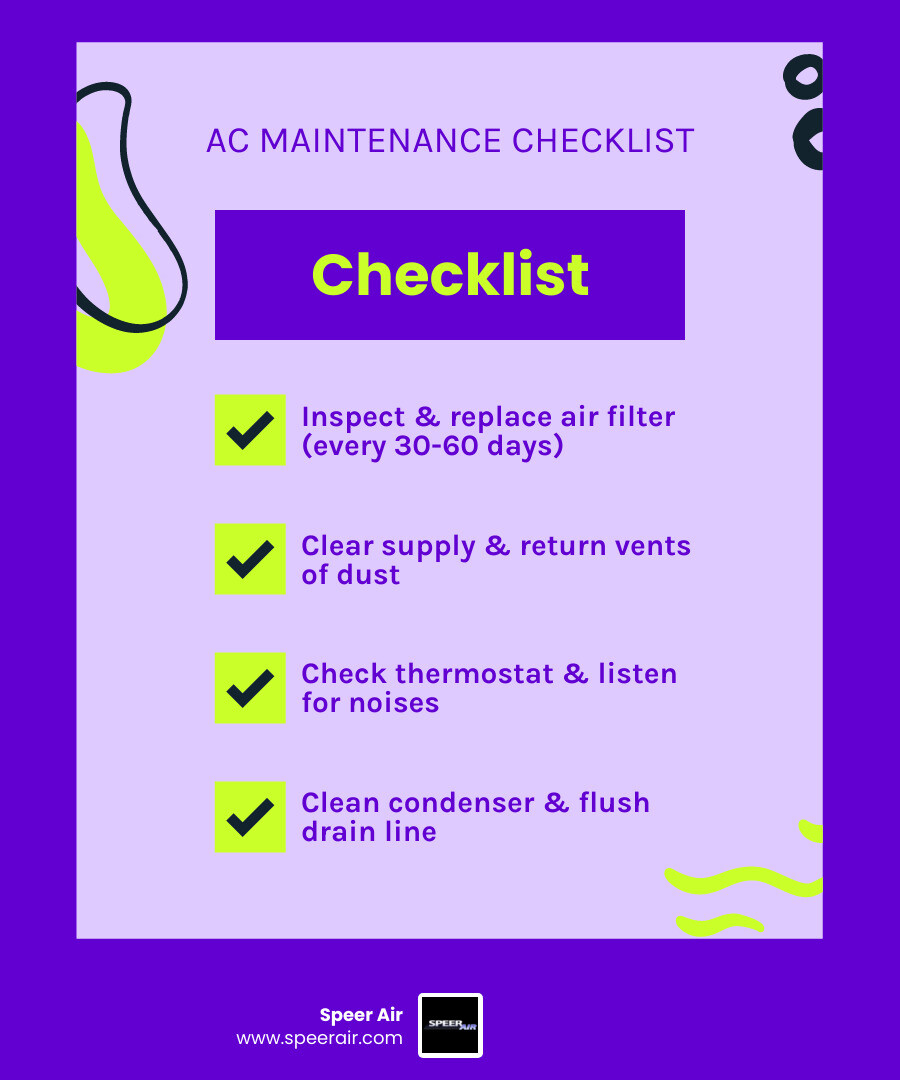
- Inspect and replace the air filter (every 30-60 days)
- Clear supply and return vents of dust and obstructions
- Check thermostat settings and listen for unusual noises
Seasonal Tasks (Spring/Fall):
- Clean the outdoor condenser unit and clear a 2-foot perimeter
- Flush the condensate drain line with diluted vinegar
- Visually inspect refrigerant line insulation
- Test the system before the first heat wave
Annual Professional Tasks:
- Check refrigerant levels and inspect for leaks
- Test electrical connections and measure voltage
- Clean blower components and lubricate moving parts
- Full system controls and safety test
The pattern is frustratingly common: a homeowner skips the spring walkthrough, forgets a filter change from last fall, and then wonders why the AC quits during the hottest week of August. According to industry data, 42% of homeowners have experienced HVAC failures during heat waves — and only 47% had their system serviced in the past year. That gap is not a coincidence.
The good news is that most AC failures are not equipment failures at all. They are maintenance failures. A little consistent attention — changing filters, clearing debris, flushing a drain line — can reduce summer breakdowns by as much as 95% and extend your system’s life by three to five years.
Whether you are a longtime homeowner in Morris County or new to Northern New Jersey, this guide walks you through every task on the list: what you can do yourself, what needs a licensed technician, and how to build a schedule that keeps your system running reliably all year long.
Why an AC Maintenance Checklist for Homeowners Matters
An AC system does not usually fail all at once. More often, it declines slowly: reduced airflow, longer run times, rising humidity, and a utility bill that suddenly feels rude.
Regular maintenance matters because it helps us catch small problems before they become major ones. Dirty filters can reduce efficiency by up to 15%. Dirty coils can cut cooling efficiency by as much as 30%. Damaged refrigerant line insulation can hurt performance by up to 10%. Add that up, and a neglected system has to work much harder to cool the same home.
How regular maintenance protects comfort and equipment
Routine care reduces wear on major parts like the blower motor, compressor, and fan components. Industry data shows regular maintenance can extend equipment lifespan by 3 to 5 years and reduce summer breakdowns by up to 95%.
That is especially important during hot, humid stretches in Northern New Jersey and nearby Pennsylvania service areas, where AC systems may run for long cycles. When airflow is restricted or coils are dirty, the system strains longer than it should. More strain means more wear, and more wear means a higher chance of losing cooling when you need it most.
How maintenance improves efficiency and lowers utility bills
Air conditioning accounts for about 12% of U.S. home electricity use, totaling roughly $29 billion annually. A clean, properly tuned system uses less energy to do the same job.
A few examples:
- Replacing air filters can lower AC energy consumption by 5% to 15%
- Regular maintenance can lower overall HVAC-related costs by 23%
- Airflow problems can reduce efficiency by up to 15%
- Leaky ducts can waste up to 30% of conditioned air, while sealing and insulating ducts can improve efficiency by up to 20%
In plain English: cleaner airflow and better system performance usually mean lower bills.
How maintenance supports healthier indoor air
We spend about 90% of our time indoors, and indoor pollutants are often 2 to 5 times more concentrated than outdoor levels. Your AC plays a big role in managing dust, allergens, humidity, and airflow.
A clogged filter lets performance drop. A dirty coil can trap grime. A blocked condensate drain can lead to excess moisture, water leaks, and even mold concerns. A good maintenance routine supports cleaner air, steadier humidity, and a more comfortable home overall.
Your Complete AC Maintenance Checklist for Homeowners

Below is a practical checklist homeowners can follow throughout the year.
Monthly AC maintenance checklist for homeowners
Use this monthly ac maintenance checklist for homeowners during cooling season:
- Check the air filter and replace it if dirty
- Inspect supply and return vents for dust, furniture blockage, or closed dampers
- Confirm the thermostat is in cooling mode and set properly
- Listen for unusual noises like buzzing, rattling, grinding, or hissing
- Notice any musty, burning, or chemical-like odors
- Watch for short cycling, weak airflow, or uneven cooling
- Glance at the indoor unit area for signs of water around the condensate line or drain pan
Monthly checks take only a few minutes, but they catch many of the most common problems early.
Seasonal AC maintenance checklist for homeowners
At the start of spring, and again before heavy seasonal use, add these tasks:
- Remove leaves, pollen, grass clippings, and debris from around the outdoor condenser
- Maintain at least a 2-foot clearance around the unit and open space above it
- Gently rinse condenser coils with a garden hose
- Flush the condensate drain line with diluted vinegar if accessible
- Inspect refrigerant line insulation for cracking, missing sections, or sun damage
- Test the thermostat and run the system before the first major heat wave
- Check visible duct sections for gaps, damage, or disconnected insulation
- Make sure any winter cover has been completely removed before operation
For a deeper look at preventive care, see regular AC maintenance for your home comfort.
Annual tasks that belong to a professional tune-up
Some work should always be done by a trained technician. An annual AC tune-up should include:
- Testing electrical connections
- Measuring voltage and current draw
- Checking refrigerant charge and inspecting for leaks
- Cleaning blower components
- Inspecting evaporator and condenser coils
- Testing system controls and startup sequence
- Verifying thermostat operation and calibration
- Evaluating condensate drainage
- Inspecting motors and lubricating moving parts where applicable
This is the part of maintenance that homeowners cannot safely or fully replace with DIY steps.
DIY AC Maintenance Tasks You Can Do Safely
A few simple tools make basic AC upkeep easier:
- Replacement filters
- Screwdriver
- Garden hose
- Soft brush
- Shop vacuum or wet/dry vacuum
- Gloves
- Diluted vinegar
- Fin comb for lightly bent condenser fins
Before doing any work, shut off power to the system when needed and follow manufacturer instructions.
How to check and replace an AC air filter
This is the most important homeowner task.
Steps:
- Turn the system off.
- Locate the filter slot, usually at the return grille, air handler, or furnace cabinet.
- Slide the filter out and check the size printed on the frame.
- If the filter looks gray, packed with dust, or fails the simple “hold it up to the light” test, replace it.
- Install the new filter with the airflow arrow pointing toward the blower or air handler.
- Turn the system back on.
For most homes, a MERV 8 to 11 filter offers a good balance of filtration and airflow. Higher-rated filters are not always better. If the system is not designed for a very restrictive filter, airflow can suffer and coils may freeze.
General timing:
- Every 30 to 60 days during heavy use
- More often with pets, allergies, smokers, or renovation dust
- Up to 90 days in lighter-use situations, if the filter still looks clean
How to clean the outdoor condenser unit safely
A clogged outdoor unit cannot release heat efficiently, so the AC runs longer and harder.
Safe cleaning steps:
- Shut off power at the disconnect box and thermostat.
- Remove leaves, twigs, and loose debris from the base and surrounding area.
- Trim plants to maintain at least 2 feet of side clearance.
- Remove the top grille only if the design allows simple access and you are comfortable doing so.
- Use a soft brush or vacuum to remove surface debris.
- Rinse the coil gently with a garden hose from the inside out if accessible, or from the outside with light pressure.
- Never use a pressure washer. It can flatten fins and damage the coil.
- Check that the unit sits level on its pad.
- Straighten lightly bent fins with a fin comb if needed.
Keep at least several feet of open space above the condenser too. It needs room to move heat, not a shrub hug.
For seasonal guidance, visit AC maintenance tips for Maplewood residents.
How to clean the condensate drain line and check for clogs
Your AC removes moisture from indoor air, and that water has to drain somewhere. If the line clogs with algae or sludge, it can overflow and cause water damage or humidity issues.
Basic steps:
- Turn off the system.
- Locate the condensate drain access tee near the indoor unit if one is present.
- Pour a small amount of diluted vinegar into the opening.
- Let it sit briefly to help break down buildup.
- If the outdoor drain termination is accessible, a wet/dry vacuum can sometimes help pull out the clog.
- Restart the system and monitor for proper drainage.
If the line remains blocked or you notice recurring overflow, call for service. Repeated clogs may point to a larger issue.
How to inspect thermostat settings, vents, and basic airflow
Sometimes the “problem” is a setting, not a breakdown.
Check these basics:
- Set the thermostat to cool mode
- Set fan to auto, not on, unless continuous circulation is intentional
- Replace thermostat batteries if applicable
- Verify the programmed schedule matches your household routine
- Make sure supply and return vents are open and not blocked by rugs, curtains, or furniture
- Notice if some rooms are much warmer than others
- Pay attention to weak airflow at multiple vents
These checks can help identify airflow issues, thermostat problems, or early system trouble.
What Homeowners Should Never DIY
Some AC tasks are not just difficult. They are unsafe, equipment-sensitive, or legally restricted.
Do not DIY:
- Refrigerant charging or leak repair
- Electrical testing involving capacitors, contactors, or live voltage
- Deep evaporator coil access inside sealed compartments
- Chemical coil cleaning without proper products and handling
- Compressor or motor replacement
- Opening sealed refrigeration components
Federal rules require proper certification for refrigerant handling. More importantly, low refrigerant is usually a symptom of a leak, not something that should simply be topped off and ignored.
Signs of low refrigerant and why it needs a professional
Common warning signs include:
- Warm air from vents
- Ice on refrigerant lines or evaporator coil
- Hissing or bubbling sounds
- Long run times with poor cooling
- Frozen coil
- Sudden performance drop in hot weather
If you notice these signs, turn the system off and schedule service. Running an AC with low refrigerant can damage the compressor, and that is one problem no homeowner wants to “wait and see” about.
AC warning signs that mean it is time to call for service
Call a professional if you notice:
- High indoor humidity
- Water leaks near the indoor unit
- Burning smells
- Loud banging, screeching, or grinding
- Weak airflow
- Frequent on-and-off cycling
- Rising utility bills without a clear reason
- Thermostat setting that does not match room comfort
- Repeated drain backups
- Uneven cooling that does not improve after filter replacement
If your system is showing any of these signs, learn more about AC service in Rockaway, NJ or AC service in Rockaway.
Seasonal Tips, Common Mistakes, and When Maintenance Is Not Enough
Common AC maintenance mistakes homeowners make
Even well-intentioned DIY maintenance can go sideways. Common mistakes include:
- Using a pressure washer on condenser coils
- Installing a filter with too high a MERV rating for the system
- Closing too many vents to force air into certain rooms
- Skipping spring service and waiting until the first heat wave
- Ignoring the condensate drain until it leaks
- Forgetting to remove a winter cover before startup
- Running a humidifier while the AC is trying to dehumidify
- Letting shrubs and weeds crowd the outdoor unit
- Assuming refrigerant just “runs low” naturally
A lot of these are preventable with a simple schedule and a quick monthly look-over.
How to prepare your AC for extreme weather or storms
Storm prep matters in our region, especially when summer brings heavy rain, wind, and debris.
Before a storm:
- Trim branches near the outdoor unit
- Secure loose yard items that could strike equipment
- Clear gutters and drainage paths to reduce overflow near the foundation
- Check the area around the condenser for flooding risk
- Make sure the disconnect and service area are accessible
After a storm:
- Inspect the outdoor unit for debris, bent fins, or impact damage
- Do not run the system if the unit was submerged or electrical components got wet
- Check the refrigerant line insulation and visible wiring for damage
- Listen for unusual sounds when restarting
- Call for inspection if cooling seems weak or the unit looks compromised
Best schedule for tune-ups and maintenance plans
For most homeowners, the best routine is simple:
- Monthly filter and airflow checks during cooling season
- Spring startup and cleaning before heavy summer use
- Annual professional AC tune-up in early spring
- Fall HVAC check if your system also handles heating
A good rule of thumb is to tie maintenance to daylight saving time changes so it is easier to remember.
Maintenance plans can also be helpful. They often make upkeep more consistent, create a documented service history, and help homeowners stay ahead of failures instead of reacting to them.
Learn more here:
When to keep maintaining vs when to consider replacement
Maintenance is usually the right move when the system is basically sound and problems are minor. But there comes a point when repeated service is not the best long-term answer.
| Keep Maintaining | Consider Replacement |
|---|---|
| System cools well after normal service | Frequent breakdowns or recurring major issues |
| Airflow improves with filter, coil, or duct corrections | Comfort remains poor despite repairs |
| Minor drain, thermostat, or maintenance-related issues | Refrigerant leaks keep returning |
| Equipment is operating safely and efficiently | Major component failure or severe efficiency decline |
| Problems are isolated and not constant | System age and repair history point to declining reliability |
If you are seeing repeated refrigerant issues, major component failures, or ongoing comfort problems, it may be time for a professional evaluation rather than another short-term fix.
Frequently Asked Questions about AC Maintenance Checklist for Homeowners
How often should homeowners do AC maintenance tasks?
Monthly checks are ideal during the cooling season. Inspect filters every 30 to 60 days, or more often if your home has pets, allergies, or heavy AC use. Seasonal prep should happen in spring before the first heat wave, and every system should have a professional tune-up once a year.
What tools or supplies are needed for basic AC maintenance?
Most homeowners only need a few basics:
- Replacement air filters
- Garden hose
- Soft brush
- Shop vacuum or wet/dry vacuum
- Screwdriver
- Gloves
- Diluted vinegar
If you are doing light outdoor coil care, a fin comb can also be useful.
Does AC maintenance really improve efficiency and indoor air quality?
Yes. Clean filters improve airflow, clean coils help heat transfer, and a clear condensate drain supports humidity control. Since indoor air can contain far more pollutants than outdoor air, maintenance helps your system do a better job filtering dust and circulating cleaner air. It also reduces wasted energy caused by dirt, restriction, and strain.
Conclusion
A smart AC maintenance checklist for homeowners is not complicated, but it does need consistency. Monthly filter checks, seasonal cleaning, and annual professional service can help prevent breakdowns, improve indoor air quality, reduce energy waste, and extend the life of your system.
At Speer Air, we have been serving homeowners in Northern New Jersey with trusted HVAC expertise since 1900. As a family business with a NATE-certified team, we believe preventive care is one of the best ways to protect home comfort before problems turn into emergencies.
If your system is due for service or showing signs of trouble, explore our air conditioning service in Rockaway to take the next step toward reliable cooling.