

Why How Ductwork Mistakes During Installation Hurt Your Comfort Is Something Every Northern New Jersey Homeowner Should Know
How ductwork mistakes during installation hurt your comfort is one of the most important — and most overlooked — questions a homeowner can ask before any HVAC work begins. Most people focus on the furnace or air conditioner itself, but the duct system is what actually delivers conditioned air to every room in your home. Get the ducts wrong, and even a brand-new, high-end HVAC unit cannot save you from hot spots in summer, cold bedrooms in winter, and energy bills that keep climbing.
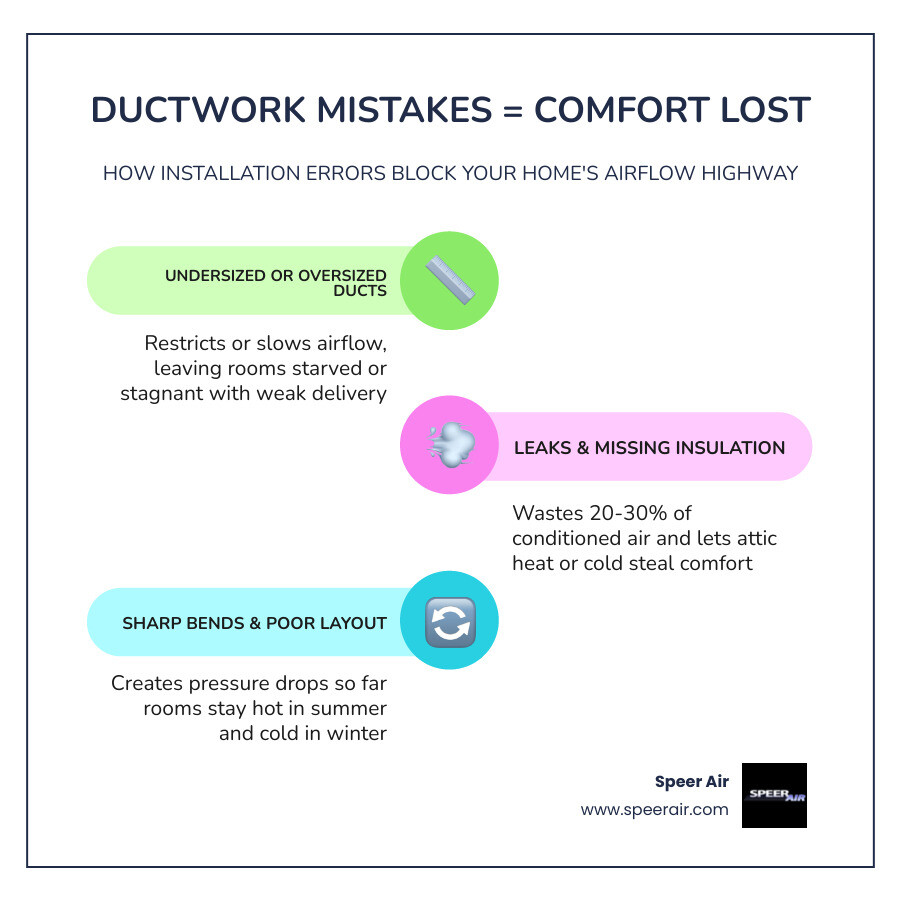
Here is a quick summary of how common ductwork installation mistakes directly reduce your comfort:
- Undersized ducts restrict airflow, strain the blower motor, and leave rooms starved for conditioned air
- Oversized ducts drop air velocity so low that air falls out of vents instead of mixing properly into the room
- Air leaks at joints and seams waste 20–30% of conditioned air before it ever reaches your living spaces
- Sharp bends and long duct runs create pressure drops that leave far-off rooms barely heated or cooled
- Missing or inadequate insulation allows attic heat or cold to rob ducts of their thermal energy before delivery
- Insufficient return vents pressurize rooms, making it physically harder for conditioned air to enter
- Poor system sizing combined with bad duct design causes short cycling, humidity problems, and uneven temperatures throughout the home
The average duct system operates at only about 60% efficiency — meaning nearly half of what your HVAC system produces never reaches you. More than half of new ductwork systems never hit their rated efficiency because of avoidable installation errors. Understanding where things go wrong is the first step toward a home that actually feels comfortable year-round.
How Ductwork Mistakes During Installation Hurt Your Comfort
To understand why poorly installed ductwork ruins your indoor climate, think of your air distribution system as a highway network. When designed correctly, traffic flows smoothly at the correct speed, and everyone reaches their destination on time. When a contractor makes installation mistakes, they essentially build narrow lanes, dead ends, sharp hairpins, and open potholes. The air cannot travel where it needs to go.

At the heart of this issue is a concept called static pressure. Static pressure is the resistance to airflow within your HVAC system. When ducts are designed or hung poorly, static pressure spikes. Your blower motor has to fight incredibly hard to push air through the system. This restriction leads to a host of problems, including noisy operation, weak airflow, and accelerated wear and tear on your expensive heating and cooling equipment.
If you are currently experiencing weak airflow from your registers, it is often a direct result of these physical restrictions. You can learn more about identifying these symptoms in our guide on Troubleshooting Poor Airflow from HVAC Vents.
How undersized ductwork mistakes during installation hurt your comfort
Undersized ductwork is perhaps the most common blunder in residential HVAC installations. Many contractors rely on outdated “rules of thumb” rather than performing precise calculations, leading them to install ducts that are far too small for the volume of air your system needs to move.
Imagine trying to breathe through a tiny cocktail straw while running a marathon. That is exactly what your HVAC system goes through when forced to operate with undersized ducts. The physical consequences of this mistake are immediate and severe:
- Severe Airflow Restriction: The volume of air reaching your living spaces is drastically reduced. You might feel a faint, pathetic whisper of air coming out of your registers instead of a strong, conditioning breeze.
- Blower Motor Strain: To overcome the high static pressure caused by tight ducts, your system’s blower motor must run at maximum capacity. This constant overexertion leads to overheating, premature motor failure, and noisy vibrations that echo through your walls.
- Skyrocketing Energy Bills: Because the system cannot distribute air efficiently, it has to run much longer cycles to satisfy the thermostat setting, consuming far more electricity and gas.
- Unbearable Noise: When too much air is forced through a space that is too small, it creates a loud, rushing, or whistling sound. Your home should be a quiet sanctuary, not sound like a wind tunnel every time the climate control kicks on.
How poor layout ductwork mistakes during installation hurt your comfort
Even if the ducts are technically the correct diameter, a chaotic, poorly planned layout will completely destroy your home’s comfort. Air has mass and momentum; it does not like to make sudden movements or travel unnecessary distances.
When installers take the “path of least resistance” to finish a job quickly, they often create sharp 90-degree bends, kinked flexible ducts, and excessively long duct runs. Every sharp bend acts like a brick wall to moving air, creating immense turbulence and pressure drops. By the time the conditioned air travels through multiple sharp turns and long runs to reach a bedroom at the far end of the house, it has lost all its velocity and thermal energy.
The result? You end up with a home divided into extreme climate zones. One room feels like the Sahara Desert while another feels like the North Pole. If you are struggling with this exact issue, discover how to balance your home’s climate by reading our article on How to Address Uneven Cooling at Home.
The Impact of Leaky Seals and Inadequate Insulation
Ductwork is meant to be a completely closed, sealed loop. Unfortunately, industry studies show that the average home loses 20% to 30% of its conditioned air through gaps, holes, and unsealed connections. In poorly executed installations, that number can climb to a staggering 40%.
When air leaks out of your supply ducts, you are paying to heat or cool spaces that nobody lives in, such as your attic, crawlspace, or the wall cavities. Worse yet, when the system turns off, leaky return ducts can pull dusty, dirty, and humid air from those unconditioned spaces directly into your breathing air. This introduces dust, allergens, and even pest contaminants into your home.
Furthermore, if your ducts run through unconditioned zones like a hot attic (which can easily climb past 130 degrees Fahrenheit during a humid New Jersey summer), missing or low-quality insulation will ruin your comfort. Without proper thermal resistance (R-value), the hot attic air quickly heats up the cold air inside your ducts before it ever reaches your vents. This thermal loss forces your air conditioner to run constantly, leaving your home feeling warm and clammy. In winter, uninsulated ducts running through a freezing crawlspace suffer the exact opposite problem, robbing your furnace of its warmth.
To illustrate the massive difference professional sealing and insulation make, consider the following performance comparison:
| Performance Metric | Unsealed & Uninsulated Ducts (Poor Installation) | Sealed & Insulated Ducts (Professional Installation) |
|---|---|---|
| Air Loss Percentage | 20% to 40% loss of conditioned air | Less than 5% air loss |
| System Efficiency | Operates at roughly 60% of rated capacity | Operates at 95% to 100% of rated capacity |
| Indoor Air Quality | High risk of pulling in attic dust, mold, and insulation fibers | Clean, fully filtered air distribution |
| Monthly Utility Impact | 20% to 30% increase in energy consumption | Minimal waste, lower monthly bills |
| Temperature Consistency | Severe hot and cold spots across different rooms | Even, balanced temperatures throughout |
System Sizing Imbalances and Pressure Issues
A common misconception is that “bigger is always better” when it comes to HVAC design. In reality, oversized ducts are just as detrimental to your comfort as undersized ones.
When ductwork is oversized, the air pressure inside the system drops dramatically. Instead of being projected forcefully into your rooms to promote healthy air mixing, the conditioned air simply “falls” out of the registers and pools on the floor. This low velocity leaves the air stagnant, making the room feel stuffy and unevenly conditioned.
Furthermore, when improper ductwork is paired with an incorrectly sized HVAC unit, the entire system falls out of balance. If your air conditioner is oversized and your ducts cannot handle the airflow, or if the system short cycles (turns on and off rapidly in 5-to-7-minute bursts), it will fail to run long enough to remove moisture from the air. This leaves your home feeling incredibly clammy and humid, which can eventually lead to mold growth.
Another hidden comfort killer is the lack of proper return vents. Your HVAC system is a circulation loop: for every cubic foot of air pushed into a room, a cubic foot of air must be pulled back out. If installers fail to put return vents in bedrooms, closing the bedroom doors completely blocks the airflow loop. This pressurizes the bedroom, physically preventing new, conditioned air from entering while forcing the existing air out through tiny gaps in your windows and exterior walls. You can read more about how these crucial airflow dynamics impact your home’s air conditioner by exploring our guide on How Airflow Affects Your Air Conditioners Performance.
How to Prevent Installation Blunders with Proper Design
Preventing these costly and frustrating comfort issues requires treating duct installation as a precise science rather than a guessing game. It all starts with choosing a qualified, experienced contractor who refuses to cut corners.
When we design a duct system, we follow a strict, multi-step engineering process to ensure perfect airflow:
- Manual J Load Calculation: We calculate the exact heating and cooling needs of each individual room based on square footage, insulation levels, window sizes, and local Northern New Jersey climate patterns.
- Manual D Duct Design: Using the room-by-room load data, we calculate the exact duct sizes, layout, and register placements required to deliver the perfect volume of air (measured in Cubic Feet per Minute, or CFM) to every corner of your home.
- Smooth Transitions: We use plenum boxes, gradual Y-fittings, and sweeping curves instead of sharp, restrictive 90-degree metal elbows to keep static pressure low.
- Mastic Sealing: We seal every single joint and seam with high-quality, professional-grade mastic sealant or UL 181 rated foil tape, completely avoiding standard cloth duct tape which quickly dries out and fails.
- Airflow Balancing: After installation, we perform professional commissioning, using specialized tools to measure the actual airflow coming out of each vent to ensure it perfectly matches the original design specifications.
If you are planning to upgrade your heating and cooling equipment soon, taking the time to prepare your home and evaluate your existing ductwork is essential. Learn how to get ready by reading our checklist on how to Prepare Home for New HVAC System Setup.
Frequently Asked Questions About Ductwork Performance
What are the warning signs that my ductwork was installed incorrectly?
The most common warning signs of poorly installed ductwork include:
- Hot and Cold Spots: Rooms that never seem to reach the temperature set on your thermostat.
- Weak Airflow: Barely feeling any air coming out of your registers when the system is running.
- Noisy Vents: Loud whistling, rattling, popping, or rushing wind sounds coming from your walls or ceilings.
- Excessive Dust: Finding a thick layer of dust on your furniture shortly after cleaning, which often indicates leaky return ducts pulling in debris from your attic or crawlspace.
- High Utility Bills: Energy costs that are significantly higher than your neighbors’ bills, despite having similar heating and cooling habits.
Why is ductwork insulation so important in June 2026?
As we head into the heat of June 2026, attic temperatures in Northern New Jersey can easily soar past 130 degrees Fahrenheit. If your ductwork runs through these unconditioned spaces without adequate insulation, the extreme heat will transfer directly through the duct walls, warming up the cold air your air conditioner worked so hard to produce. Proper insulation prevents this thermal loss, stops condensation from forming on the outside of your cold metal ducts (which can cause water damage and mold), and keeps your energy bills manageable during the peak summer months.
Can I use standard duct tape to seal my air vents?
No! Despite its misleading name, standard cloth duct tape is actually one of the worst materials you can use to seal HVAC ducts. The adhesive on traditional duct tape quickly dries out, cracks, and loses its grip when exposed to the extreme temperature swings found in attics and crawlspaces. Within a few seasons, the tape will simply flake off, leaving your ducts leaking air once again. Professional HVAC technicians use specialized UL 181 rated foil-backed tape or liquid mastic sealant, which cures into a flexible, permanent, and airtight bond that lasts for decades.
Conclusion
Your home’s ductwork is the vital highway system that delivers comfort to your family. No matter how advanced or expensive your new air conditioner or furnace is, it can only perform as well as the ductwork allows. Avoiding common installation mistakes — like undersized runs, sharp bends, leaky seams, and missing insulation — is the only way to guarantee a quiet, energy-efficient, and perfectly balanced indoor environment.
If you are dealing with uneven temperatures, weak airflow, or high energy bills in Rockaway, Denville, or anywhere else in Morris County and Northern New Jersey, let our family-owned team help. Since 1900, we have provided trustworthy, professional HVAC services built on deep industry roots and technical expertise. As a Carrier Factory Authorized Dealer with NATE-certified technicians, we have the specialized training required to evaluate, design, seal, and balance your duct system for maximum comfort.
Find out how we can improve your home’s air quality and system performance by visiting our guide to Enhance Your Homes IAQ with Duct Installation or learn more about our local services on our Duct Installation Replacement Rockaway NJ page.
Ready to experience true, balanced comfort in your home? Contact us today to Schedule My Service and have our experts perform a comprehensive ductwork evaluation.