

Why Tankless Water Heater Benefits Explained Simply Can Change How You Think About Hot Water
If you’ve been researching tankless water heater benefits explained, here’s the short answer: tankless water heaters heat water only when you need it, eliminating the energy waste of keeping a large tank hot 24/7. The result is lower energy bills, endless hot water on demand, a longer-lasting system, and less risk of water damage in your home.
Key tankless water heater benefits at a glance:
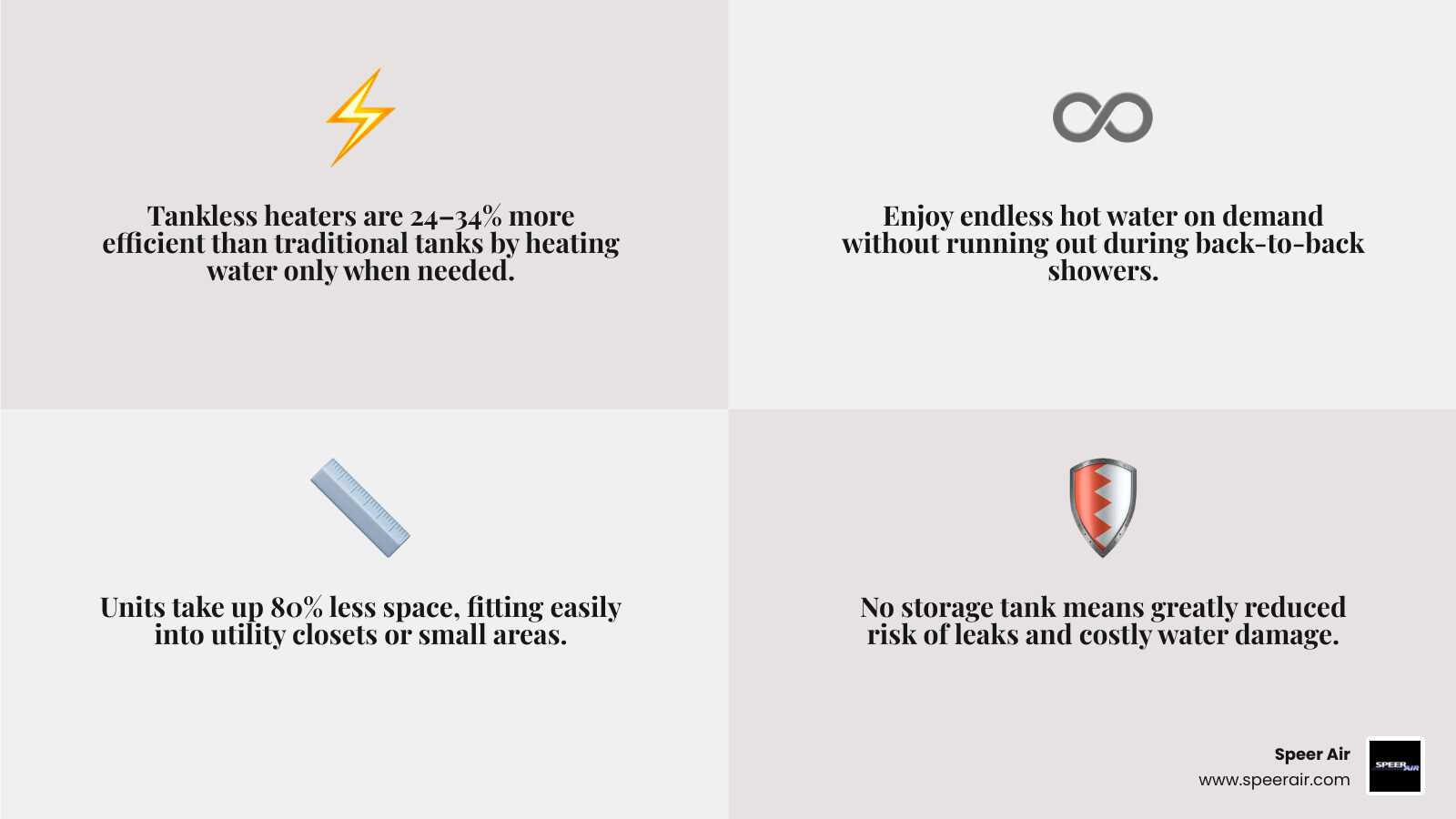
- Energy efficiency – Up to 24%–34% more efficient than traditional tank heaters for average households
- Endless hot water – No storage tank means no running out mid-shower
- Longer lifespan – Most tankless units last 20+ years vs. 10–15 years for tank models
- Space savings – Tankless units take up roughly 80% less space than a traditional tank
- Reduced flood risk – No stored water means far less chance of a costly leak or tank failure
- Lower energy bills – ENERGY STAR certified models can save a four-person household significantly on annual gas costs
For Northern New Jersey homeowners weighing whether to make the switch, the case is compelling — but there are also real-world considerations around installation, sizing, and maintenance worth understanding before you decide.
Every year, more homeowners ditch their aging storage tanks — not just because they’re tired of cold showers, but because a quality tankless system is simply a smarter long-term investment. Think about it: the average water heater flood causes thousands of dollars in damage, and a tank that runs out of hot water during back-to-back showers is a daily frustration that doesn’t have to be your reality.
This guide walks you through everything you need to know — how the technology works, what the real savings look like, how tankless stacks up against traditional storage tanks, and what installation actually involves here in Northern NJ.
Understanding On-Demand Technology: How It Works
A tankless water heater, also called an on-demand or demand-type water heater, heats water as it flows through the unit instead of storing hot water in a large tank.
Here is the simple version of what happens:
- You turn on a hot water tap.
- A flow sensor inside the unit detects water movement.
- The system fires a gas burner or activates electric heating elements.
- Cold water passes through a heat exchanger.
- Water is heated almost instantly and sent to the fixture.
That is the biggest difference from a traditional tank heater. A tank model keeps dozens of gallons hot all day and all night, whether anyone is showering or not. A tankless model only works when there is actual demand.
This matters because standby heat loss is real. With a storage tank, energy is constantly used to maintain temperature. With tankless, that waste is dramatically reduced.
Gas tankless units usually deliver higher flow rates than electric models, which is why they are often a better fit for whole-house use. Electric units can still work well in smaller homes, additions, or point-of-use applications, but sizing is critical either way. If the unit is too small, the result is not “endless hot water.” It is more like “endless disappointment with occasional lukewarm showers.”
If you want help understanding the right setup for your home, our tankless water heater services in Rockaway NJ page is a helpful next step.
Tankless water heater benefits explained for energy efficiency
When homeowners ask us for tankless water heater benefits explained in plain English, energy savings is usually the first thing they want to understand.
According to the research, tankless water heaters can be:
- 24% to 34% more energy efficient than conventional storage water heaters in homes using 41 gallons or less of hot water per day
- 8% to 14% more energy efficient in homes using around 86 gallons per day
In other words, they are usually most efficient in homes with moderate daily hot water use, but even higher-usage homes can still see efficiency gains.
Other important efficiency points include:
- No standby losses from storing heated water
- Better performance from ENERGY STAR certified models
- Higher efficiency condensing gas models available for qualifying homes
- Potential annual utility savings, often $100 or more depending on household use and equipment type
Research also shows that ENERGY STAR certified tankless systems can save a four-person household an average of $1800 on gas bills over time compared to a storage model. Exact savings vary by usage habits, fuel source, water temperature settings, and the home itself, but the long-term direction is clear: using less wasted energy generally means paying for less wasted energy.
Tankless Water Heater Benefits Explained: Why Homeowners are Switching
The popularity of tankless systems is not just hype. Homeowners switch because the day-to-day benefits are easy to notice.
The biggest advantages include:
- Continuous hot water
- Improved energy efficiency
- Longer equipment life
- Smaller footprint
- Reduced leak and flood risk
- Better temperature control
Let’s break those down.
Endless hot water is the headline feature for a reason. Traditional tanks have a recovery period. Once the stored hot water is used up, you wait. Tankless units do not run out in the same way because they keep heating water as long as demand stays within the unit’s capacity. For families who stagger showers, run laundry, or use hot water throughout the day, that can feel like a major upgrade.
Space savings are another big plus. Tankless units are wall mounted and can take up about 80% less space than bulky storage tanks. In many homes across Northern New Jersey, that matters. Utility closets, basements, laundry areas, and mechanical rooms are often tight already. Reclaiming floor space is a practical benefit, not just a brochure benefit.
Longer lifespan is also a major reason homeowners choose tankless. Most tankless water heaters last more than 20 years with proper care, compared with roughly 10 to 15 years for many storage tank units. That does not mean maintenance can be ignored forever, but it does mean the equipment is often built for a longer service life.
If you are planning a replacement or upgrade, our tankless water heater installation in Bergen County NJ resource can help you understand what professional installation involves.
Tankless water heater benefits explained for home safety
Safety and risk reduction do not get as much attention as endless hot water, but they should.
A tankless unit does not store a large volume of hot water under constant pressure. That means there is no big tank sitting in your home waiting to corrode, leak, or fail. While any plumbing appliance can develop issues, removing the storage tank reduces one of the biggest sources of water-heater-related property damage.
Key safety and protection benefits include:
- Lower risk of catastrophic tank leaks
- Less chance of large-scale water damage
- More precise temperature control
- Modern safety sensors and shutdown features on many units
Precise temperature control is especially helpful for families with children, older adults, or anyone sensitive to temperature swings. Many tankless systems allow tighter control over output temperature than older tank systems.
Of course, “safer” does not mean “install it however you want and hope for the best.” Gas models need proper venting, combustion air, and fuel supply. Electric models need the right electrical capacity. Professional installation matters.
If your old water heater fails unexpectedly, our emergency tankless water heater installation in Rockaway NJ page explains what to expect when fast replacement is needed.
Comparing Tankless vs. Traditional Storage Tank Systems
Choosing between tankless and tank style comes down to more than one feature. The better question is: which system fits how your household actually uses hot water?
Here is a simple comparison:
| Feature | Tankless Water Heater | Traditional Tank Water Heater |
|---|---|---|
| How it heats water | On demand | Stores and reheats water |
| Energy use | Lower due to reduced standby loss | Higher due to constant tank heating |
| Typical lifespan | 20+ years | 10-15 years |
| Space needs | Compact, wall-mounted | Larger floor footprint |
| Hot water supply | Continuous within flow limits | Limited by tank size |
| Leak risk | Lower without storage tank | Higher due to tank corrosion/failure |
| Maintenance | Regular descaling and service needed | Sediment flushing and standard maintenance |
For many homes, the biggest practical differences are efficiency, lifespan, and available hot water.
Traditional tanks are simpler and often more forgiving if maintenance has been skipped. But they also waste energy by reheating stored water and eventually wear out from the inside. Tankless systems avoid standby losses and usually last longer, but they demand proper sizing and regular maintenance to perform well.
If you are weighing replacement options, our tankless water heater replacement in Rockaway NJ guide goes deeper into deciding when it makes sense to upgrade.
Simultaneous usage and flow rates
This is the most important reality check in the whole tankless conversation: tankless does not mean unlimited flow.
It means continuous hot water up to the unit’s rated capacity.
Most tankless water heaters produce hot water at a certain gallons-per-minute, or GPM, rate. Research commonly places typical tankless flow around 2 to 5 GPM for many units, with higher-output gas models capable of more. Gas systems generally outperform electric ones on whole-home flow rate.
Why does this matter? Because your household may use several fixtures at once:
- Shower in the main bath
- Second shower upstairs
- Dishwasher running
- Washing machine filling
- Someone washing hands at the sink because apparently that cannot wait 30 seconds
If total hot water demand exceeds the unit’s output, performance drops. That can mean reduced temperature or reduced flow.
To size a tankless heater correctly, we look at two main factors:
- Peak hot water demand in GPM
- Required temperature rise based on incoming cold water temperature
In colder months in New Jersey and Pennsylvania service areas, incoming water temperatures can be low enough that the system must work harder to achieve the target output temperature. That is why proper sizing is essential here.
Some homes may need:
- A larger whole-house unit
- A high-efficiency condensing gas model
- More than one tankless unit
- A point-of-use tankless heater for distant bathrooms or specialty fixtures
For larger households or homes with heavy simultaneous use, our tankless water heater installation in Maplewood NJ page covers what to consider before choosing equipment.
Installation and Maintenance Requirements in Northern NJ
Tankless water heaters are not a drop-in swap in every home. Installation may involve changes to gas lines, venting, electrical service, plumbing connections, or condensate drainage depending on the model selected.
Common installation considerations include:
- Gas line capacity for gas-fired models
- Proper venting materials and vent routing
- Electrical connection for controls and ignition
- Dedicated circuits for electric models
- Water quality and hardness
- Local code compliance and permits
- Placement for service access and airflow
Gas tankless heaters often require much higher BTU input than a tank heater, so the existing gas line may need to be evaluated. Venting also differs by model. Non-condensing and condensing systems have different requirements, and these are not areas for guesswork.
Electric tankless systems avoid combustion venting, but they can require substantial electrical capacity. In some homes, that makes electric a practical fit. In others, it can be a limiting factor.
Water quality is another major issue in Northern New Jersey. Mineral buildup, especially scale on the heat exchanger, is one of the most common tankless problems. Hard water can reduce efficiency, trigger error codes, and shorten equipment life if maintenance is ignored.
That is why annual service matters. Our tankless water heater maintenance in Rockaway NJ resource explains why routine flushing and inspection are so important.
Long-term durability and service
One reason tankless systems last so long is that they do not store water in a steel tank where corrosion slowly wins the battle. Many internal parts are also serviceable or replaceable, which can extend useful life.
Still, long life depends on consistent care. A good maintenance plan typically includes:
- Annual flushing or descaling of the heat exchanger
- Checking and cleaning inlet water filters
- Inspecting burners or heating elements
- Verifying venting and combustion performance on gas models
- Testing safety controls and sensors
- Checking for mineral buildup or debris
- Reviewing error history and system operation
- Inspecting valves and service ports
Homes with harder water may need more frequent descaling or added water treatment. In some cases, a water softener or scale prevention strategy makes sense to protect the heat exchanger.
Signs a tankless unit may need service include:
- Fluctuating water temperature
- Reduced hot water flow
- Error codes on the display
- Delayed ignition
- Unusual noises
- Unit shutting off during use
If you are already dealing with those issues, our tankless water heater repair in Maplewood NJ page can help you understand when repair is the right next step.
Frequently Asked Questions
How long do tankless water heaters typically last?
Most tankless water heaters last more than 20 years with proper maintenance. That is one of their biggest long-term advantages over storage tanks, which commonly last about 10 to 15 years.
Their longer life comes from a few factors:
- No large tank storing water around the clock
- Less internal corrosion from standing water
- Replaceable components in many systems
- Better long-term efficiency when maintained correctly
That said, longevity is not automatic. Hard water, skipped maintenance, poor installation, and incorrect sizing can all shorten service life. Routine care matters, especially heat exchanger descaling.
For homeowners who want to protect long-term performance, our tankless water heater maintenance in Middlesex County NJ page is a useful resource.
Is a tankless water heater worth it for a large family?
It can be, but only if it is sized correctly.
A tankless system is often a great fit for large families because it can provide continuous hot water without the stop-and-wait cycle of a storage tank. If your household regularly has back-to-back showers, frequent laundry, and heavy hot water use, tankless can solve a lot of daily frustration.
However, large-family success depends on:
- Peak simultaneous demand
- Number of bathrooms
- Showerhead flow rates
- Dishwasher and laundry use patterns
- Fuel type
- Incoming water temperature in winter
In some larger homes, a single undersized tankless unit will struggle. A larger-capacity gas model, multiple units, or strategic point-of-use equipment may be the right answer.
If your family has outgrown your current hot water setup, our tankless water heater installation in Rockaway NJ page can help you understand the next steps.
What are the main drawbacks to consider?
Tankless water heaters are excellent in the right application, but they are not magic boxes that solve every hot water problem without planning.
The main drawbacks include:
- More complex installation requirements
- Need for accurate sizing
- Limited flow rate if too many fixtures run at once
- Annual maintenance requirements
- Possible gas, venting, or electrical upgrades
- Dependence on electricity for controls and operation
That last point surprises some homeowners. Even gas tankless systems typically need electricity for ignition, controls, and fans. So during certain power outages, the unit may not operate unless the home has backup power.
None of these drawbacks mean tankless is a bad choice. They simply mean the system has to match the home. If you are troubleshooting poor performance or considering whether repair or replacement makes more sense, our tankless water heater repair in Rockaway NJ page offers helpful guidance.
Conclusion
For many homeowners across Northern New Jersey and nearby Pennsylvania service areas, tankless water heaters offer a smarter way to handle hot water: less wasted energy, longer equipment life, more usable space, and far fewer worries about a rusting tank leaking all over the floor.
The key is choosing the right unit, installing it correctly, and keeping up with maintenance. When those pieces are in place, the benefits are real and long lasting.
At Speer Air, we bring the kind of experience homeowners value when making important home comfort decisions. We have served the region since 1900, and our team is known for reliable service, technical knowledge, and a practical approach to home systems. If you are considering a tankless upgrade or replacing an aging water heater, we are here to help you make an informed decision based on your home, your usage, and your goals.
To learn more or get started, visit our page to schedule your water heater assessment in Rockaway NJ.