

Why Efficiency Ratings Explained for Homeowners Actually Matter for Your Wallet
Efficiency ratings explained for homeowners is one of those topics that sounds technical but has a very real impact on what you pay every month to heat and cool your home. If you’ve ever stared at a yellow EnergyGuide sticker, seen “SEER 18” on an AC unit, or heard the term “HERS rating” and had no idea what any of it meant — you’re not alone.
Here’s a quick breakdown of the most common efficiency ratings you’ll encounter:
| Rating | What It Measures | Where You’ll See It |
|---|---|---|
| HERS | Overall home energy efficiency (lower = better; 100 = average new home) | New home construction, energy audits |
| SEER | Cooling efficiency of air conditioners and heat pumps | AC units, heat pumps |
| AFUE | Heating efficiency of furnaces and boilers (% of fuel converted to heat) | Furnaces, boilers |
| HSPF | Heating efficiency of heat pumps | Heat pumps |
| U-factor | How fast a window loses heat (lower = better insulation) | Windows, doors, skylights |
| SHGC | How much solar heat a window lets in (lower = less summer heat) | Windows, doors, skylights |
| ENERGY STAR | Pass/fail certification for homes and appliances meeting EPA standards | Appliances, homes, HVAC |
These numbers aren’t just marketing jargon. According to data from Freddie Mac, homes with energy efficiency ratings sell for 2.7% more than those without — and homes with better ratings command 3–5% higher prices. ENERGY STAR certified homes use at least 10% less energy than code-built homes, with an average improvement closer to 20%. A single upgrade to a heat pump water heater can save a family of four more than $550 per year.
The problem is that most homeowners in Northern New Jersey are making big decisions — replacing an AC, buying a new furnace, or shopping for windows — without a clear understanding of what these ratings actually tell them. That leads to overpaying upfront, underperforming equipment, or missing out on rebates and savings that were right there for the taking.
This guide breaks it all down in plain language so you can make smarter decisions for your home.
Understanding Whole-Home Efficiency Ratings for Homeowners
When we talk about efficiency ratings explained for homeowners, it helps to start with the “big picture.” Just as a car has an overall MPG rating, your home has a total efficiency score. This is especially important for those living in areas like Morris County or Essex County, where older housing stock often competes with high-performance new builds.
Understanding these certifications can help you determine if a home is a “gas-guzzler” or a “hybrid.” If you are considering a transition to more modern systems, exploring Ductless HVAC Services Rockaway NJ is a great way to see how high-efficiency technology fits into this whole-home approach.
The HERS Index Explained

The HERS (Home Energy Rating System) Index is the industry standard by which a home’s energy performance is measured. Developed by RESNET, it is essentially a “scoring” system where a lower number is better.
- Baseline 100: A typical new home built to the 2006 International Energy Conservation Code (IECC) is assigned a score of 100.
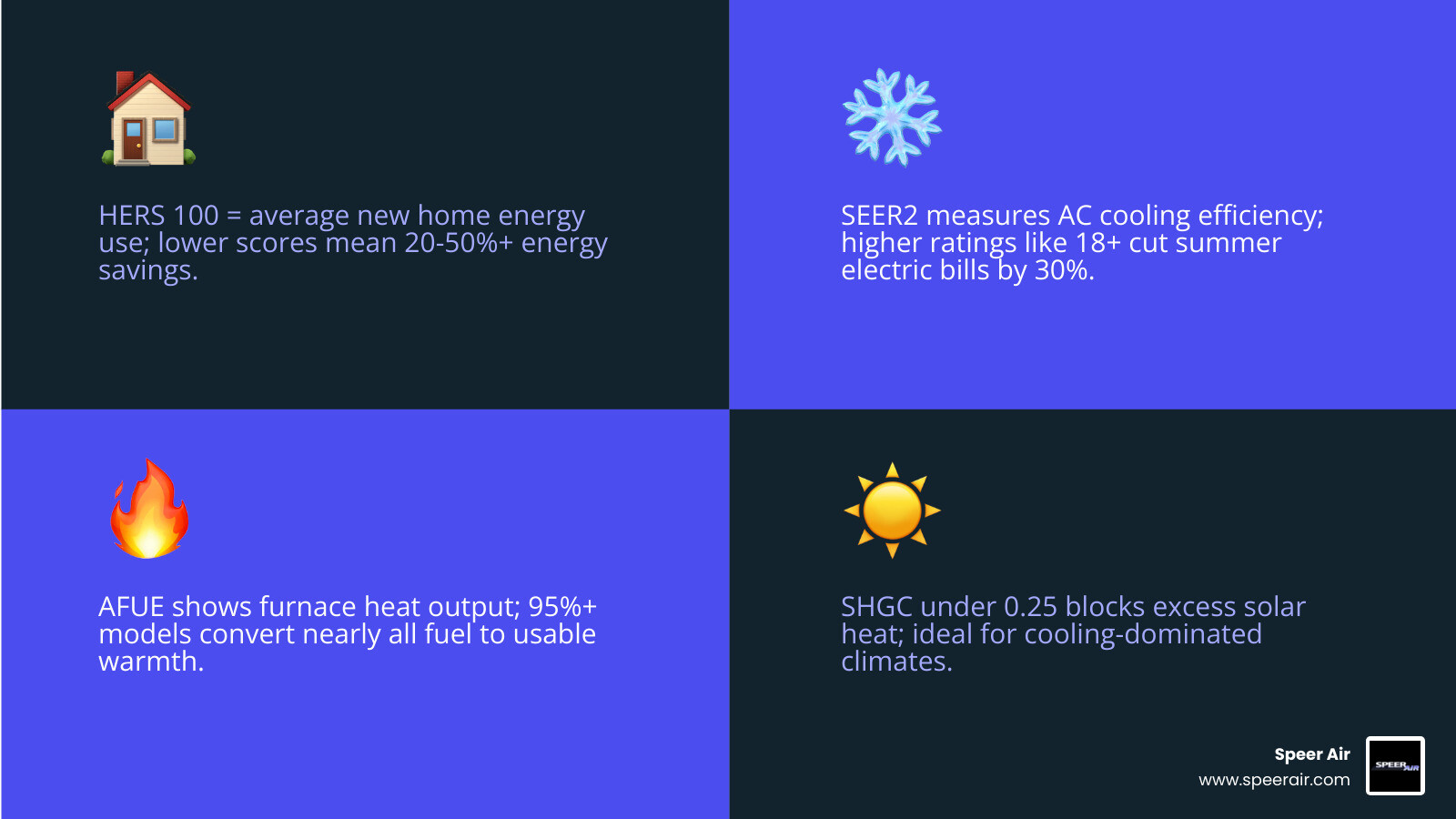
- The Scale: Every 1-point decrease in the HERS Index corresponds to a 1% reduction in energy consumption compared to the baseline. For example, a home with a HERS rating of 70 is 30% more energy efficient than a standard new home.
- Net Zero Energy: A HERS score of 0 represents a “Net Zero Energy” home, which produces as much energy as it consumes (usually through solar panels).
To get a HERS score, a certified energy rater performs an energy audit, looking at insulation levels, window efficiency, wall-to-window ratios, and the performance of heating and cooling systems.
Green Building Certifications
Beyond the HERS score, you’ll see several “brand name” certifications that indicate a home meets high standards:
- ENERGY STAR Certified Homes: These homes are at least 10% more efficient than those built to code. They undergo rigorous third-party inspections to ensure high-performance insulation, tight air sealing, and high-efficiency HVAC.
- LEED Certification: Leadership in Energy and Environmental Design (LEED) is a globally recognized symbol of sustainability. It awards points across categories like water efficiency, indoor air quality, and materials.
- NGBS Green Building Standard: This evaluates six factors including resource efficiency and lot development.
- DOE Zero Energy Ready Homes: These are ultra-high-performance homes so efficient that a small solar system can offset most or all annual energy consumption. They also incorporate the EPA’s Indoor airPLUS guidelines for superior air quality.
- ENERGY STAR NextGen: Launched recently, this program focuses on electrification and decarbonization, requiring high-efficiency heat pumps and electric water heaters, along with EV charging readiness.
Decoding HVAC Efficiency Ratings Explained for Homeowners
While the HERS score looks at the whole house, HVAC ratings tell you how individual pieces of equipment perform. These are the numbers you’ll see when browsing our HVAC Learning Center.
| Metric | Full Name | Primary Use |
|---|---|---|
| SEER2 | Seasonal Energy Efficiency Ratio 2 | Cooling (AC & Heat Pumps) |
| AFUE | Annual Fuel Utilization Efficiency | Heating (Furnaces & Boilers) |
| HSPF2 | Heating Seasonal Performance Factor 2 | Heating (Heat Pumps) |
Cooling Metrics: SEER and EER Efficiency Ratings Explained for Homeowners
When you’re looking at AC Installation Rockaway or considering an AC Replacement Rockaway NJ, SEER is the most important number.
SEER (Seasonal Energy Efficiency Ratio) measures cooling efficiency over an entire season. It’s calculated by taking the total cooling output (measured in BTUs) and dividing it by the total electric energy input (in watt-hours) used during that time.
- 2023 DOE Standards: As of 2023, the Department of Energy raised the minimum SEER for new AC units to 14.
- High Efficiency: Modern systems can go as high as 26 SEER. A system with a SEER of 16 vs. 13 could potentially reduce your cooling costs by 20–25% annually.
- EER (Energy Efficiency Ratio): While SEER is an average, EER measures how efficient the unit is at a specific high temperature (usually 95°F). If you live in a part of Northern New Jersey that experiences intense heat waves, a high EER is a good indicator that your system won’t buckle under the pressure.
You can use our SEER Calculator to see how much you could save by upgrading your current unit.
Heating Metrics: AFUE and HSPF Efficiency Ratings Explained for Homeowners
For heating, we use different metrics because we’re often dealing with different fuel sources.
AFUE (Annual Fuel Utilization Efficiency) is for furnaces and boilers. It is expressed as a percentage. If a furnace has a 95% AFUE rating, it means 95% of the fuel you pay for is converted into usable heat, while 5% is lost through the chimney or exhaust.
- Standard Efficiency: 80% AFUE.
- High Efficiency: 90% to 98.7% AFUE. Upgrading from an 80% unit to a 95% unit means you stop wasting 15 cents of every dollar spent on gas.
HSPF (Heating Seasonal Performance Factor) is the heating equivalent of SEER, specifically for heat pumps. It measures the total heating output relative to the electricity consumed.
- High Efficiency: Ratings above 8.8 are considered excellent.
- Why it Matters: Heat pumps are incredibly efficient because they move heat rather than creating it. For more on this, check out Understanding Heat Pumps: A Guide.
If you’re wondering, “What Size Heat Pump Does Your Maplewood Home Need?“, the answer involves looking at both the HSPF for winter and the SEER for summer.
Performance Ratings for Windows, Doors, and Skylights
Your HVAC system works hard to generate comfort, but your windows and doors are often where that comfort “leaks” out. When shopping for windows in Somerset County or Union County, look for the NFRC (National Fenestration Rating Council) label.
- U-factor: This measures the rate at which a window transmits non-solar heat flow. Unlike SEER, lower is better. A lower U-factor means the window is a better insulator.
- Solar Heat Gain Coefficient (SHGC): This is a number between 0 and 1 that tells you how much solar radiation comes through the glass. In New Jersey, we often want a “balanced” SHGC—low enough to keep out the summer sun, but high enough to allow some “free” solar heating in the winter.
- Visible Transmittance (VT): This measures how much light comes through. A higher VT means more natural light, which can reduce the need for electric lighting.
- Air Leakage: This measures how much air moves through the window’s joints. Proper installation is key here; even a high-rated window will perform poorly if it isn’t sealed right.
- Condensation Resistance: This indicates how well the window resists moisture buildup on the glass—a common issue during our humid Jersey summers and freezing winters.
Understanding these can also help you realize the Zone Control Benefits with Ductless Systems, as better windows allow for more precise temperature management in specific rooms.
Factors That Influence Real-World Efficiency Performance
It’s important to remember that a rating is a “lab result.” In the real world, your mileage may vary based on how the system is treated.
Beyond the Label
- System Sizing: This is the most common mistake. Many homeowners think “bigger is better,” but an oversized unit will “short cycle”—turning on and off rapidly. This prevents the system from reaching its peak efficiency and leaves your home humid and uncomfortable. We use a Manual J load calculation to ensure your system is sized perfectly for your home’s square footage and layout.
- Installation Quality: A 20-SEER unit installed poorly can perform like a 14-SEER unit. Issues like mismatched air handlers and condensers or poor static air pressure can cripple efficiency.
- Ductwork Integrity: If your ducts are leaky or uninsulated, you could be losing 20–30% of your conditioned air to your attic or crawlspace before it ever reaches your living room.
- Maintenance: A dirty air filter or a clogged condenser coil makes the system work harder, driving up energy use. Regular maintenance is the only way to sustain those high ratings.
- Smart Controls: Smart Thermostats Enhance Comfort and Efficiency by learning your schedule and automatically adjusting temperatures, ensuring you aren’t paying to cool an empty house.
When Choosing the Right AC System: Factors to Consider, always look beyond the sticker and consider the quality of the installation and the home envelope.
Frequently Asked Questions About Home Efficiency
What is a good HERS rating for a new home?
A typical new home built to code usually lands around a 100. However, most energy-efficient “good” new homes aim for a HERS 50 or lower, meaning they are 50% more efficient than the 2006 baseline. High-performance homes in our area often achieve scores in the 30s or 40s.
Does a high efficiency rating guarantee lower utility bills?
Not necessarily. While a high rating provides the potential for savings, your operational habits matter. If you have a 25-SEER AC but leave your windows open while it’s running, your bills will still be high. Efficiency is a partnership between high-quality equipment and smart homeowner habits like using programmable settings and maintaining weather stripping.
How do I find the efficiency rating on my current HVAC unit?
Look for the yellow and black EnergyGuide label on the side of the outdoor condenser or the indoor furnace. If that’s missing, find the manufacturer nameplate and note the model and serial numbers. You can search these on the manufacturer’s website or use an AHRI directory to find the original SEER or AFUE rating.
Start Saving Today with Speer Air
Understanding efficiency ratings explained for homeowners is the first step toward a more comfortable, affordable home. At Speer Air, we’ve been helping families across Northern New Jersey and Eastern Pennsylvania since 1900. Whether you are in Bergen County, NJ, or Easton, PA, our goal is to take the guesswork out of your home comfort.
As a Carrier Factory Authorized Dealer and NATE-certified team, we don’t just sell equipment; we provide engineered solutions. We can help you navigate the complexities of SEER2, AFUE, and HERS scores to find the system that fits your budget and your lifestyle.
Ready to see how your current system stacks up? Use our SEER Calculator to estimate your potential savings, or contact us today to schedule a professional assessment. Let’s make your home the most efficient it’s ever been.