

Is It Time? How to Know When Should You Replace Your Air Conditioner
Knowing when should you replace your air conditioner can save you from wasting money on repairs that simply delay the inevitable — and spare you the misery of a breakdown on the hottest day of the year. For homeowners in Northern New Jersey, where humid summers put serious strain on cooling systems, getting this decision right matters more than most people realize.
Most AC systems last between 10 and 15 years. But age is just one piece of the puzzle. Repair costs, energy bills, refrigerant type, and how well your home is actually staying cool all factor into the decision.
Here are the most common signs it’s time to replace your air conditioner:
- Your unit is 10 years old or older
- You’ve needed repairs two or more times in the past year
- Your energy bills have risen noticeably without a change in usage
- Your home has uneven temperatures or humidity problems
- Your system uses R-22 (Freon) refrigerant, which is no longer produced
- A major component like the compressor has failed
- Your unit is making unusual noises or producing strange odors
If two or more of these apply to your system, replacement is likely the smarter long-term move.
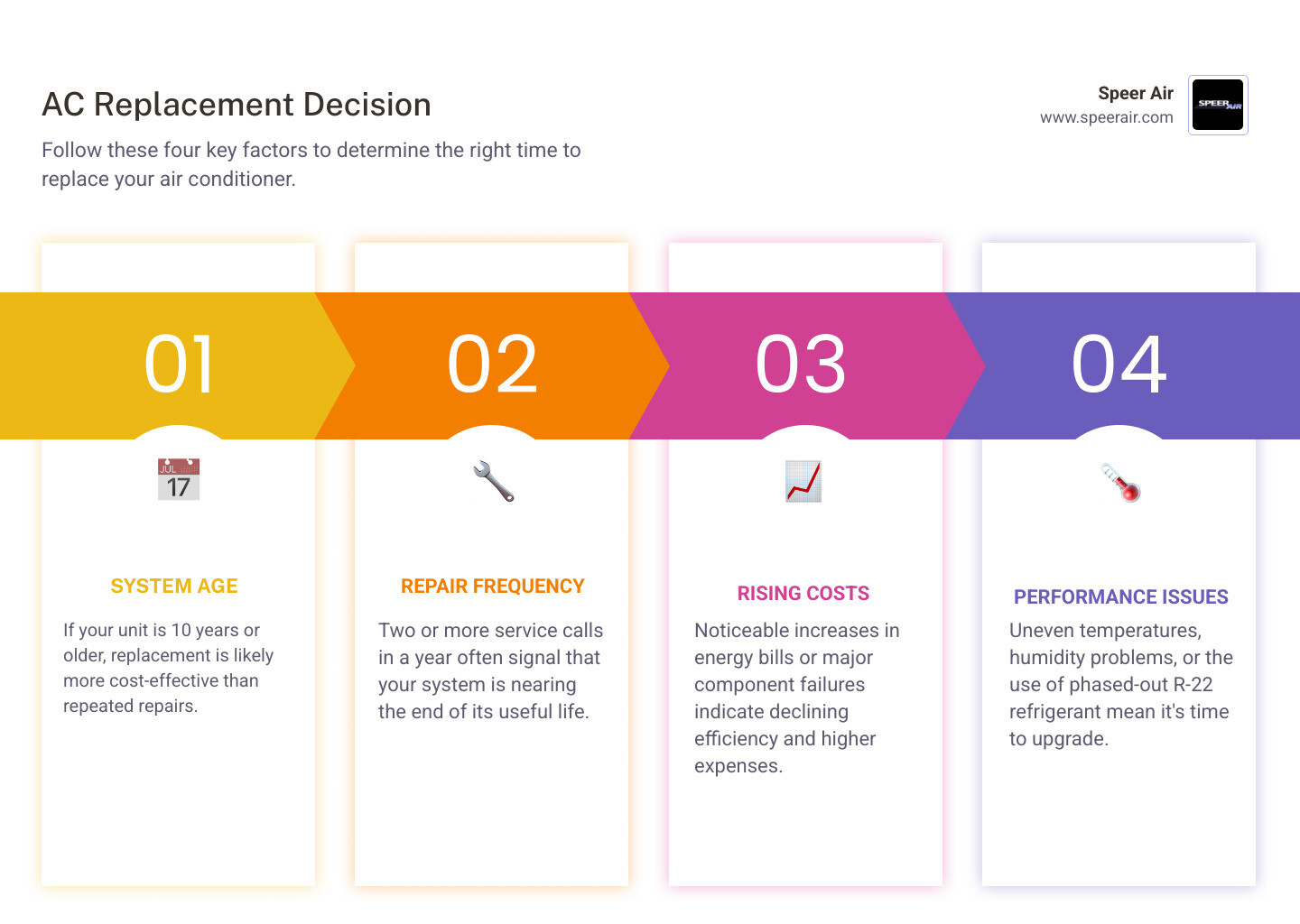
Deciding When Should You Replace Your Air Conditioner

Deciding whether to keep patching up your existing cooling system or to invest in a brand-new one is a major crossroads for any homeowner. It is easy to fall into the cycle of paying for “just one more repair,” but over time, those quick fixes can add up to a sum that exceeds the cost of a modern, highly efficient system. To help you spot the tipping point, it is vital to learn the Signs HVAC System is Ready for an Upgrade.
When an air conditioner begins to fail, it rarely does so in complete silence. Instead, it drops hints through declining performance, weird sounds, and subtle changes in your indoor environment. Recognizing these warning signs early allows you to plan a replacement on your own terms rather than dealing with an emergency installation in the dead of July.
Frequent Breakdowns and Rising Energy Bills
An air conditioner should be a reliable partner in keeping your home comfortable. If you find yourself on a first-name basis with your local HVAC technician because your system breaks down every few months, your system’s reliability is gone. While a single minor repair—like replacing a failed capacitor or cleaning out a clogged condensate drain—is perfectly normal, multiple service calls in a single season are a clear indicator of systemic wear.
At the same time, your utility bills serve as an excellent report card for your system’s health. Air conditioning accounts for roughly 12% to 27% of your monthly power bills, and heating and cooling combined can make up to 50% of your home’s total energy consumption. As components like the compressor and blower motor age, they must work significantly harder to deliver the same amount of cooling. If your energy bills are climbing year-over-year despite normal summer weather and routine filter changes, your AC is losing its efficiency. Upgrading to a modern system can stop this financial drain immediately.
Uneven Temperatures and Humidity Issues
Have you noticed that your upstairs bedrooms feel like a sauna while your basement is freezing? Or perhaps your living room remains uncomfortably muggy even when the air conditioner is running constantly? These comfort problems point directly to airflow and humidity issues.
A properly functioning air conditioner does not just cool the air; it also extracts moisture. When a system begins to short-cycle—turning on and off rapidly without completing a full cooling cycle—it fails to run long enough to remove humidity from the air. This leaves your home feeling clammy and damp, which can negatively impact your indoor air quality and create a breeding ground for mold and dust mites. If your system can no longer maintain a consistent, comfortable temperature and relative humidity throughout your home, it has likely reached its operational limit.
How System Age and Climate Impact Your AC Lifespan
Understanding how long an air conditioner is designed to last is essential when evaluating its performance. However, equipment age is heavily influenced by local climate conditions and how hard the system has to work. To get a better sense of where your unit stands on its life journey, it helps to read up on Is Your HVAC Over the Hill? Knowing When to Say Goodbye.
In Northern New Jersey, our systems face a unique set of environmental challenges. We experience dramatic seasonal shifts—from freezing, snowy winters to hot, sticky summers. This intense thermal cycling places unique physical stress on outdoor condenser units, causing materials to expand and contract repeatedly, which accelerates wear and tear on electrical connections, coils, and seals.
The 10-to-15-Year Lifespan Rule in the Northeast
On average, a central air conditioning unit has a lifespan of 10 to 15 years. While some modern systems operating under absolutely perfect conditions with meticulous maintenance can last up to 20 years, older units in our region typically reach their functional limit around the 10-to-12-year mark.
According to ENERGY STAR® guidelines, homeowners should begin considering an upgrade once their cooling system passes 10 years of age. Even if a 12-year-old system is still running, its internal components are likely worn, and its efficiency rating is significantly lower than the standards of today. Keeping an over-the-hill system running is often a gamble, as major component failures become highly probable with each passing season.
Why Outdated R-22 Refrigerant Means It’s Time to Replace
If your air conditioner was installed before 2010, there is a very high probability that it uses R-22 refrigerant (commonly known as Freon®). Because R-22 contains ozone-depleting substances, the Environmental Protection Agency (EPA) completely phased out its production and import.
As of 2026, finding R-22 to service an older system is incredibly difficult and expensive, relying entirely on scarce, recycled supplies. If your older system develops a refrigerant leak, attempting to repair the leak and recharge the system is simply not economically viable. An R-22 label on your outdoor condenser is an immediate sign that you should replace your system rather than trying to keep it on life support. Modern systems use eco-friendly refrigerants that are readily available, highly efficient, and far better for the environment.
The $5,000 Rule and Financial Decision Frameworks
When faced with a repair recommendation, it can be difficult to decide if the expense is justified. Fortunately, the HVAC industry uses several objective mathematical frameworks to remove the guesswork and emotion from the decision-making process. These simple formulas help you compare the short-term cost of a repair against the long-term value of a complete system upgrade. For an in-depth breakdown of these strategies, explore our When to Repair vs Replace Your HVAC System: A-Z Guide.
To help visualize how the decision-making process works, consider this quick comparison of repair versus replacement outcomes:
| Feature / Outcome | Proceeding with AC Repair | Choosing AC Replacement |
|---|---|---|
| Upfront Cost | Lower (short-term fix) | Higher (long-term investment) |
| System Reliability | Uncertain; other old parts may fail | High; backed by a new manufacturer warranty |
| Energy Efficiency | Remains low; utility bills stay high | High; modern SEER2 standards reduce bills |
| Refrigerant Type | May use obsolete, expensive R-22 | Uses modern, eco-friendly refrigerants |
| Home Comfort | Inconsistent cooling may persist | Even temperatures and superior humidity control |
How to Calculate the $5,000 Rule for Your System
The $5,000 rule is an industry-standard formula that combines the age of your air conditioner with the cost of the proposed repair to give you a clear “Decision Number.”
The math is incredibly simple: $$\text{Age of the AC Unit (in Years)} \times \text{Estimated Cost of the Repair} = \text{Decision Number}$$
If your Decision Number is under $5,000, proceeding with the repair is generally considered a reasonable financial move. If the Decision Number is over $5,000, investing that money into a replacement is the smarter choice.
Let’s look at two real-world examples:
- Scenario A: You have a 12-year-old air conditioner that needs a $500 repair. $$12 \times \$500 = \$6,000$$ Since $6,000 exceeds the $5,000 threshold, the rule strongly suggests replacing the unit.
- Scenario B: You have a 6-year-old air conditioner that needs the same $500 repair. $$6 \times \$500 = \$3,000$$ Since $3,000 is well below the threshold, repairing the system is the logical path forward, especially since the unit is likely still under its parts warranty.
The 50% Rule for Major Component Failures
Another excellent rule of thumb is the 50% rule. This guideline states that if the cost of a single repair exceeds 50% of the value of a brand-new, comparable cooling system, you should replace the unit immediately.
This rule is particularly relevant when dealing with major component failures, such as a burned-out compressor or a failed outdoor fan motor on an out-of-warranty system. Spending a significant portion of a new system’s cost on a unit that still has old, worn-out electrical controls, coils, and blower motors is rarely a wise investment.
Planning Your AC Replacement: Sizing, Timing, and Benefits
Once you have decided that replacement is the right path, the planning phase begins. This is your opportunity to correct existing comfort issues, lower your carbon footprint, and customize your home’s climate controls. To ensure your new system is set up for success, consult our AC Installation Rockaway NJ Guide and learn about the benefits of installing an Energy Efficient HVAC System Rockaway.
Replacing an old air conditioner is about more than just swapping out a metal box. It requires a comprehensive look at your home’s insulation, ductwork, and overall airflow to maximize your return on investment.
Why Proper System Sizing and Ductwork Matter
One of the most common mistakes made in residential HVAC is improper system sizing. Many older systems were sized using basic, inaccurate square-footage rules of thumb, resulting in systems that are either oversized or undersized.
- An oversized system will cool the home too quickly, leading to rapid on-and-off cycling (short-cycling) that fails to remove humidity and wears out the compressor prematurely.
- An undersized system will run continuously without ever reaching your thermostat’s target temperature, wasting energy and causing excessive wear.
To avoid these issues, we perform a detailed Manual J load calculation. This scientific assessment takes into account your home’s square footage, wall orientation, window efficiency, insulation levels, and local climate patterns to determine the exact cooling capacity your home requires. Additionally, we inspect your ductwork. Even the most efficient air conditioner will struggle if air is escaping through leaking, unsealed, or poorly insulated ducts.
When is the Best Time of Year to Replace Your AC?
While many homeowners wait until their system dies in the middle of a summer heatwave to buy a new one, this is actually the most challenging time to schedule an installation. During peak summer, HVAC companies are flooded with emergency repair calls, meaning wait times for installation can be longer, and you may have to live in a hot home for several days.
The absolute best time to replace your air conditioner is during the “shoulder seasons”—specifically late winter to early spring (February through April) or mid-to-late autumn (September through November). During these milder months, contractor availability is much more flexible, allowing you to schedule the installation at a time that is most convenient for you. You also avoid the stress of making a major financial decision under emergency conditions.
Frequently Asked Questions About AC Replacement
How do I know when should you replace your air conditioner instead of repairing it?
You should seriously consider replacing your air conditioner if it is more than 10 to 12 years old and requires frequent repairs, causes your energy bills to rise steadily, or uses phased-out R-22 refrigerant. If you are constantly calling for service or if a single repair estimate fails the $5,000 rule, investing in a new, energy-efficient system is the most cost-effective and reliable choice.
Does a new air conditioner increase home equity?
Yes, upgrading your cooling system is an excellent way to boost your home’s value and market appeal. Buyers in Northern New Jersey look closely at the age and condition of mechanical systems. A brand-new, high-efficiency system eliminates a major future expense for potential buyers, making your property stand out and preventing buyers from asking for price reductions or credits during negotiations. To learn more about how this works, check out our guide on Why Upgrading Your HVAC is a Smart Investment for Your Equity.
What are the signs that indicate when should you replace your air conditioner in New Jersey?
In New Jersey, our high summer humidity levels and freezing winters place unique demands on HVAC equipment. Key local signs that it is time for a replacement include an inability to keep indoor humidity levels comfortable during muggy July days, uneven temperatures between different floors of your home, and rapid system cycling. If you are experiencing these issues, review our AC Replacement Rockaway NJ services and check out these helpful Rockaway AC Replacement Tips to guide your next steps.
Conclusion
Deciding when should you replace your air conditioner is a significant decision, but you do not have to make it alone. By paying attention to the warning signs—like frequent breakdowns, rising energy bills, and poor humidity control—and applying mathematical tools like the $5,000 rule, you can make an informed, stress-free choice that keeps your home comfortable for years to come.
At Speer Air, we have been helping homeowners throughout Northern New Jersey and neighboring areas stay comfortable since 1900. Our deep industry roots, NATE-certified technicians, and status as a Carrier Factory Authorized Dealer mean we have the technical expertise to evaluate your system honestly and guide you toward the perfect solution for your home.
Whether you need a minor repair to get through the season or are ready to explore a Complete HVAC Replacement Northern NJ with a High Efficiency HVAC Installation Northern NJ, we are here to help. Contact us today to schedule a professional system evaluation, or book your appointment online for expert Air Conditioning Service in Rockaway. We will help you find the perfect match for your home comfort needs!