

Why How Proper AC Installation Affects Long-Term Performance Is More Important Than Most Homeowners Think
How proper AC installation affects long-term performance is one of the most overlooked factors when homeowners invest in a new cooling system. Most people spend weeks comparing brands, efficiency ratings, and features — then hand the job off to whoever offers the lowest price. But here’s the thing: the quality of the installation itself often matters more than the equipment you choose.
Quick answer — how proper AC installation affects long-term performance:
| Installation Factor | Long-Term Impact |
|---|---|
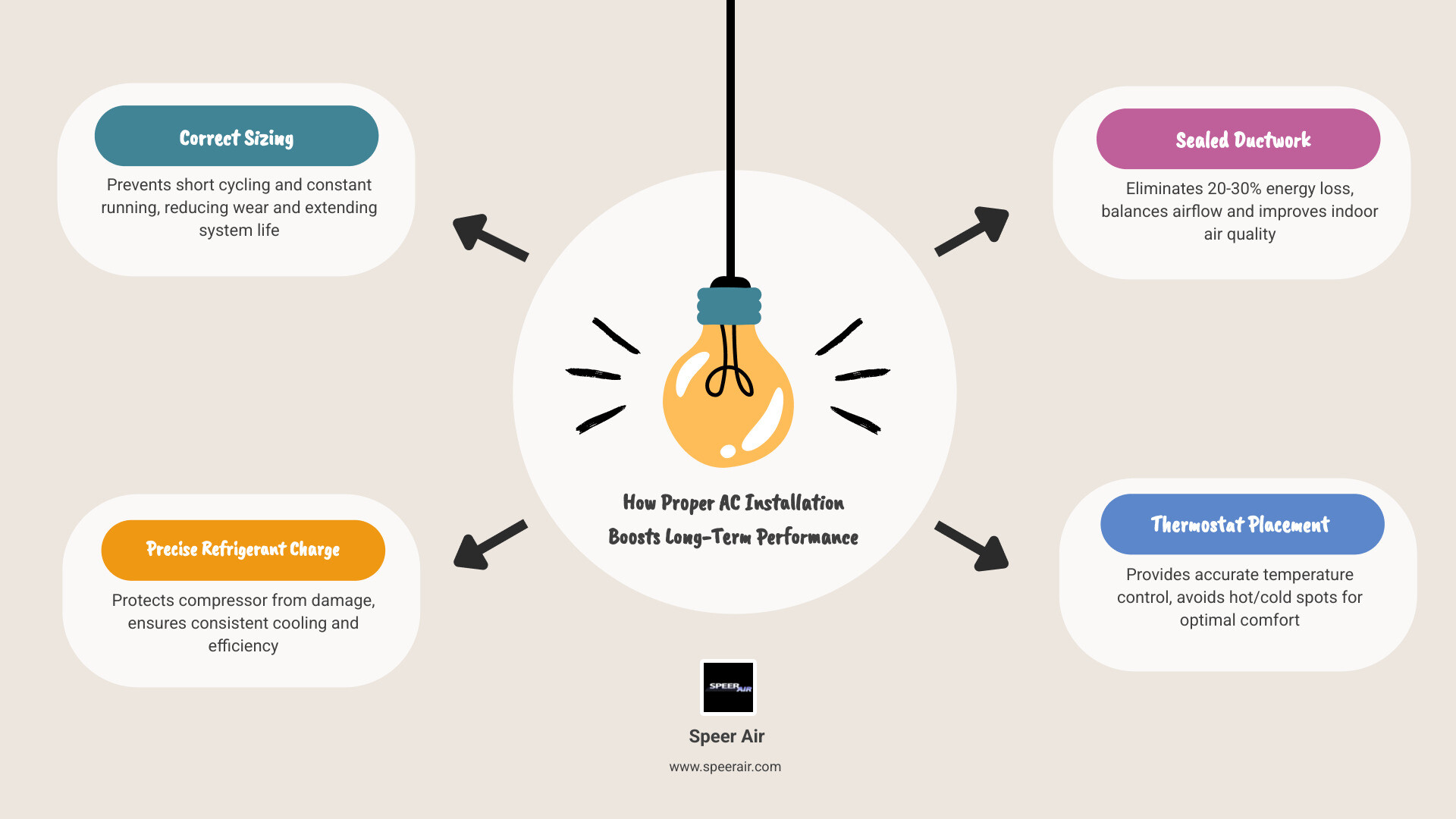
| Correct system sizing | Prevents short cycling and constant running, reducing wear |
| Precise refrigerant charge | Protects the compressor and ensures consistent cooling |
| Sealed, balanced ductwork | Prevents 20–30% cooling loss and improves air quality |
| Proper thermostat placement | Ensures accurate temperature control and efficiency |
| Drainage and electrical setup | Avoids water damage, mold risk, and breaker issues |
| Professional startup testing | Catches problems before they become expensive repairs |
A well-installed system in a Northern New Jersey home can run reliably for 15 to 25 years. A poorly installed one — even a high-efficiency model — can start causing problems within the first few seasons, driving up your electric bill and leading to repairs you shouldn’t need.
Air conditioning already accounts for up to 50% or more of your home’s electric usage during summer months. When the setup is wrong from day one, that number climbs even higher — and it stays high for as long as the system runs.
At Speer Air, serving Rockaway, Denville, Morris County, and across Northern New Jersey, our team has been installing and servicing HVAC systems since 1900. We’ve seen what a proper installation protects — and what a rushed or incorrect one costs homeowners over time.
This guide walks through every critical factor that connects installation quality to long-term performance, so you know exactly what to expect and what to ask for.
What Proper AC Installation Really Means for Long-Term Results
Proper AC installation is not just setting a unit in place, connecting a few wires, and hoping cold air comes out. A correct installation is a full process that includes:
- Load calculations based on the home itself, not just square footage
- Matching the indoor and outdoor equipment properly
- Following manufacturer specifications
- Meeting local code requirements
- Verifying electrical connections and safety controls
- Setting up condensate drainage correctly
- Testing airflow and system performance during startup
In other words, installation is the foundation. If the foundation is crooked, the whole system leans with it for years.
For homeowners in Northern New Jersey and nearby Pennsylvania service areas, climate matters too. Our summers can be humid, and that means an AC system has to do more than lower temperature. It also has to remove moisture effectively. That only happens when sizing, airflow, refrigerant charge, and controls are all dialed in together.
If you are planning a new system, our AC Installation Rockaway NJ Guide and AC Installation in Denville NJ Guide can help you understand what a professional setup should include.
How proper ac installation affects long term performance from day one
The first day matters more than most people realize. Startup is where we confirm that the system is actually operating the way it was designed to operate.
A proper day-one setup helps with:
- Stable cooling instead of temperature swings
- Better humidity removal
- Lower strain on the compressor and blower motor
- Fewer nuisance shutdowns and electrical issues
- More even airflow room to room
This is why how proper AC installation affects long-term performance is really a day-one story. If airflow is too low, refrigerant is off, or controls are misconfigured, the system starts life under stress. That stress does not stay small. It builds into higher energy use, more wear, and more service calls.
Why a high-efficiency unit still underperforms if the setup is wrong
A high-efficiency AC is not magic. If installed incorrectly, even a premium system can deliver very ordinary results.
Common examples include:
- An oversized unit that short cycles and never runs long enough to dehumidify properly
- An undersized unit that runs nonstop and still struggles on the hottest days
- Leaky ducts that throw away cooled air before it reaches living spaces
- Poor thermostat placement that causes false temperature readings
- Startup settings that leave airflow or charge out of spec
That means the rated efficiency on the brochure may not match real-life performance in your home. The unit may be capable of excellent results, but poor setup can cancel out the benefit.
How Proper AC Installation Affects Long Term Performance Through Sizing and Refrigerant Accuracy
Two of the biggest long-term performance issues come down to sizing and refrigerant accuracy. These are not guesswork items. They should be measured, calculated, and verified.
Manual J load calculations help determine the correct system size by considering:
- Insulation levels
- Window size and orientation
- Air leakage
- Home layout
- Ceiling height
- Local climate conditions
- Occupancy patterns
Then comes refrigerant charging. That should be checked against manufacturer targets using real measurements such as subcooling and superheat where applicable, not by “it feels cold enough.” That phrase has probably launched a thousand preventable service calls.

Why correct system sizing protects efficiency, comfort, and lifespan
Correct sizing affects almost everything your AC does.
If the system is oversized:
- It cools too fast
- It shuts off too often
- It short cycles
- It removes less humidity
- It creates more wear from repeated starts and stops
If the system is undersized:
- It runs constantly
- It struggles to keep up during hot weather
- It uses more electricity over time
- It experiences more ongoing strain
- It may have a shorter lifespan because it never gets a break
A right-sized system runs in healthier cycles. That improves comfort, supports efficiency, and reduces wear on motors, contactors, and compressors.
Research consistently shows that oversized or undersized equipment leads to short cycling or constant running, both of which reduce efficiency and increase wear. That is one of the clearest examples of how proper AC installation affects long-term performance.
How proper ac installation affects long term performance through precise refrigerant charging
Refrigerant charge is critical because the entire cooling cycle depends on it. Too much or too little refrigerant can cause long-term trouble.
Low charge can lead to:
- Poor cooling
- Frozen evaporator coils
- Longer runtimes
- Compressor overheating
Overcharge can lead to:
- Reduced efficiency
- Higher pressure in the system
- Poor heat transfer
- Extra compressor stress
The compressor is one of the most important and expensive parts of an AC system. Incorrect refrigerant charge during installation can damage it slowly or quickly, depending on how far off the system is. Either way, it is bad news.
Proper charging helps the system:
- Reach target temperatures efficiently
- Protect the compressor
- Maintain stable pressures
- Reduce coil freeze risk
- Deliver better long-term reliability
Ductwork, Airflow, and Thermostat Placement: The Hidden Performance Drivers
Homeowners often focus on the equipment box outside and the thermostat on the wall. But the hidden performance drivers are usually in the ductwork and airflow setup behind the scenes.
Poorly installed ductwork can lead to 20% to 30% cooling loss. That is a huge hit to comfort and efficiency. It also means you may be paying to cool attics, crawlspaces, or wall cavities instead of your living room.
For more on why installation quality helps avoid future problems, see this guide on how AC installation prevents future repairs.
| Proper Installation | Poor Installation |
|---|---|
| Ducts sealed and insulated | Air leaks waste cooled air |
| Airflow balanced by room | Hot and cold spots develop |
| Return air path verified | Weak circulation stresses blower |
| Thermostat placed correctly | False readings cause overcooling or short cycling |
| Static pressure checked | Restricted airflow reduces performance |
| Humidity managed better | Home feels cool but clammy |
Why duct design and sealing matter for efficiency and cleaner indoor air
Ductwork does more than move air. It affects efficiency, comfort, and indoor air quality.
When ducts are leaky or poorly designed, you can end up with:
- Uneven cooling from room to room
- Reduced airflow at vents
- Higher static pressure
- More dust and allergens pulled into the system
- Poor humidity control
- Extra wear on the blower
Leaky return ducts can also pull in attic dust, insulation particles, and other contaminants. That means poor installation does not just waste energy. It can make indoor air quality worse.
If existing ducts are older, damaged, or mismatched to a new system, they should be evaluated before installation. A new AC connected to bad ductwork is a little like putting new tires on a car with a bent axle. Technically possible. Not wise.
How thermostat placement and airflow balancing support long-term efficiency
The thermostat is the decision-maker for the system. If it gets bad information, the system makes bad decisions.
Poor thermostat placement can cause problems when it is installed:
- In direct sunlight
- Near supply vents
- Close to kitchens or appliances
- On exterior walls with temperature swings
- In areas that do not represent average home conditions
That can lead to short cycling, overcooling, undercooling, and uneven comfort.
Airflow balancing matters too. Proper setup includes checking how much air each room receives and making adjustments as needed. This helps avoid hot spots upstairs, cold spots downstairs, and the classic “one room feels like a freezer while another feels like a garage in August” problem.
What Goes Wrong With Poor Installation and How Homeowners Can Spot It
Poor installation usually does not stay hidden forever. It starts showing up in comfort complaints, higher utility usage, and service issues.
Here are common warning signs homeowners should watch for:
- Uneven temperatures between rooms
- AC that runs constantly or turns on and off too often
- Weak airflow from vents
- Whistling, rattling, or banging duct noises
- Clammy indoor air
- Rising electric bills
- Water leaks near the indoor unit
- Frozen coils
- Breaker trips
- Unusual vibration or loud startup sounds
If you are already seeing these issues, our AC Repair page and Signs You Need HVAC Repair in Rockaway can help you decide when it is time for a professional inspection.
Common consequences of poor AC installation
The long-term consequences can be serious:
- Premature system failure
- Frequent repairs
- Poor comfort despite a new unit
- Higher energy consumption
- Drainage problems and water damage
- Mold risk from moisture issues
- Loose wiring and intermittent electrical faults
- Reduced equipment lifespan
- Possible warranty complications if installation requirements were not followed
Research shows properly installed systems can last 15 to 25 years, while poor installation can cut lifespan to less than a decade. That is a dramatic difference, and it explains why professional setup is not just a first-day service. It is a long-term investment in performance.
Signs your system may have been installed incorrectly
Some symptoms are especially suggestive of installation problems:
- Whistling vents that may indicate duct leakage or restrictions
- Nonstop operation on moderate days
- Short cycling that starts shortly after installation
- Temperature swings from one part of the home to another
- Excessive vibration from loose connections or poor mounting
- Weak airflow even with a clean filter
- Persistent humidity indoors even while the AC is running
If any of that sounds familiar, it is worth having the system evaluated before those small signs grow into major repairs. For local support, you can also review AC Repair Rockaway NJ and AC Service Rockaway NJ.
Protecting Performance After Installation: Maintenance, Warranty, and Choosing the Right Pro
A great installation is the starting point, not the finish line. Even a perfectly installed AC needs regular maintenance to keep performing well.
For ongoing care, visit our AC Maintenance Rockaway NJ page.
How professional installation helps protect warranty coverage and code compliance
Professional installation supports warranty protection in several ways:
- Equipment is matched correctly
- Manufacturer instructions are followed
- Startup data can be documented
- Required electrical and refrigerant procedures are performed correctly
- Local permit and code requirements are addressed
Many manufacturers require professional installation and proper documentation to preserve warranty coverage. If the system was installed incorrectly, homeowners may face an unpleasant surprise later when a major claim depends on whether the installation met standards.
Code compliance matters too. AC systems involve electricity, drainage, refrigerant handling, and ventilation details that must be installed safely. Done right, that protects the equipment, the home, and everyone in it.
At Speer Air, our long history since 1900, NATE-certified technicians, and Carrier Factory Authorized Dealer status reflect the kind of detail-focused work homeowners should expect from an installer.
How often maintenance should be done after a proper installation
A proper installation does not eliminate maintenance. It makes maintenance more effective because the system starts from a good baseline.
A practical maintenance schedule includes:
- Professional tune-up once a year, ideally in spring before heavy cooling season
- Twice-yearly service for some high-use systems or mixed residential and light commercial needs
- Filter checks every 30 to 90 days depending on pets, dust, and usage
- Periodic coil inspection
- Condensate drain inspection and cleaning
- Refrigerant and airflow verification during service visits
Routine maintenance helps preserve efficiency, catch wear early, and prevent dirt buildup from forcing the system to work harder. Think of installation as aligning the car and maintenance as changing the oil. You want both. Your compressor agrees.
What homeowners should look for when choosing an AC installer
Choosing the right installer has a direct impact on system life, comfort, and reliability. We recommend looking for a company that will:
- Perform a real load calculation instead of sizing by rule of thumb
- Inspect existing ductwork and airflow
- Explain thermostat placement and control options
- Verify refrigerant charge and startup performance
- Check drainage, electrical connections, and safety controls
- Follow manufacturer requirements and local codes
- Offer local service and ongoing maintenance support
- Provide a clear scope of work
It also helps to choose a company with deep roots in the area and a long service history. If you are researching installers, this resource may help: I Need to Find a Company for a New AC Installation in Rockaway NJ.
If you are in nearby service areas, you can also learn more about our local installation services here:
- AC Installation Rockaway NJ
- AC Installation Randolph NJ
- AC Installation Maplewood NJ
- AC Installation in Bushkill PA
- Locations for AC Installation in Maplewood Home
- Carrier AC Installation Denville
- Buyers Guide Best Carrier AC Installers in Denville
Frequently Asked Questions about How Proper AC Installation Affects Long-Term Performance
How long can a properly installed AC system last?
With proper installation and regular maintenance, many systems can last 15 to 25 years. Some may fall closer to 10 to 15 years depending on usage, maintenance habits, and operating conditions, but installation quality plays a major role in where your system lands on that range.
Can improper installation really raise electric usage that much?
Yes. Since AC can account for 50% or more of summer electric use, installation mistakes can have a big impact. Duct leakage alone can reduce cooling efficiency by 20% to 30%. Add short cycling, poor airflow, or incorrect refrigerant charge, and the system may run longer and work harder all season.
Is maintenance still necessary if the AC was installed correctly?
Absolutely. Proper installation gives the system a strong start, but dust, filter loading, coil buildup, drainage issues, and normal wear still happen over time. Maintenance helps retain the efficiency and reliability created by a good installation and reduces the risk of surprise breakdowns.
Conclusion
When homeowners ask us about long-term AC value, our answer is simple: installation quality shapes everything that follows. The right setup improves efficiency, protects the compressor, supports better humidity control, keeps airflow balanced, and reduces the odds of frequent repairs.
That is the real answer to how proper AC installation affects long-term performance. It affects your comfort, your electric usage, your indoor air quality, your repair history, and how long your system lasts.
At Speer Air, we have been helping homeowners across Rockaway, Denville, Morris County, and Northern New Jersey since 1900. If you want your next AC system installed for dependable performance from day one, explore our AC installation services in Rockaway.