

Why Proper HVAC Sizing Makes or Breaks Your Northeast Summer Comfort
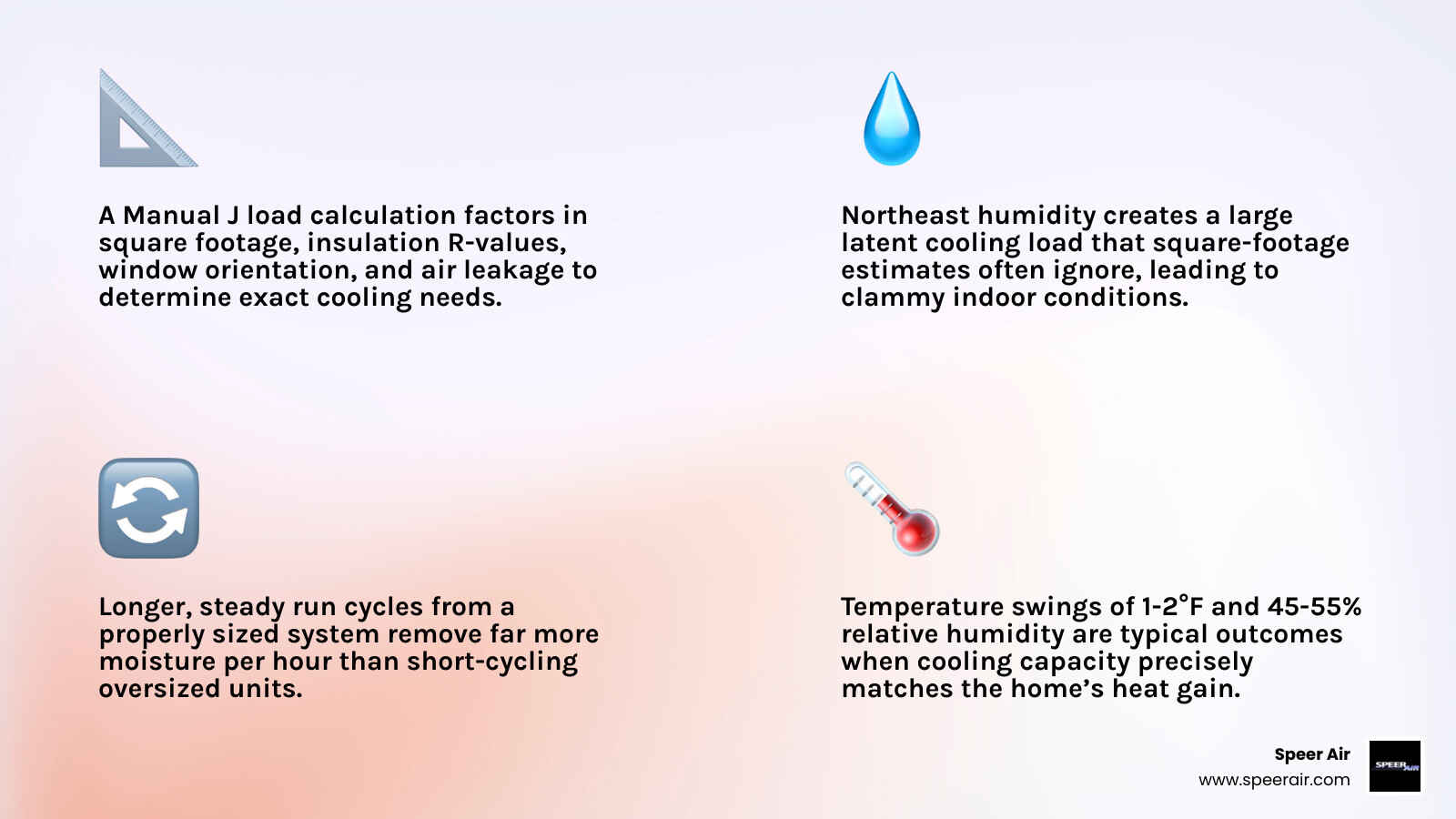
How a properly sized system handles northeast summers comes down to one core idea: matching your equipment’s cooling capacity to your home’s actual heat load — not just its square footage.
Here’s a quick breakdown:
- Maintains temperature within 1-2 degrees of your thermostat setting, even on the hottest, most humid days
- Removes moisture effectively, keeping indoor humidity at a comfortable level throughout July and August
- Runs in longer, steady cycles instead of short bursts, which means better dehumidification and lower energy bills
- Avoids short cycling (a common problem with oversized units) that leaves rooms feeling clammy and equipment wearing out faster
- Handles Northeast humidity spikes that square-footage rules of thumb simply can’t account for
Northern New Jersey summers are a unique challenge. Temperatures can swing dramatically from mild June mornings to sweltering late-July heat waves, all while humidity levels climb high enough to make even a 85°F day feel unbearable indoors. A system that’s too large will blast cold air and shut off before it ever pulls meaningful moisture from the air. A system that’s too small will run nonstop, struggle to keep up, and rack up energy costs in the process.
Getting the size right — through a proper engineering process, not a rough guess — is the foundation of every reliable, efficient cooling system in the region.
The Science of Load Calculations: Beyond Square Footage
Many homeowners assume that buying an air conditioner or heat pump is as simple as matching the square footage of their home to a chart on a box. In the HVAC industry, this is one of the most common and costly mistakes. Sizing a system solely by square footage assumes every home is a uniform cardboard box with identical windows, insulation, and sun exposure.
In reality, cooling capacity is measured in British Thermal Units (BTUs) and tons (where 1 ton equals 12,000 BTUs per hour of heat removal). To determine exactly how many BTUs your home needs to stay cool, we must perform a detailed load calculation. This calculation determines the amount of heat energy your home gains from the outside during the peak of summer, as well as the heat generated inside by appliances, lighting, and human beings.
True load calculations analyze a variety of shifting factors:
- Home Orientation: Which direction does your home face? A home with large, south- or west-facing windows receives a massive amount of solar heat gain in the afternoon compared to a home shaded by mature trees or facing north.
- Insulation Quality: The R-value of your attic, wall, and floor insulation determines how fast heat migrates into your living spaces.
- Ceiling Heights: A room with 12-foot cathedral ceilings holds a much larger volume of air than a room with standard 8-foot ceilings, requiring more cooling capacity even if the floor square footage is identical.
Why Manual J Matters for New Jersey Homes
To get an accurate measurement of these variables, professional HVAC contractors use the Air Conditioning Contractors of America (ACCA) Manual J load calculation protocol. This is the gold standard for residential system design. It takes into account the entire “building envelope” — the barrier between your conditioned indoor air and the outdoor environment.
For homes in Northern New Jersey, where we have a beautiful but challenging mix of historic colonials, mid-century split-levels, and modern new constructions, a Manual J calculation is non-negotiable. Older homes in Morris County or Bergen County often have plaster walls, minimal wall insulation, and older double-hung windows that allow significant air leakage. Newer homes in Rockaway or Denville might have tight building envelopes, double-pane low-E glass, and superior insulation that drastically reduces the cooling load.
If you are looking to replace your system, relying on the size of your old unit is also a gamble. Over the years, you may have upgraded your windows, added insulation, or sealed drafts. These improvements reduce your home’s cooling load. If you replace your old system with one of the exact same capacity without running a new calculation, you could easily end up with an oversized system.
To prevent these issues, it is essential to learn How to Size Your NJ HVAC Without Breaking a Sweat before making an investment. Additionally, proper seasonal upkeep is key to maintaining this balance. You can prepare your system ahead of time by reading The Garden State Guide to Spring AC Preparation or explore our tips on Getting Your Cooling System Ready for Warm Weather Without Breaking a Sweat.
How a Properly Sized System Handles Northeast Summers and Humidity
To understand why precise sizing is so critical in May 2026, we have to look at how an air conditioner actually cools your home. Air conditioners do not actually “create” cold; they remove heat and moisture. This process involves managing two distinct types of heat:
- Sensible Heat: This is the heat you can feel on your skin and read on a thermometer. When the indoor temperature drops from 80°F to 72°F, your system is removing sensible heat.
- Latent Heat: This is the heat stored in airborne water vapor. It represents the relative humidity of your indoor air. When your system condenses water out of the air and drains it outside, it is removing latent heat.
During a humid Northeast summer, managing latent heat is often more important for your comfort than dropping the actual temperature. High relative humidity makes the air feel thick, sticky, and warmer than it actually is because it prevents your body’s natural sweat from evaporating.
A properly sized system is engineered to run long, steady cycles. As warm, humid indoor air passes slowly over the cold evaporator coil, the moisture in the air condenses onto the coil and drains away. This process of continuous moisture removal lowers the relative humidity of your home to a comfortable 40% to 50%. When the humidity is controlled, you can actually set your thermostat a few degrees higher and feel just as comfortable, saving you money on your monthly utility bills.
Oversized vs. Undersized: The Cost of Improper Sizing
When a cooling system is sized incorrectly, your comfort, system lifespan, and energy consumption all suffer. Finding the “just right” capacity is the ultimate goal. To keep your system running smoothly and avoid costly emergencies, understanding the balance of sizing is The Secret to Lower Energy Bills and Zero Summer Breakdowns.
The Short-Cycling Trap of Oversized Units
There is a common misconception that “bigger is better” when it comes to air conditioning. Homeowners often think that buying a larger system will cool the house faster and work less. In reality, the exact opposite is true.
When an air conditioner or heat pump is oversized for a home, it experiences a phenomenon known as short cycling. Because the system has too much cooling capacity, it blasts the home with cold air and rapidly satisfies the thermostat in 5 to 10 minutes. The system then shuts off. A few minutes later, as heat radiates back into the rooms, the thermostat calls for cool air again, and the system turns back on.
This constant starting and stopping creates several major problems:
- Poor Dehumidification: It takes roughly 10 to 15 minutes of continuous operation for an evaporator coil to get cold enough to start condensing moisture out of the air. Because an oversized unit shuts off so quickly, it never removes humidity. You are left with indoor air that is cold but incredibly damp and clammy.
- Uneven Temperatures: The rapid blast of cold air doesn’t have time to circulate properly throughout the home. You will experience cold spots near the supply registers while upstairs bedrooms and distant corners remain hot and stuffy.
- Extreme Equipment Wear: The most stressful part of an HVAC system’s operation is the startup cycle. Short cycling forces the compressor and fan motors to start up dozens of times a day, leading to premature component failures and a significantly shortened system lifespan.
- High Energy Bills: Electric motors draw a massive surge of electricity when they first start up. Running shorter, more frequent cycles consumes far more energy than running one long, continuous cycle.
Why Undersized Systems Run Constantly During Heat Waves
On the other side of the spectrum, an undersized system lacks the cooling capacity to handle the heat load of a true Northeast heat wave. When outdoor temperatures climb into the 90s, an undersized air conditioner or heat pump will run continuously without ever reaching the setpoint on your thermostat.
The consequences of an undersized system include:
- Continuous Runtime: The system will run 24/7 in a desperate attempt to cool the home. While long cycles are good for dehumidification, running continuously without a break puts massive strain on the compressor and outdoor fan motor.
- High Utility Bills: Because the system never shuts off, your electrical consumption will skyrocket during the hottest months of the year.
- Hot Spots and Discomfort: The system will struggle to keep upstairs areas or rooms with high solar exposure comfortable, leaving your family sweltering during peak afternoon hours.
- Premature System Failure: Constant operation accelerates the wear and tear on moving parts, leading to frequent breakdowns and early system retirement.
How a Properly Sized System Handles Northeast Summers: Heat Pumps vs. Traditional AC
As we navigate the energy landscape of May 2026, homeowners are increasingly choosing between traditional air conditioners and modern air-source heat pumps. Both systems utilize the exact same refrigeration cycle to cool your home in the summer. They both use a compressor, an outdoor condenser coil, an indoor evaporator coil, and refrigerant to extract heat from your indoor air and dump it outside.
However, heat pumps feature a reversing valve that allows them to reverse this process in the winter, pulling heat from the outdoor air to warm your home. Let’s look at how these two technologies compare during the summer cooling season:
| Feature | Traditional Central AC | Modern Air-Source Heat Pump |
|---|---|---|
| Cooling Capacity | Identical to heat pumps (measured in tons) | Identical to central AC (measured in tons) |
| Energy Efficiency | High (typically 13 to 21 SEER2) | Outstanding (typically 14 to 22+ SEER2) |
| Dehumidification | Excellent (standard single- or two-stage) | Superior (often paired with variable-speed inverter technology) |
| Operational Cost | Standard summer cooling costs | 30% to 40% lower cooling costs compared to older AC units |
| Versatility | Cooling only | Year-round heating and cooling |
Cooling Performance and Efficiency Differences
When properly sized, a 3-ton heat pump provides the exact same cooling capacity as a 3-ton air conditioner. Some homeowners worry that heat pumps cannot cool as effectively during extreme summer heat, but this is a myth.
The real differentiator is energy efficiency. Modern heat pumps can be 30% to 40% more efficient in cooling mode than traditional air conditioners. For a typical 2,000-square-foot home in Northern New Jersey, upgrading to a properly sized, high-efficiency heat pump can save significant money on summer cooling bills.
This efficiency is largely due to the widespread use of variable-speed inverter compressors in modern heat pumps. Unlike traditional single-stage compressors that are either 100% “on” or 100% “off,” an inverter compressor can adjust its speed in tiny increments (from 25% to 100% capacity) to precisely match the real-time cooling load of your home.
On a mild 78°F June day, a variable-speed heat pump might run continuously at just 35% capacity, consuming a fraction of the electricity of a standard AC while maintaining a perfectly steady indoor temperature. To learn more about how these systems excel in our region, check out our guide on How Modern Heat Pumps Handle the Deep Freeze and High Humidity.
Dehumidification and Comfort Control
Because variable-speed heat pumps run for longer, lower-capacity cycles, they are absolute champions at moisture removal. The indoor blower motor adjusts its speed to match the compressor, allowing air to glide slowly across the cold evaporator coil. This extended contact time extracts maximum moisture from the air, drastically improving your indoor air quality and eliminating that “sticky” summer feeling.
Traditional single-stage AC units, even when properly sized, must cycle on and off more frequently to maintain temperature, which inherently limits their dehumidification performance compared to variable-speed systems.
Navigating Regional Efficiency Standards and SEER2 Ratings
When choosing a new cooling system, you will encounter energy efficiency ratings established by the U.S. Department of Energy (DOE). The primary metric for cooling efficiency is the Seasonal Energy Efficiency Ratio 2 (SEER2).
SEER2 measures the total cooling output of an air conditioner or heat pump over a typical cooling season divided by the total electrical energy it consumes. It replaced the older SEER rating system to provide a more realistic representation of real-world operating conditions, accounting for the static pressure found in typical residential ductwork.
To compare different ratings and see how much you could save by upgrading, you can use our SEER Calculator.
Understanding Northern Region SEER2 Requirements
The Department of Energy divides the United States into regional climate zones, each with its own minimum efficiency standards. Because the Northeast has shorter cooling seasons than the South, our regional standards are slightly different.
In our service territory — including Northern New Jersey counties like Morris, Passaic, Bergen, and Essex, as well as our neighboring communities in Eastern Pennsylvania — the minimum allowable efficiency for a newly installed split-system air conditioner is 13.4 SEER2 (which corresponds to the old 14 SEER standard).
While a 13.4 SEER2 system is highly affordable and fully compliant with local laws, opting for a higher-efficiency system is often a smart investment. To understand why efficiency ratings are more than just a marketing buzzword, read our article on why High Efficiency HVAC Systems Are Not Just Full of Hot Air.
How a Properly Sized System Handles Northeast Summers with High-Efficiency Equipment
Pairing proper system sizing with high-efficiency SEER2 ratings creates the ultimate summer comfort system. A high-efficiency system that is oversized will still short-cycle and fail to control humidity, completely wasting its efficiency potential. Conversely, a perfectly sized system with a low SEER2 rating will keep you comfortable but cost more to run.
When you invest in a system that is both precisely sized via a Manual J load calculation and features a high SEER2 rating (such as 16 to 20+ SEER2), you unlock maximum energy conservation and seasonal performance. This combination ensures that the system runs in its most efficient operational sweet spot for the majority of the summer, slashing your carbon footprint and your utility bills.
If you live in Morris County, you can find localized information on upgrading your home by exploring our page on installing an Energy Efficient HVAC System Rockaway.
Frequently Asked Questions about Northeast HVAC Sizing
How do I know if my current AC is improperly sized?
There are several clear warning signs that your current system is the wrong size for your home:
- If it is oversized: The system will turn on and off rapidly (every 5 to 15 minutes), your indoor air will feel cold but humid, and you will notice significant temperature differences between different rooms or floors.
- If it is undersized: The system will run continuously during hot summer days without ever cooling the house down to your thermostat’s setpoint, your energy bills will be unusually high, and you will notice persistent hot spots in rooms with western exposure or high ceilings.
Can a heat pump cool as effectively as a traditional AC in NJ?
Yes, absolutely. A properly sized air-source heat pump provides identical cooling capacity and performance to a traditional air conditioner. They use the exact same mechanical cooling process. The main difference is that a heat pump can reverse its operation to provide highly efficient heating during our cold New Jersey winters, making it a versatile, year-round comfort solution.
What is a Manual J load calculation?
A Manual J calculation is the official industry-standard protocol developed by the ACCA to determine the precise heating and cooling load of a residential building. It uses advanced mathematical formulas to analyze your home’s square footage, wall construction, insulation levels, window types, local climate data, ductwork, and solar orientation to calculate the exact BTUs required to keep your home comfortable.
Conclusion
Surviving and thriving during a humid Northeast summer requires a cooling system that is designed, sized, and installed with scientific precision. Relying on outdated rules of thumb or square-footage estimates will only lead to high energy bills, humid indoor air, and premature equipment breakdowns.
At Speer Air, we have been keeping Northern New Jersey and Eastern Pennsylvania families comfortable since 1900. Our deep industry roots, NATE-certified technicians, and status as a Carrier Factory Authorized Dealer mean we don’t guess when it comes to your comfort. We perform meticulous Manual J load calculations to ensure your new air conditioner or heat pump is sized perfectly for your unique home and lifestyle.
Don’t spend another summer dealing with clammy rooms, uneven temperatures, and soaring utility bills. Schedule your professional cooling consultation with Speer Air today and experience the difference that a properly sized, high-efficiency system can make.