

What to Do When Your AC Won’t Turn On: Quick Answers First
If you’re dealing with ac not turning on, here are the first things to check before calling a technician:
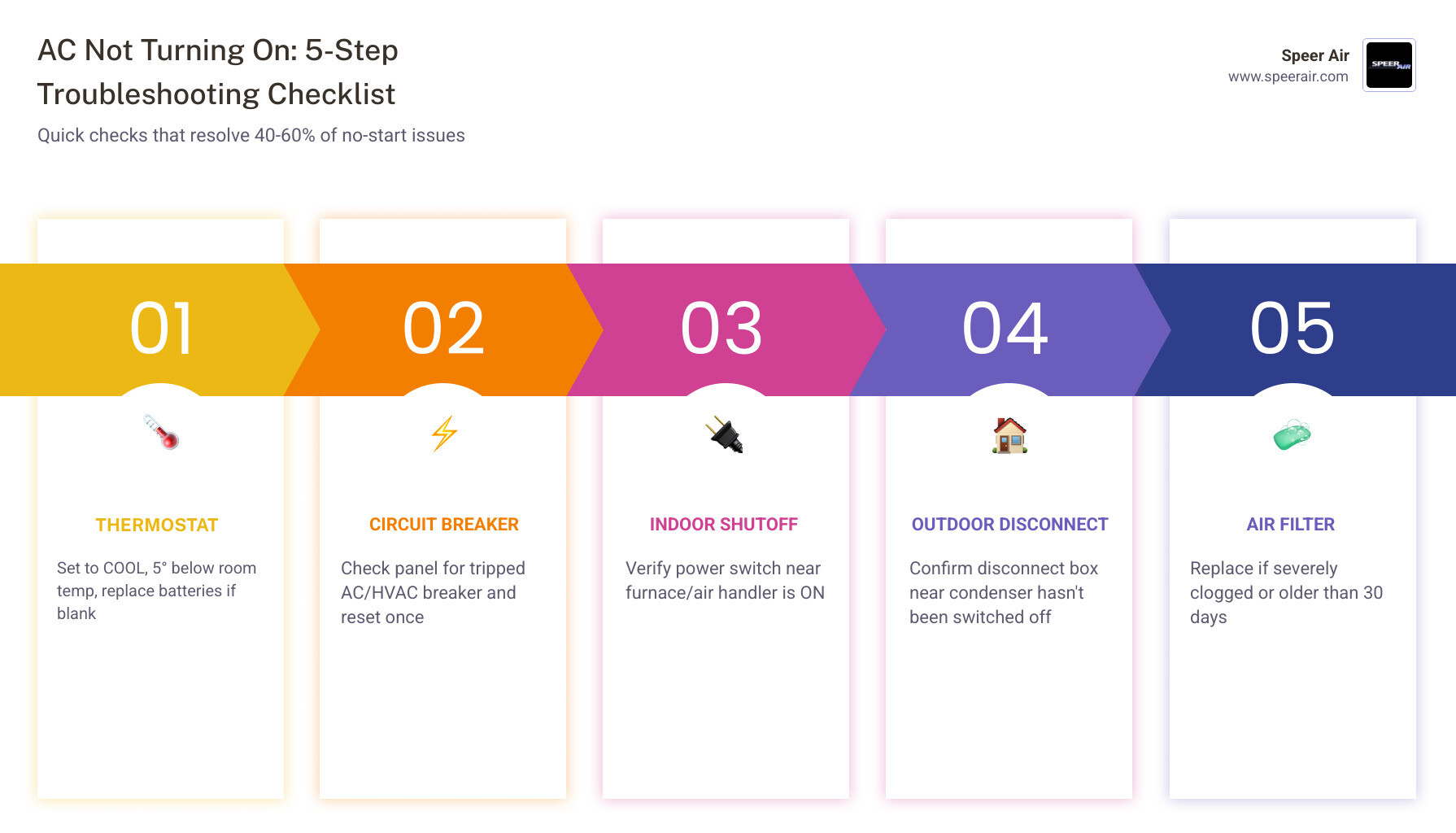
- Thermostat – Make sure it’s set to COOL and the temperature is at least 5 degrees below room temperature. Replace batteries if the screen is blank.
- Circuit breaker – Check your electrical panel for a tripped breaker labeled AC, Air Handler, or HVAC and reset it once if tripped.
- Indoor shutoff switch – Verify the power switch near your furnace or air handler is in the ON position.
- Outdoor disconnect switch – Confirm the disconnect box near your outdoor unit hasn’t been switched off.
- Air filter – A severely clogged filter can trigger a safety shutdown. Replace it if it’s been more than 30 days.
It’s a sweltering summer afternoon in Northern New Jersey, and you walk inside expecting cool air — only to find your AC isn’t turning on at all. Before you panic, here’s some reassuring news: basic troubleshooting steps resolve somewhere between 40 and 60 percent of all AC no-start situations, and roughly 30 percent of service calls turn out to be simple fixes a homeowner can handle in five minutes or less.
That said, some causes go beyond a quick DIY check. Knowing the difference between a dead thermostat battery and a failing capacitor can save you time, discomfort, and unnecessary stress. This guide walks you through exactly what to check first — in the right order — so you can get your home cool again as fast as possible.
AC Not Turning On: What to Check First for Power and Thermostat Issues
When your cooling system goes completely silent, the absolute first line of defense is to look at the power supply. Central air conditioning systems are divided into two main parts: the indoor air handler (or furnace) and the outdoor condenser unit. Because these components consume a significant amount of electricity, they are heavily protected by safety switches, circuit breakers, and fuses. If any of these safety devices detect an overload, a power surge, or an unsafe operating condition, they will instantly cut the power.

To systematically diagnose why power isn’t reaching your system, check these electrical components in order:
- The Circuit Breaker Panel: Walk over to your home’s main electrical panel. Look for breakers labeled “AC,” “Air Handler,” “HVAC,” or “Furnace.” Sometimes, a breaker can trip but still look like it is in the “ON” position. To be sure, firmly switch the breaker to the “OFF” position first, then flip it back to “ON.” If you want to dive deeper into why this happens, read our guide on Why Your AC Might Be Tripping Your Circuit Breaker.
- The Indoor Shutoff Switch: This looks like a standard light switch located on or directly next to your indoor furnace or air handler (often in basements, attics, or utility closets). It is incredibly common for someone to accidentally flip this switch off while retrieving holiday decorations or cleaning nearby. Ensure this switch is toggled to the “ON” position.
- The Outdoor Disconnect Switch: Located right next to your outdoor condenser unit, you will find a metal box mounted to the side of your house. Inside this box is a switch, lever, or pull-out fuse block that shuts off power to the outdoor unit. Lawn care crews, painters, or children playing outside can occasionally knock this switch into the “OFF” position.
- Blown Fuses: Some outdoor disconnect boxes contain cartridge fuses. If a power surge occurs—which is common during summer thunderstorms in New Jersey—these fuses can blow to protect the compressor. Checking these requires a multimeter to test for continuity, which is best left to a professional if you are uncomfortable working with electrical components.
Common AC Startup Failure Symptoms
To help you narrow down the issue, here is a quick list of symptoms and what they typically point to:
- The thermostat is completely blank: No power is reaching the thermostat, or its internal batteries are dead.
- The indoor fan blows air, but the outdoor unit is completely silent: The indoor unit has power, but the outdoor unit does not (likely a tripped outdoor breaker, a flipped outdoor disconnect, or a failed outdoor capacitor).
- The outdoor unit hums but the fan doesn’t spin: The capacitor has likely failed, or the fan motor is seized.
- The entire system is completely dead (no lights, no sounds anywhere): A tripped main circuit breaker, a blown transformer, or a triggered safety float switch.
Thermostat Settings: AC Not Turning On What to Check First
If your electrical panel looks perfect, the issue may lie with your thermostat. Think of the thermostat as the brain of your HVAC system; if it isn’t communicating properly, the rest of the unit will remain entirely unresponsive.
Start by checking the screen. If it is completely blank or dim, the batteries are likely dead. Most modern thermostats rely on AA or AAA batteries to retain settings and send signals to your system. Replace them immediately, even if the screen still has a faint display, as low voltage can cause inconsistent signals.
Next, verify your settings. We often see situations where a family member accidentally flipped the system to “HEAT” or “FAN ONLY” mode. Ensure the thermostat is set explicitly to COOL.
Once set to cool, apply the 5-degree rule: lower the target temperature at least 5 degrees below the current room temperature. This forces a clear “call for cooling” signal down to the control board. That most systems have a built-in delay of 3 to 5 minutes to protect the compressor from short-cycling. Wait a few minutes to see if you hear the system kick on. If you are experiencing other odd thermostat behaviors, you can learn How to Diagnose Constant AC Running Issues to see how control signals impact system performance.
Troubleshooting Airflow: Filters and Frozen Coils
Many homeowners are surprised to learn that a simple airflow restriction can cause a total system shutdown. When air cannot flow freely through your cooling system, temperature and pressure balances are thrown completely out of alignment, triggering automatic safety switches designed to protect expensive components like the compressor.
In fact, industry statistics show that dirty or clogged air filters cause 50% of all AC problems. When troubleshooting, it helps to know which issues you can safely handle yourself and when it is time to call in the professionals:
| Issue | DIY Fix | Professional Repair |
|---|---|---|
| Dirty Air Filter | Slide out the old filter and replace it with a fresh one matching the correct dimensions. | Not required, though a technician can show you where it is located. |
| Tripped Breaker | Reset the breaker once. If it trips again immediately, stop and call a pro. | Diagnose electrical shorts, replace weak breakers, or fix compressor issues. |
| Clogged Drain Line | Clear loose debris from the exit line or use a wet/dry vac to clear the pipe. | Flush the line completely, treat for algae, and replace faulty float switches. |
| Frozen Evaporator Coil | Turn the system to “Fan Only” mode and let it thaw completely for 24 hours. | Inspect for refrigerant leaks, test operating pressures, and repair blower motors. |
| Failed Capacitor | Avoid DIY; capacitors store dangerous electrical charges even with power off. | Test capacitor microfarad ratings and install a matching replacement. |
Airflow and Filters: AC Not Turning On What to Check First
A severely clogged air filter acts like a wall inside your ductwork. When the indoor blower motor tries to pull air through a dirty filter, the lack of airflow causes the temperature of the indoor evaporator coil to drop below freezing. As moisture from your household air condenses on this freezing coil, it instantly turns to ice.
Once the coil is encased in ice, your system’s low-pressure safety switch detects the dangerous drop in pressure and shuts down the compressor entirely to prevent permanent damage. If your system keeps trying to run under these conditions before shutting down, it can lead to severe operational issues. For more details on this pattern, check out our article on Why AC Might Be Short Cycling and How to Fix It. We recommend replacing standard 1-inch pleated filters every 30 to 60 days—and even more frequently if you have pets, allergies, or live in a dusty area.
Identifying and Thawing a Frozen Evaporator Coil
If you suspect your system has frozen up, look for the following warning signs:
- Visual ice forming on the brass valves or copper lines connected to your outdoor unit.
- A puddle of water pooling around the base of your indoor furnace or air handler.
- Weak, warm airflow coming from your supply registers.
If you spot ice anywhere on the system, stop running the AC in cooling mode immediately. Running a frozen system can destroy the compressor, which is the most expensive component to replace.
To resolve this, switch your thermostat to OFF and set the fan switch to ON (or “Fan Only”). This keeps the indoor blower running without running the outdoor compressor, forcing warm household air over the frozen indoor coil to melt the ice safely. Be prepared: a heavily frozen coil can take anywhere from 12 to 24 hours to thaw completely. If you live in Essex County and find yourself dealing with this issue, read our localized guide on What to Do When HVAC Freezes in Maplewood for specific, step-by-step recovery instructions.
Managing Condensate Drain Lines and Safety Switches
Your air conditioner doesn’t just cool your home; it also acts as a heavy-duty dehumidifier. As warm, humid air passes over the cold evaporator coil, moisture condenses on the metal fins and drips down into a drain pan. From there, the water flows out of your home through a 3/4-inch PVC pipe known as the condensate drain line.
Over time, this dark, damp drain line becomes a breeding ground for algae, mold, and mildew. If a clog forms inside this narrow pipe, the water backing up will quickly overflow the drain pan, leading to thousands of dollars in water damage to your ceilings, walls, and floors.
To prevent this nightmare, modern HVAC systems are equipped with a condensate safety float switch. This switch is installed directly on the drain line or inside the emergency overflow pan. If the water level rises too high, a small floating mechanism inside the switch rises, breaking the low-voltage electrical circuit to your thermostat and instantly shutting down the entire system.
If your AC won’t turn on and your thermostat is completely unresponsive, check your drain pan:
- Locate your indoor air handler and look for the PVC drain line.
- Check if the emergency drain pan beneath the unit is filled with standing water.
- If you see water, you have a clogged drain line that has triggered the safety float switch.
- To clear the clog, you can hook up a wet/dry vacuum to the end of the PVC drain line outside your home. Seal the connection with a rag, turn the vacuum on, and let it run for a minute to suck out the built-up algae and debris.
- Once the water drains away completely, the float switch will drop back down, restoring power to your thermostat and allowing your AC to turn back on.
Frequently Asked Questions About AC Startup Issues
Why did my AC stop working suddenly?
A sudden, unexpected shutdown is usually caused by one of three things: a blown capacitor, a tripped circuit breaker, or a clogged drain line triggering the safety float switch. Capacitors act like temporary batteries that provide the high-voltage electrical boost needed to start the outdoor compressor and fan motors. In the extreme summer heat of New Jersey, these capacitors are under tremendous stress and can fail without warning. If you hear a faint clicking or humming sound coming from your outdoor unit but the fan isn’t spinning, a blown capacitor is the highly likely culprit. For a complete breakdown of other sudden failure indicators, check out our guide on Signs You Need HVAC Repair in Rockaway.
My outside AC unit is not turning on but the inside unit runs fine. What’s wrong?
If your indoor blower is running and pushing warm air through your vents, but the outdoor condenser is completely lifeless, the problem is isolated to the outdoor unit. Start by checking your electrical panel for a tripped outdoor breaker (often labeled “AC” or “Condenser”). Next, verify that the outdoor disconnect switch next to the unit is turned on. If both have power, the issue is likely a failed dual-run capacitor, a burnt-out contactor (the switch that pulls power into the unit when the thermostat calls for cool), or a seized fan motor. Because these components handle high-voltage electricity, they should always be diagnosed and replaced by a licensed professional.
Is it safe to keep resetting a tripped AC breaker?
No, it is not safe to repeatedly reset a tripping breaker. A circuit breaker’s job is to protect your home from electrical fires by cutting power when current levels exceed safe limits. If a breaker trips once, it is acceptable to reset it once. However, if it trips a second time, you have an active electrical overload or short circuit. This could be caused by a failing compressor motor pulling too many amps, grounded electrical wiring, or a shorted capacitor. Forcing the breaker to reset repeatedly can overheat your home’s wiring, destroy your compressor, or cause an electrical fire. Keep the breaker off and call an HVAC professional immediately.
Conclusion
When your air conditioner refuses to turn on, walking through these basic troubleshooting steps can save you time and help you identify simple, zero-cost fixes like a flipped switch or a dead thermostat battery. However, if you have checked the power supply, replaced the air filter, cleared the drain line, and your system still refuses to start, it is time to bring in the professionals.
At Speer Air, we have been keeping Northern New Jersey homes comfortable since 1900. As a family-owned business with over 125 years of deep industry roots, we are incredibly proud of our NATE-certified technicians and our standing as a Carrier Factory Authorized Dealer and Generac® Dealer. Whether you live in Morris County, Sussex County, Bergen County, or any of our other Northern NJ service areas, our team has the tools, training, and expertise to safely diagnose and repair all major brands of HVAC equipment.
To keep your system running reliably all summer long, we highly recommend scheduling a seasonal tune-up. You can learn more about our comprehensive maintenance options by visiting our AC Maintenance Rockaway NJ and Professional AC Maintenance in Rockaway pages.
If your system is completely down and you need fast, reliable repairs, don’t suffer through the heat. Learn more about our localized repair services on our AC Repair Rockaway NJ page, or simply Schedule professional service with Speer Air today to get your home back to a cool, comfortable sanctuary!