

Why New Jersey’s Summer Humidity Is Your AC’s Biggest Challenge
How New Jersey humidity makes your AC work harder is something most homeowners in Morris County and across Northern New Jersey feel every summer — even when the thermostat reads a perfectly comfortable 72°F, the air still feels thick, sticky, and draining.
Here’s why that happens at a glance:
- Your AC has two jobs: cool the air (sensible heat) and remove moisture (latent heat)
- High humidity adds a hidden load: the more moisture in the air, the longer your AC runs to manage both
- New Jersey summers are brutal for this: coastal counties regularly see relative humidity above 70%, and Ocean County can hit 70–90% on most summer days
- Newark logs over 1,100 Cooling Degree Days per year, with dew points frequently above 70°F — conditions that push AC systems to their limits
- The result: longer run cycles, higher energy bills, more wear on components, and a home that still feels muggy
New Jersey’s mix of coastal air, summer storms, and dense older housing stock makes this worse than many other regions. Your AC was built to cool your home — but in a New Jersey summer, it’s also fighting a constant battle against moisture it may not be designed to win alone.
Understanding this dynamic is the first step to fixing it. Below, we’ll walk through exactly what’s happening inside your system, what signs to watch for, and what you can do about it.
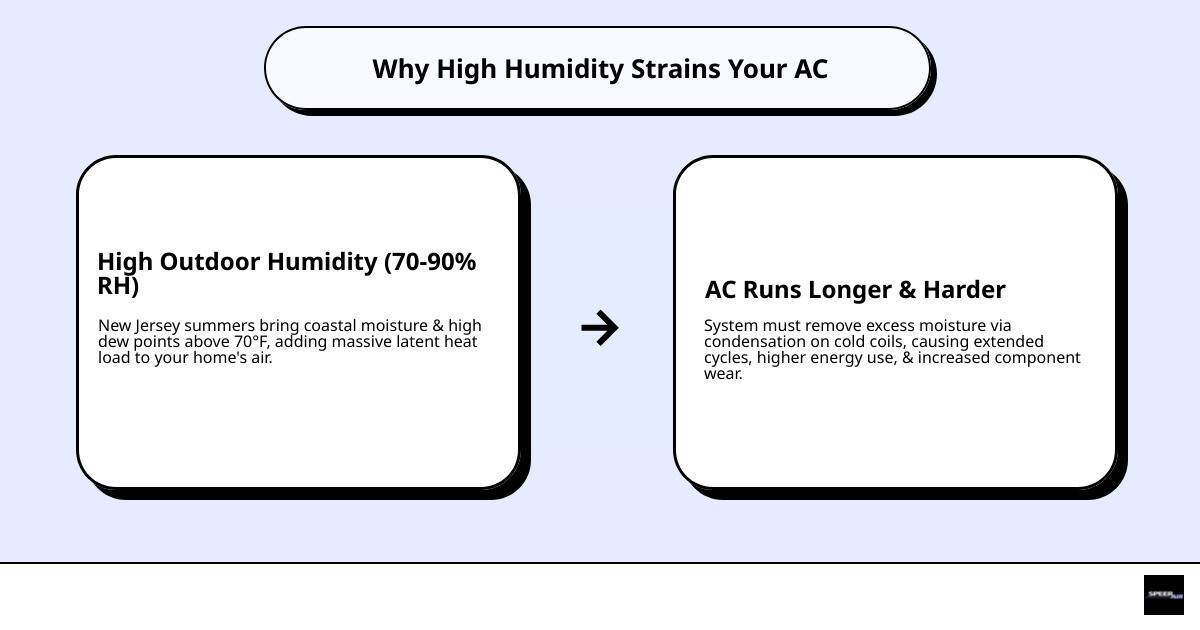
How New Jersey Humidity Makes Your AC Work Harder
To understand the strain on your system, we have to look at the difference between “sensible heat” and “latent heat.” Sensible heat is what you see on your thermometer—the actual temperature of the air. Latent heat is the energy held by the moisture in that air. In New Jersey, the latent load is often what pushes a system over the edge.
The science behind how new jersey humidity makes your ac work harder
When your air conditioner runs, the evaporator coil becomes extremely cold. As warm, moist air from your home is pulled across this coil, the moisture condenses into liquid water—much like beads of sweat forming on a cold glass of iced tea on a July afternoon in Rockaway. This water drips into a drain pan and is channeled outside.
However, removing this moisture requires energy. If the air is incredibly humid, the AC spends a massive portion of its energy just turning vapor into liquid before it can even begin to drop the air temperature. This is why how new jersey humidity makes your ac work harder is primarily a story of “latent load.” When the dew point (the temperature at which air becomes saturated) stays above 70°F, your AC has to work overtime just to keep up with the condensation process.
Why 72°F can still feel sticky indoors
Have you ever set your thermostat to 72°F, only to find yourself still feeling “clammy”? This is the “comfort gap.” High relative humidity (RH) prevents your sweat from evaporating off your skin, which is your body’s natural cooling mechanism. Even if the air is technically cool, if the RH is above 60%, you’ll feel muggy and uncomfortable. This often leads homeowners to turn the thermostat even lower, forcing the AC into even longer runtimes and higher energy consumption.
What makes Northern New Jersey homes especially vulnerable
From Bergen County down to Union County, our geography plays a major role. We are caught between the humid Atlantic air and inland summer storms. Additionally, many homes in our service area—including older residences in Essex and Hudson counties—feature basements that naturally hold dampness. Infiltration through older window seals and duct leakage (which can lose up to 30% of cooled air) allows that heavy Jersey air to seep in, constantly replenishing the moisture your AC is trying to remove.
What Indoor Humidity Should Be and When It Becomes a Problem
Humidity isn’t just a comfort issue; it’s a health and structural issue. Knowing the numbers is the first step to taking control of your indoor environment.
Ideal humidity levels for comfort, health, and AC performance
According to the Mayo Clinic and industry standards, the “sweet spot” for indoor humidity is between 30% and 50%.
- Below 30%: The air is too dry, leading to itchy skin and respiratory irritation.
- Above 50%: You enter the danger zone for mold growth and dust mite infestations. Staying within this range allows your AC to cycle efficiently and ensures you get the best possible sleep and indoor air quality.
Signs your house is too humid even with the AC running

You don’t always need a hygrometer to tell you there’s a problem. Watch for these red flags:
- Foggy Windows: Condensation on the inside of your glass.
- Musty Odors: That “old basement” smell in your living areas.
- Damp Walls or Surfaces: Feeling a slight tackiness on wooden furniture or drywall.
- Sweaty Vents: Visible water droplets forming around your AC registers.
- Sticky Skin: Feeling like you need a shower five minutes after stepping inside.
Health and home damage risks from uncontrolled moisture
When humidity stays high, it does more than make you sweat. It can cause wooden floors to warp and rot, and paint to peel. More importantly, it impacts your health. High humidity is a breeding ground for bacteria, mold, and dust mites, which are major triggers for asthma and allergies. To learn more about protecting your breathing space, check out our guide on Indoor Air Quality Rockaway NJ.
The AC Problems Humidity Exposes Faster
Humidity is like a stress test for your HVAC system. If there is a small, underlying problem, the heavy moisture of a Jersey July will find it.
How new jersey humidity makes your ac work harder when the system is oversized
It sounds counterintuitive, but a “bigger” AC isn’t always better. If your AC is too large for your home, it will “short-cycle.” It cools the air so quickly that the thermostat hits the target temperature and shuts the system off before the AC has had enough time to remove the moisture. This results in the “70 and 70” problem: a home that is 70 degrees but 70% humidity. You end up cold and clammy, and your system wears out faster from constant stopping and starting.
Small issues that become big in humid weather
- Dirty Evaporator Coils: If your coils are covered in dust, they can’t effectively “grab” the moisture from the air. This can lead to the moisture freezing, creating an ice block that kills airflow.
- Refrigerant Leaks: Low refrigerant levels mean the coils don’t get cold enough to reach the dew point, leaving the air humid.
- Blocked Condensate Drains: With the high volume of water being pulled from NJ air, a tiny clog in your drain line can quickly lead to a backup and water damage in your home.
Duct leaks and thermostat settings that sabotage dehumidification
If your ductwork has leaks, it can pull in humid air from attics or crawlspaces, bypassing the cooling process entirely. Furthermore, check your thermostat fan setting. If the fan is set to “ON” instead of “AUTO,” the fan keeps blowing even after the cooling cycle ends. This blows air over the wet evaporator coil, evaporating all the water the AC just collected right back into your home.
When humidity means your AC may need professional attention
If your vents are blowing warm air, your registers are dripping, or your home stays stubbornly muggy despite the AC running 24/7, it’s time for an expert look. You can find more details on why your system might be struggling at Why is My AC Not Cooling My Rockaway Home or schedule a professional AC Service Rockaway NJ to get things back on track.
How to Reduce Indoor Humidity and Ease the Load on Your AC
While your AC is the primary tool for moisture removal, you can help it out with a few simple habits and maintenance steps.
DIY steps homeowners can start today
- Use Exhaust Fans: Always run the fan during and for 15 minutes after a shower or while cooking on the stove.
- Cover Your Pots: Boiling water adds massive amounts of steam to the air; keep lids on.
- Check Your Vents: Ensure furniture isn’t blocking airflow, and keep interior doors open to allow the AC to pull air from every corner of the house.
- Manage Your Plants: Overwatering indoor plants can actually increase indoor humidity.
- Ceiling Fans: While they don’t lower humidity, they create a wind-chill effect that makes you feel cooler at higher temperatures.
Maintenance habits that help your AC remove more moisture
The cleaner your system, the better it handles moisture.
- Change Filters Monthly: A clogged filter restricts airflow, preventing the AC from “seeing” the humid air it needs to treat.
- Clean the Coils: Annual professional cleaning ensures maximum heat and moisture transfer.
- Clear the Drain Line: Ensure water is flowing freely out of the system.
Regular checkups are vital in New Jersey. Learn more about AC Maintenance Rockaway NJ and The Importance of Regular AC Service in Rockaway to ensure your system is ready for the peak of summer.
When a whole-home dehumidifier makes sense
Sometimes, even a perfectly maintained AC can’t keep up with New Jersey’s 90% humidity days. If your basement is always damp or your home feels sticky despite a new AC, a whole-home dehumidifier is the gold standard. Unlike portable units that only clear one room and need constant emptying, these systems integrate with your HVAC to pull gallons of water from the air every day, automatically draining it away.
Explore your options for a Dehumidifier Rockaway NJ or read our guide on how to Deal with Excessive Humidity Despite Running AC.
Long-Term Solutions for New Jersey Homes With Persistent Humidity
If you’re tired of the annual battle with “the stickies,” it’s time to look at the bigger picture of your home’s performance.
Why proper AC sizing matters as much as AC power
When it’s time for a replacement, we perform what’s called a Manual J Load Calculation. This looks at your home’s square footage, insulation, and window types to ensure the AC is sized perfectly. A correctly sized unit will run long enough to thoroughly dehumidify without wasting energy or short-cycling.
Professional fixes that solve humidity at the source
- Duct Sealing: Stopping the “leaks” that let humid attic air in.
- Airflow Balancing: Ensuring every room gets the right amount of treated air.
- Advanced Filtration: Upgrading to systems that handle both moisture and particulates.
Building a humidity-control plan for your home
A whole-home approach involves monitoring your RH levels with a simple hygrometer and scheduling seasonal checkups. By sealing attic leaks and managing basement moisture, you create a “tight” envelope that makes your AC’s job significantly easier.
Frequently Asked Questions About How New Jersey Humidity Makes Your AC Work Harder
Why does my AC run all day when it’s humid outside?
It’s likely because the system is struggling with the “latent load.” It has to remove the moisture before it can effectively lower the temperature. On a very humid day, the moisture removal process can take hours, leading to much longer cycles.
Is 60% indoor humidity too high in summer?
Yes. While it might feel okay to some, 60% is the threshold where mold begins to thrive. Ideally, you want to keep your home between 30% and 50% for maximum comfort and system efficiency.
Should I repair my AC or add a dehumidifier?
It depends on the cause. If your AC is failing to reach the target temperature, it needs a repair. However, if your home is cool but still damp, your AC may be oversized or simply outmatched by the local climate, making a whole-home dehumidifier the better solution.
Conclusion
Living in Northern New Jersey means accepting the beauty of our summers—and the humidity that comes with them. Understanding how new jersey humidity makes your ac work harder is the key to maintaining a comfortable, healthy home. From simple DIY tips like using exhaust fans to long-term solutions like whole-home dehumidification, you have the power to take the “sweat” out of summer.
At Speer Air, we’ve been helping New Jersey families stay comfortable since 1900. Whether you’re in Morris, Sussex, or Passaic County, our NATE-certified technicians are here to help you find the perfect balance of temperature and humidity. Don’t let the Jersey stickiness win—contact us today to learn more about a dehumidifier Rockaway NJ and take back your summer comfort.