

What Are the Most Common AC Repairs and What Causes Them?
Understanding the most common AC repairs and what causes them can save you from a miserable summer in Rockaway — and a much bigger repair bill down the road. In fact, research shows that 9 out of 10 central air units that stop cooling properly trace back to a single, fixable problem: a dirty air filter. Yet every cooling season, homeowners across Northern New Jersey are caught off guard when their system suddenly fails during the hottest stretch of the year.
Here is a quick overview of the most common AC repairs and their primary causes:
| AC Repair | Primary Cause |
|---|---|
| Bad capacitor | Heat stress, power surges, age-related wear |
| Dirty or frozen evaporator coil | Restricted airflow from clogged filters |
| Refrigerant leak | Corrosion, vibration, or physical damage to lines |
| Clogged condensate drain | Algae, mold, and debris buildup |
| Compressor failure | Low refrigerant, short cycling, or overheating |
| Blower motor failure | Dust buildup, electrical faults, worn bearings |
| Tripped circuit breaker | Electrical overload or failing components |
| Thermostat issues | Dead batteries, wrong settings, sensor displacement |
AC problems rarely appear out of nowhere. Most failures build slowly over months — sometimes years — of small maintenance lapses. A filter that goes unchanged too long, a drain line that gets ignored, or a capacitor quietly weakening under summer heat stress can each spiral into a costly emergency call. The good news is that knowing what to look for puts you ahead of most breakdowns before they happen.
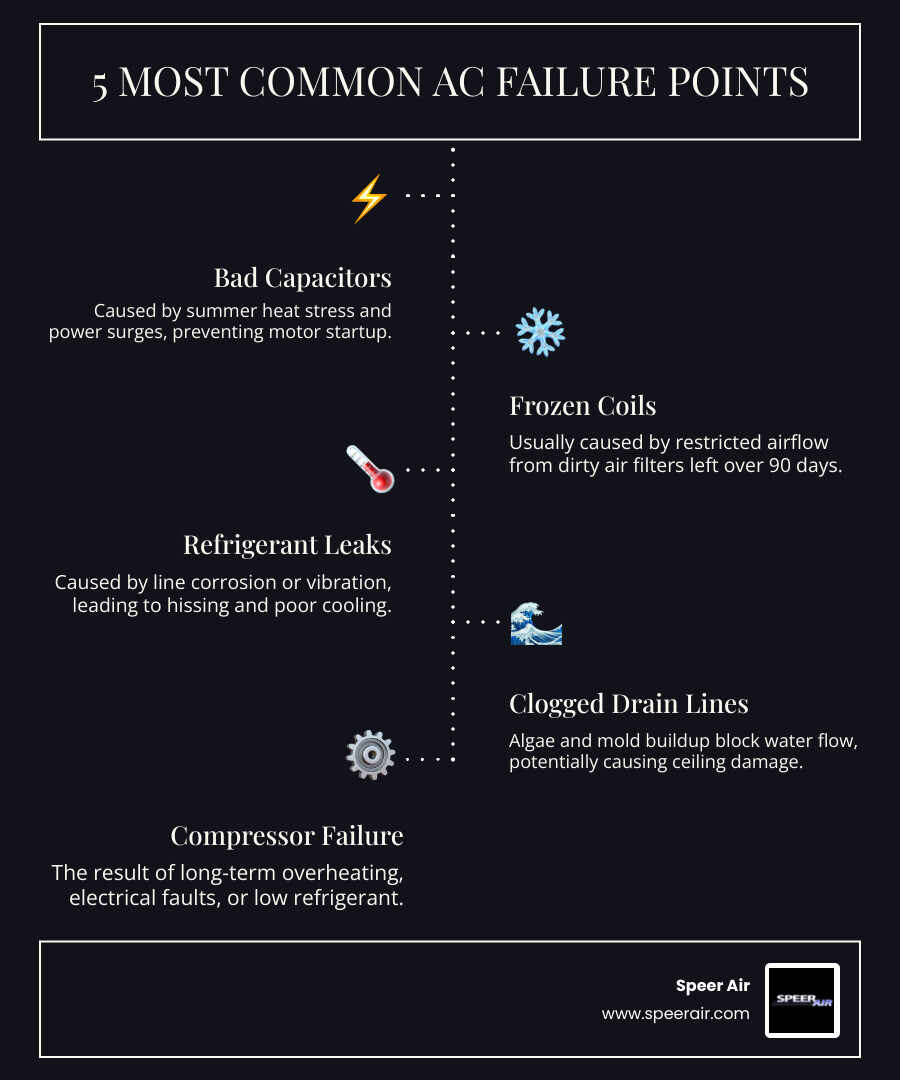
The Most Common AC Repairs and What Causes Them
When we look at recurring AC service problems in Rockaway and across Northern New Jersey, a pattern shows up fast: most breakdowns come from heat stress, electrical wear, airflow restriction, moisture problems, and plain old neglect. In other words, your AC is a bit like a marathon runner forced to sprint in July while breathing through a straw.
The most frequent homeowner AC repairs usually include:
- Capacitor replacement
- Frozen or dirty evaporator coil service
- Refrigerant leak repair
- Condensate drain cleaning
- Compressor-related repairs
- Blower motor or condenser fan motor repairs
- Thermostat and electrical control issues
- Circuit breaker and power-related faults
Many of these problems announce themselves before total failure. Weak airflow, warmer supply air, rising humidity, odd noises, or frequent shutdowns are all warning signs. If you want a fuller checklist, our guide on top signs you need air conditioning repair is a good next read.
Electrical Failures and Bad Capacitors as Most Common AC Repairs and What Causes Them
Bad capacitors deserve special attention because they are one of the most common AC repairs homeowners face. In tracked service data from the research, bad capacitors accounted for 52 out of 242 repair calls, or 21.5 percent. That is a big share for one small part.
A capacitor stores and delivers the electrical jolt needed to start and run the compressor and fan motors. When it weakens, your system may struggle to start, hum without fully turning on, or shut down unexpectedly.
Common causes of capacitor failure include:
- High outdoor temperatures
- Repeated power surges
- Age and normal electrical wear
- Long run times during heat waves
- Dirty coils that force the system to work harder
In Rockaway summers, heavy cooling demand can push aging electrical parts over the edge. A capacitor may work fine one day and fail the next, which is why homeowners often describe this repair as “sudden.” In reality, it was usually fading for a while.
Warning signs of capacitor trouble include:
- AC will not start
- Outdoor unit hums or clicks
- System starts, then shuts off quickly
- Fan runs slowly
- Breaker trips without a clear reason
Because capacitors hold a charge even after power is cut, this is not a safe DIY repair. If your AC is repeatedly tripping power, read why AC might be tripping your circuit breaker and then call for service rather than trying to force the unit back on.
Airflow Restrictions and the 30-90 Day Filter Rule
Airflow problems are the silent troublemakers of air conditioning. A clogged filter can start as a minor issue and end as a frozen coil, blower strain, poor humidity control, or even compressor damage.
That is why the 30-90 day filter rule matters so much:
- Check your filter monthly
- Replace it every 30 to 90 days depending on filter type, pets, dust levels, allergies, and system use
- Replace it sooner if it looks dirty or light cannot pass through it easily
This single habit helps prevent one of the most common causes of poor cooling. Research shows neglected AC systems can lose 5 to 15 percent efficiency per year. Restricted airflow is a major reason why.
Dirty filters cause problems by:
- Reducing the volume of air moving across the evaporator coil
- Making the blower motor work harder
- Lowering system efficiency
- Allowing the coil to get too cold and freeze
- Increasing wear on motors and controls
One important note: higher MERV filters are not always better if your system was not designed for them. A filter with too much resistance can choke airflow just like a dirty one. We recommend sticking with the manufacturer-recommended range and asking during maintenance if you are unsure.
If your AC is running but not cooling well, always start with the filter. Seriously, before blaming the thermostat, weather, or Mercury being in retrograde, check the filter. Our article on why your AC is blowing warm air walks through this in more detail.
Mechanical Issues: Refrigerant Leaks and Frozen Coils
Mechanical problems often show up as comfort complaints first: weak cooling, longer run times, high indoor humidity, or ice on the line set. Two of the most common are refrigerant leaks and frozen evaporator coils, and they are often connected.
Your evaporator coil is where indoor heat is absorbed. If airflow drops too low or refrigerant charge is off, coil temperature can plunge below freezing. Moisture on the coil turns to ice, and cooling performance falls even further. Left alone, this can stress or damage the compressor.
Our guide on solutions for frozen evaporator coils in an AC system explains the problem in more depth.
Identifying Refrigerant Leaks and What Causes Them
Refrigerant does not get “used up” like gas in a car. If your system is low, there is almost always a leak that must be found and repaired. Simply topping it off without fixing the leak is a temporary bandage, not a solution.
Common causes of refrigerant leaks include:
- Coil corrosion
- Vibration that loosens connections over time
- Physical damage to refrigerant lines
- Factory or installation defects
- Age-related wear in joints and tubing
In older equipment, corrosion is a frequent cause. Moisture, contaminants, and years of operation can slowly eat away at copper tubing. Once a leak starts, cooling drops, energy use rises, and the compressor may overheat from improper pressures.
Signs of a refrigerant leak include:
- Hissing or bubbling sounds
- Sweet or chemical-like odor
- Ice on the evaporator coil or refrigerant lines
- AC runs longer but cools less
- Indoor air feels clammy or humid
- Higher electric bills without better comfort
As of May 2026, the old R-22 era is fully behind us, and equipment and refrigerant standards continue to change. R-410A systems are also part of a broader industry transition toward lower-impact refrigerants such as R-32 in newer equipment. For homeowners, the key takeaway is simple: refrigerant work is technical, regulated, and absolutely not a DIY project.
If you suspect a leak, see AC refrigerant leak issues in your home and schedule professional service.
Compressor Failure and Unusual Noises
The compressor is the heart of the cooling cycle, and when it fails, the repair is usually serious. Compressors often do not fail randomly. They are commonly damaged by other unresolved problems, such as:
- Low refrigerant from a leak
- Dirty or frozen coils
- Short cycling
- Electrical faults
- Overheating from restricted airflow
- Failed capacitors or contactors
This is why early action matters. Ignoring a dirty filter or low refrigerant condition can set off a chain reaction that ends with compressor damage.
Listen for noises that suggest mechanical or electrical trouble:
- Hissing can indicate a refrigerant leak
- Clicking can point to relays or electrical controls
- Buzzing may signal capacitor or contactor trouble
- Rattling can mean loose parts or debris
- Grinding or screeching can indicate worn motor bearings
- Banging or clanking may point to internal compressor damage
Short cycling is another red flag. A normal AC cycle often runs roughly 15 to 20 minutes under typical load. If your system starts and stops in quick bursts, it may be overheating, oversized, low on refrigerant, or dealing with electrical control problems. That repeated restarting is hard on the compressor. Learn more in why AC might be short cycling and how to fix it and why AC compressor might be making loud noises.
Drainage Problems and Environmental Factors in Rockaway
Not every AC problem is about cooling output. Some are about water, and water can damage a home surprisingly fast.
As your AC removes humidity from indoor air, condensate drains away through a line and pan. When that drainage path gets blocked, water can back up into the system or overflow into surrounding areas. In basements, attics, closets, or utility spaces, that can mean stained ceilings, damaged drywall, soaked flooring, or mold growth.
Rockaway and Northern New Jersey homes deal with seasonal humidity, pollen, dust, and organic growth that can all contribute to drainage trouble. Add in long cooling cycles and dark, damp drain lines, and you have a perfect environment for slime, algae, and debris buildup.
Our article on fixing water leaks from your AC unit covers common leak sources.
Clogged Condensate Drain Lines and Home Damage
A clogged condensate drain line is one of the most common service calls because it is both frequent and preventable. The main causes include:
- Algae growth
- Mold or biofilm buildup
- Dust and dirt washed off the coil
- Rust or sediment from older components
- Infrequent maintenance
- Improper drain slope or installation issues
When the line clogs, homeowners may notice:
- Water around the indoor unit
- Musty odors
- AC shutting off unexpectedly
- Overflow from the drain pan
- Stains on ceilings or walls near the system
- Increased indoor humidity
Many systems include protective components such as a float switch or secondary drain pan. These can help reduce the chance of major overflow, but they are not substitutes for cleaning the line and correcting the cause.
This is one reason regular maintenance matters so much. Drain problems often begin small and hidden, then become obvious only after moisture has already escaped where it should not.
For more detail, read solutions for AC drain line clogs at home.
Troubleshooting and Prevention Strategies for Homeowners
The best AC repair is the one you never need. A little preventive care can stop many of the most common failures before they start. Research consistently shows that regular maintenance is the most effective way to extend system life, potentially taking a cooling system from around 12 years to as much as 20 years in favorable conditions.
Here are the homeowner checks we recommend first:
- Confirm the thermostat is set to cool and below room temperature
- Replace thermostat batteries if needed
- Check the air filter
- Make sure supply vents and return grilles are open and unobstructed
- Check the breaker once if the system will not start
- Clear leaves, grass, and debris from around the outdoor unit
- Gently rinse the outdoor coil with a garden hose if visibly dirty and power is off
- If the coil is frozen, turn cooling off and let it thaw completely
Also remember that neglected systems can lose efficiency year after year. Even if the unit still runs, it may be cooling less effectively while using more energy and putting extra strain on expensive components.
Safe DIY Checks vs. Professional Intervention
Some troubleshooting is safe for homeowners. Some definitely is not.
Safe homeowner checks:
- Thermostat settings
- Thermostat batteries
- Filter inspection and replacement
- Basic breaker check
- Clearing plant growth and debris around the outdoor unit
- Making sure vents are not blocked by rugs, furniture, or curtains
Call a professional for:
- Refrigerant leaks or low charge
- Capacitor replacement
- Electrical wiring issues
- Repeated breaker trips
- Compressor problems
- Persistent water leaks
- Frozen coils that keep returning
- Burning smells, buzzing, or sparking
- Control board and motor diagnostics
Why the line is so firm here: AC systems contain high-voltage electricity and pressurized refrigerants. Mishandling either can injure you, damage the equipment, or create legal problems. Refrigerant handling is regulated, and electrical compartments can remain dangerous even after the unit is shut off. This is exactly why we tell homeowners: do the simple checks, but don’t be a hero and call a professional for these AC issues.
The $5,000 Rule for Repair vs. Replace
A common homeowner guideline for repair-versus-replace decisions is the “$5,000 rule.” Multiply the age of the unit by the estimated repair amount. If the result approaches or exceeds 5,000, replacement often deserves serious consideration.
Even without discussing exact pricing, the principle is useful. If you have an older system and a major repair is pending, it may make more sense to invest in a new, high-efficiency unit rather than keep pouring money into aging equipment.
Use this rule alongside a few practical questions:
- Is the unit around 12 years old or older?
- Has it needed multiple repairs recently?
- Is it using obsolete or harder-to-source refrigerant?
- Are your utility bills rising?
- Does the system struggle with comfort or humidity?
- Is the repair tied to a major component like the compressor or coil?
Well-maintained systems can last much longer than neglected ones, but age still matters. Newer high-efficiency systems with improved SEER2 performance can deliver better comfort, lower energy use, and more reliable operation.
Here is a simple comparison framework:
| Situation | Repair May Make Sense | Replacement May Make Sense |
|---|---|---|
| System age | Relatively newer | Older and near end of service life |
| Repair history | First major repair | Repeated breakdowns |
| Problem type | Isolated minor component | Major component failure |
| Efficiency | Still performing well | Declining performance and higher energy use |
| Refrigerant | Supported system | Outdated platform or recurring leak issues |
If you are unsure, we can inspect the system and give you an honest recommendation based on condition, age, and overall reliability.
Frequently Asked Questions about AC Repairs
Why is my AC running but not cooling the house?
Start with the air filter. Research indicates that most central AC systems that are not cooling properly trace back to a dirty filter. After that, check thermostat settings, open vents, breaker status, and outdoor unit airflow. If those look fine, common causes include a frozen evaporator coil, low refrigerant, dirty condenser coils, or compressor trouble.
How do I know if my AC has a refrigerant leak?
Common signs include hissing or bubbling noises, ice on the refrigerant lines or coil, longer cooling cycles, weak cooling, and indoor air that feels damp or sticky. Some homeowners also notice an unusual sweet or chemical smell. Because refrigerant should not need routine refilling, low charge usually means a leak that needs professional repair.
Can I run my AC with a frozen evaporator coil?
No. Running an AC with a frozen coil can damage the compressor. Turn the system off and allow the coil to thaw fully. In many cases, switching the thermostat to fan-only can help speed the thaw. Then address the root cause, which is often a dirty filter, blocked airflow, blower problem, or refrigerant issue.
Conclusion
Understanding the most common AC repairs and what causes them helps you catch small issues before they grow into major breakdowns. In Rockaway and throughout Northern New Jersey, the biggest troublemakers are usually familiar ones: dirty filters, weak capacitors, refrigerant leaks, frozen coils, clogged drain lines, and electrical faults.
The good news is that many of these problems are preventable with regular maintenance and quick attention to warning signs. Since 1900, we have built our reputation on helping local homeowners stay comfortable with dependable HVAC service backed by deep experience. As a NATE-certified team and Carrier Factory Authorized Dealer, we know how to diagnose problems accurately and recommend the right fix.
If your AC is blowing warm air, making odd noises, leaking water, tripping breakers, or short cycling, do not wait for a full shutdown in the middle of summer. Schedule your professional AC repair today.