

Why Knowing How to Choose the Right Water Heater for Your Home Saves You Money and Cold Mornings
Knowing how to choose the right water heater for your home is one of the most practical decisions you can make as a homeowner. Water heating accounts for roughly 18% of your household’s energy use — making it the second-largest energy expense after heating and cooling. Yet most people only think about their water heater when it stops working, which is exactly the worst time to make a rushed decision.
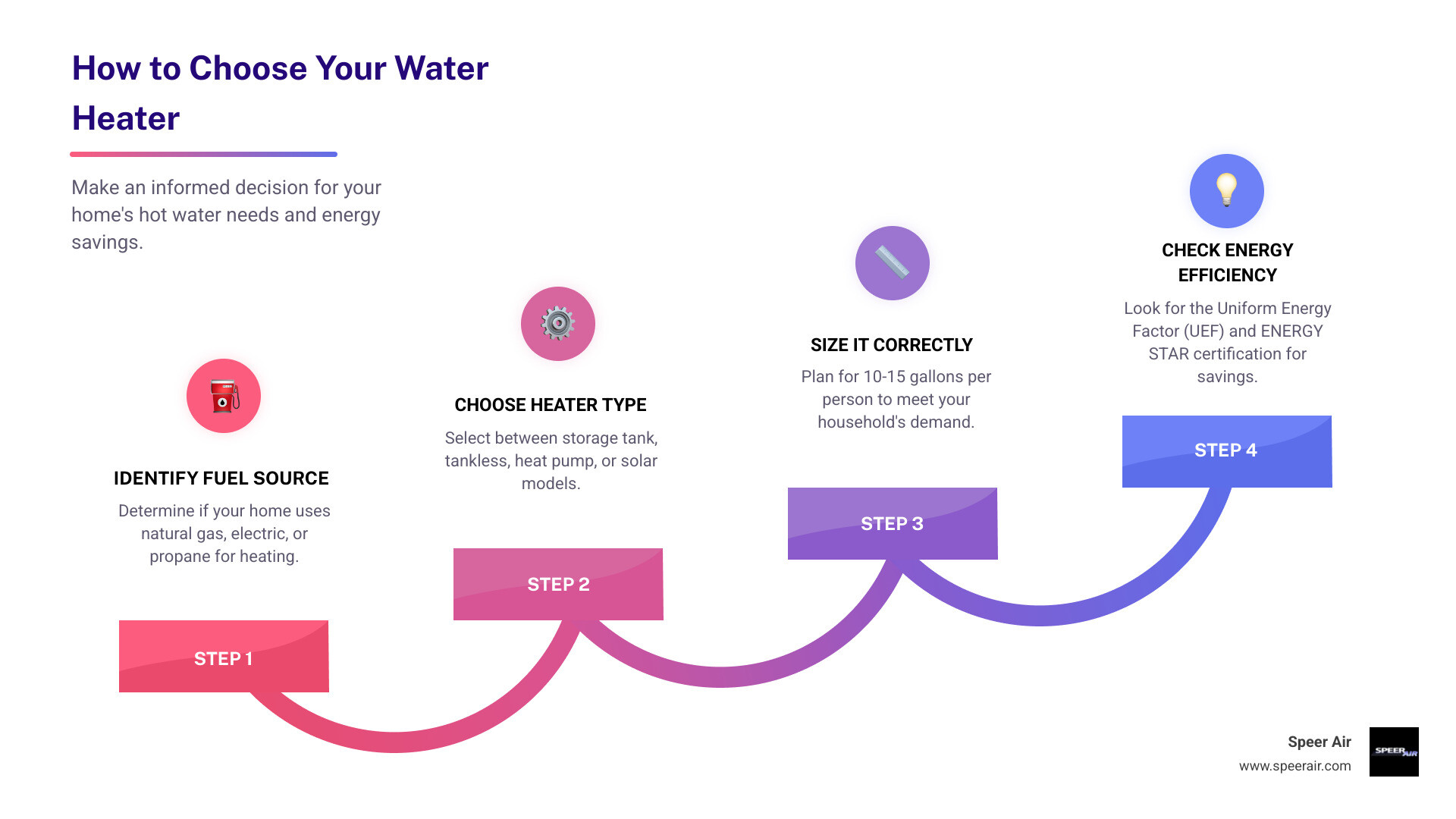
Here is a quick guide to help you choose the right water heater:
- Identify your fuel source — natural gas, electric, or propane
- Choose your heater type — storage tank, tankless, heat pump, or solar
- Size it correctly — plan for 10 to 15 gallons per person in your household
- Check energy efficiency — look for the Uniform Energy Factor (UEF) and ENERGY STAR certification
- Compare long-term costs — a higher upfront cost can mean lower monthly bills
- Plan for installation needs — some types require electrical upgrades or extra space
- Replace proactively — don’t wait for a leak or flood to start shopping
Whether you are replacing a failing unit or planning ahead for your Northern New Jersey home, this guide walks you through everything you need to make a confident, informed choice.
Comparing Storage Tank vs. Tankless Systems

When you start looking into how to choose the right water heater for your home, the first big fork in the road is deciding between a traditional storage tank and a tankless system. It is the classic debate of “ready now” versus “ready on demand.”
Storage tank water heaters are the most common sight in basements from Morris County, NJ, to Easton, PA. These units keep a large reservoir of water (typically 30 to 80 gallons) heated at all times. The upside? You have a large volume of hot water ready the moment you turn the tap. The downside is “standby energy loss.” Because the tank is constantly reheating the water to maintain a set temperature, you are paying to heat water even while you’re asleep or at work.
Tankless water heaters, on the other hand, eliminate the tank entirely. They use high-powered burners or electric elements to heat water instantly as it flows through the unit. This on-demand heating means you aren’t wasting energy on standby mode. For many homeowners, Tankless Water Heaters and Their Benefits include a significant reduction in monthly energy bills and a much smaller physical footprint.
| Feature | Storage Tank Water Heater | Tankless Water Heater |
|---|---|---|
| Lifespan | 10–15 Years | 20+ Years |
| Energy Efficiency | Lower (due to standby loss) | Higher (heats on demand) |
| Upfront Cost | Lower | Higher |
| Space Required | Large (needs floor space) | Small (wall-mounted) |
| Hot Water Supply | Limited to tank size | Continuous (endless) |
Benefits of Tankless Technology
The most famous perk of tankless technology is the “endless shower.” If you have a large family in Essex County or frequently host guests in Sussex County, you know the pain of being the fourth person in line for the shower only to find the water is lukewarm. Tankless systems provide continuous hot water because they don’t rely on a finite tank.
Additionally, tankless units are incredibly space-efficient. They are roughly the size of a small suitcase and are usually mounted on a wall, freeing up valuable floor space in your utility room or basement. However, they do require specialized care. If you live in an area with hard water, annual descaling is a must to keep the heat exchanger from clogging. If yours starts acting up, you’ll want to look into Tankless Water Heater Repair Rockway NJ to ensure the sensitive components are handled by experts. When you’re ready to make the switch, professional Tankless Water Heater Installation – Maplewood, NJ is essential, as these units often require specific venting and gas line upgrades.
How to Choose the Right Water Heater for Your Home: Fuel and Efficiency
Your home’s existing infrastructure often dictates your fuel choice. In our service areas like Union County, NJ, and the Lehigh Valley in PA, most homes run on natural gas, electricity, or propane.
- Natural Gas: Generally, gas water heaters cost about half as much to run as standard electric models. They also have a faster recovery rate, meaning they can heat a tank of water much quicker than an electric element.
- Electricity: While electric units are often cheaper to buy upfront, they can be more expensive to operate over time. However, they are highly efficient at the point of use and don’t require venting.
- Propane: Common in more rural areas like Dingmans Ferry or parts of Hunterdon County, propane offers similar performance to natural gas but requires a storage tank on your property.
- Solar Energy: While less common in the Northeast due to our cloudy winters, solar water heaters can be a great supplement to reduce energy costs, though they usually require a backup gas or electric system.
When comparing models, always look for the Uniform Energy Factor (UEF). This is the current standard for measuring water heater efficiency; the higher the number, the more efficient the unit. We always recommend looking for the ENERGY STAR label, as these models meet strict federal guidelines for energy savings. If you are looking to maximize your home’s value and efficiency, you might Upgrade Your Home with Tankless Water Heater technology to take advantage of the highest UEF ratings available in 2026.
High-Efficiency Heat Pump and Hybrid Models
As we move through 2026, heat pump water heaters (also called hybrid models) are becoming the gold standard for electric-powered homes. Instead of creating heat through resistance (like a toaster), these units pull heat from the surrounding air and move it into the tank.
This technology is incredibly efficient — often 2 to 4 times more efficient than a standard electric tank. In fact, models like the Rheem ProTerra can be up to 5X as efficient as standard units. They also provide a “dehumidification” benefit, which is great for damp New Jersey basements. For those in Rockaway or Maplewood, exploring Tankless Water Heater Services Rockaway NJ or hybrid installations can lead to massive long-term savings, especially with the 2029 Department of Energy standards on the horizon that will favor these high-efficiency technologies.
Sizing and Capacity: Finding the Perfect Fit
Getting the size right is the “Goldilocks” challenge of water heating. Too small, and you’re shivering in the shower; too large, and you’re paying to heat water you never use.
For tank-style heaters, the key metric is the First-Hour Rating (FHR). This tells you how many gallons of hot water the unit can deliver in one hour starting with a full tank. For tankless units, we look at Gallons Per Minute (GPM), which determines how many fixtures can run simultaneously. If you have a large home in Water Heater Rockaway NJ with a soaking tub and three bathrooms, you’ll need a much higher GPM or FHR than a small condo in Jersey City.
Sizing: How to Choose the Right Water Heater for Your Home Capacity
A general rule of thumb for storage tanks is to account for 10 to 15 gallons of capacity per person.
- 1-2 People: 30–40 gallons
- 3-4 People: 40–50 gallons
- 5+ People: 80 gallons
However, you must consider your “peak demand” times. If everyone in your house showers at 7:00 AM while the dishwasher is running, your peak demand is high. In these cases, a tankless unit might be better, or you may need to size up your tank. Professional Water Heater Installation Rockway NJ involves a “peak hour” calculation to ensure your system can handle your family’s busiest hour of the day. Whether it’s a new build or a replacement, getting an expert Water Heater Installation – Maplewood, NJ ensures that your unit is calibrated for your specific household flow.
Maintenance, Lifespan, and When to Replace
A water heater is a “set it and forget it” appliance until it isn’t. To get the most out of your investment, regular maintenance is non-negotiable.
The biggest enemy of your water heater is sediment buildup. In many parts of Northern NJ and Eastern PA, hard water minerals can settle at the bottom of the tank, creating an insulating layer that makes the burner work harder and eventually burns out the tank. We recommend flushing your tank at least once a year to remove this “sludge.”
Another critical component is the sacrificial anode rod. This magnesium or aluminum rod hangs inside the tank and attracts corrosive elements so they eat the rod instead of the tank walls. Checking this rod every few years can double the life of your heater. Don’t forget the Temperature and Pressure (T&P) valve, which is a vital safety feature that prevents the tank from exploding if the pressure gets too high. For homeowners who aren’t comfortable doing this themselves, Water Heater Maintenance Rockway NJ and Water Heater Maintenance – Maplewood, NJ services are available to keep your system running safely and efficiently.
Signs You Need to Know How to Choose the Right Water Heater for Your Home Replacement
How do you know when the end is near? If you notice a Water Heater Leaking Rockway NJ, that is often a sign of internal tank corrosion that cannot be repaired. Other red flags include:
- Rusty Water: If your hot water looks like tea, the inside of your tank or your pipes may be rusting.
- Strange Noises: Popping, banging, or knocking sounds are signs of heavy sediment buildup.
- Age: If your tank is over 10-12 years old, it’s living on borrowed time.
- Lack of Hot Water: If your showers are getting shorter and shorter, the heating elements or the dip tube may be failing.
If you see these signs, it is time to look into Water Heater Replacement – Maplewood, NJ. Catching a failing unit early prevents the “emergency flood” scenario that ruins basements. If you are lucky, a simple Water Heater Repair – Maplewood, NJ might solve the problem, but we always advise weighing the repair cost against the age of the unit.
Frequently Asked Questions
What is the average lifespan of a modern water heater?
Standard storage tank water heaters typically last between 10 and 15 years. Tankless models are much more durable, often lasting 20 years or more because they don’t hold standing water that causes corrosion. However, these lifespans depend heavily on water quality and maintenance. If you live in an area with very hard water and never flush the tank, you might only get 8 years out of a unit. If you’re nearing that decade mark, it’s wise to start browsing for a Water Heater Replacement Rockway NJ before an emergency strike.
How does a heat pump water heater save energy?
A heat pump water heater doesn’t actually “generate” heat; it “moves” it. Think of it like a refrigerator running in reverse. It pulls heat from the air in your basement or utility room and transfers it into the water tank. Because it’s moving heat rather than creating it through combustion or resistance, it uses a fraction of the electricity. This makes it incredibly efficient, though it does require about 1,000 cubic feet of air space around it to work properly. If your heat pump unit isn’t performing as expected, a quick Water Heater Repair Rockway NJ can often fix sensor or airflow issues.
Why is my water heater making a knocking sound?
That knocking or “kettle” sound is almost always caused by sediment. As minerals like calcium and lime build up on the bottom of the tank, air bubbles get trapped underneath the sediment layer. When the burner turns on, those bubbles “pop” as they heat up, creating that knocking sound. It’s a sign that your heater is struggling and losing efficiency. If you hear this, you should immediately check for a Water Heater Leaking – Maplewood, NJ and schedule a flush. If you have a tankless unit making odd noises, it may need a professional Tankless Water Heater Repair – Maplewood, NJ to clear the heat exchanger.
Conclusion
Choosing the right water heater isn’t just about picking a box from a store; it’s about matching a complex system to your home’s unique needs and your family’s lifestyle. From the historic homes of Middlesex County to the modern builds in Stroudsburg, PA, the right choice can save you thousands of dollars over the next decade.
At Speer Air, we’ve been helping our neighbors stay comfortable since 1900. Our NATE-certified technicians are experts in residential hot water solutions, and as a Carrier Factory Authorized Dealer, we bring a level of precision and care that only a century of experience can provide. Whether you need a high-efficiency hybrid tank, a space-saving tankless system, or a reliable traditional unit, we are here to help you navigate the options.
Don’t wait for a cold shower to tell you it’s time for a change. Schedule your professional water heater consultation today and let us help you find the perfect fit for your home.