

Why Your AC Runs Constantly During Heat Waves (And What It Means)
Why your AC runs constantly during heat waves is one of the most common concerns homeowners in Northern New Jersey deal with every summer — and the answer isn’t always a sign that something is broken.
Quick Answer: The most common reasons your AC runs constantly during a heat wave
| Cause | What’s Happening |
|---|---|
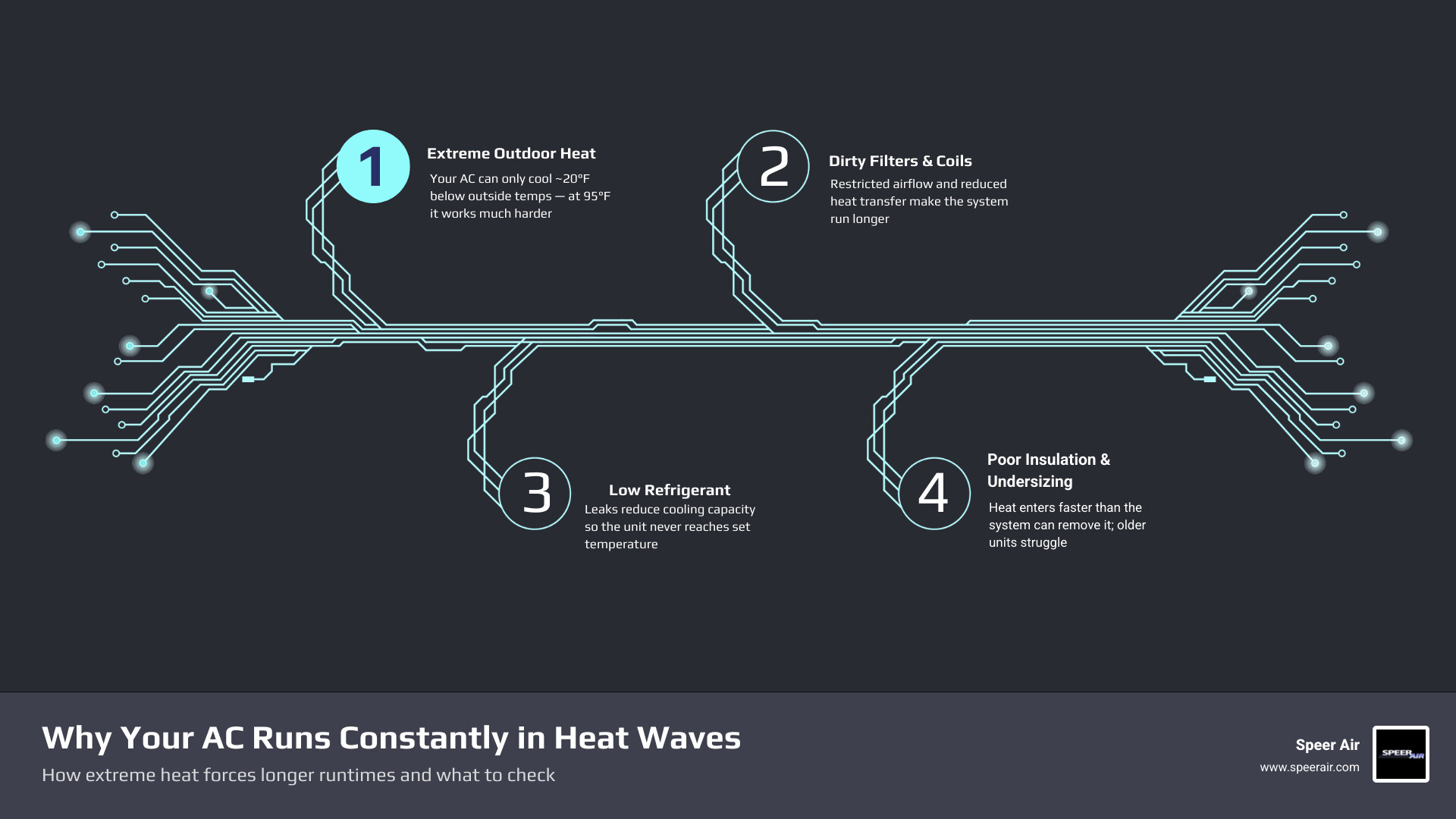
| Extreme outdoor heat | Your AC can only cool about 20°F below outdoor temps — so 95°F outside means your system has to work much harder |
| Dirty air filter | Restricted airflow forces the system to run longer to move the same amount of cool air |
| Dirty or frozen coils | Reduced heat transfer means the system can’t cool efficiently |
| Low refrigerant | A leak reduces cooling capacity, leaving the system running without results |
| Poor insulation or air leaks | Heat enters faster than the AC can remove it |
| Undersized or aging system | The unit was never designed to handle your home’s full cooling load |
| Thermostat placement issues | A poorly placed thermostat reads higher temps and keeps the system running unnecessarily |
During a heat wave, it’s completely normal for an AC to run 12 to 16 hours per day — or even longer during peak afternoon heat when outdoor temperatures climb past 95°F. But there’s an important difference between a system working hard because conditions demand it, and a system running nonstop because something is wrong. When your AC runs constantly but your home still feels hot, humid, or unevenly cooled, that’s a signal worth paying attention to.
In this guide, we’ll walk through what’s normal, what’s not, and what you can do about it — whether you’re in Rockaway, Denville, or anywhere across Morris County and Northern New Jersey.
Is It Normal for Your AC to Run Constantly During Heat Waves?
The short answer is: yes, to a point.
To understand why, we have to look at how air conditioners are designed. Most residential cooling systems are engineered to handle average summer high temperatures, not record-shattering triple-digit heat waves. In the HVAC industry, we use the “20-degree rule.” This means that under normal operating conditions, a properly sized air conditioner is designed to cool your indoor air roughly 15°F to 20°F below the outdoor temperature.
If it is a scorching 98°F afternoon in Morris County, your system is working at its absolute physical limit to keep your living room at 78°F. To maintain that temperature gap, the system will enter what we call “marathon mode,” running almost continuously from midday until late in the evening.
Additionally, if you have a modern system featuring variable-speed compressor technology, continuous operation is actually by design. Unlike older single-stage systems that cycle loudly on and off like a noisy light switch, variable-speed systems can throttle down to 30% to 50% capacity. They run for longer, quieter stretches at a lower speed to maintain a rock-steady temperature and pull excess humidity out of the air.
However, if your system is running 24/7 during milder weather, or if it runs nonstop but the indoor temperature continues to climb, you are likely dealing with an underlying mechanical or structural issue. If you find yourself wondering whether your system’s long cycles are normal, you can learn how to check the vitals of your system in our guide on How to Diagnose Constant AC Running Issues.
Mechanical Causes: Why Your AC Runs Constantly During Heat Waves
When an air conditioner runs nonstop without successfully dropping the temperature, the culprit is often found inside the cabinet. Extreme heat places immense mechanical stress on your system, exposing minor maintenance oversights and turning them into full-blown cooling emergencies.

If your system is running a marathon but only delivering lukewarm air, it is usually struggling with restricted airflow, dirty components, or a lack of cooling power. If you are noticing warm drafts instead of a chilly breeze, you can read our deep dive into The Cold Hard Truth About Why Your AC Is Blowing Warm Air.
To help you figure out if your system is experiencing normal heat-wave stress or a mechanical breakdown, we have put together this comparison table:
| Normal Heat Wave Behavior | Mechanical Problem Indicators |
|---|---|
| Runs for 40+ minutes at a time during the hottest part of the day | Runs 24/7 without ever cycling off, even late at night when it cools down |
| Keeps the indoor temperature within 15–20°F of the outdoor temperature | The indoor temperature steadily rises despite the AC running nonstop |
| Air coming from the supply vents feels cold and crisp | Air coming from the vents feels lukewarm, weak, or humid |
| Indoor humidity remains comfortable (between 45% and 55%) | The air feels muggy and clammy, or you notice water pooling near the indoor unit |
| System hums steadily and quietly | System makes loud rattling, squealing, or whistling noises |
To get to the bottom of these issues, we must look at how airflow restrictions and chemical balances affect the cooling cycle. You can learn more about how air moves through your home in our article on How Airflow Affects Your Air Conditioner’s Performance.
Airflow Restrictions and Clogged Filters
A dirty air filter is the absolute number-one cause of residential AC service calls. When a filter becomes packed with dust, pet dander, and pollen, it acts like a wall. This restriction starves the system of air, driving up the internal static pressure and forcing the blower motor to work twice as hard to push air through your ductwork.
Because less warm air is passing over the cold evaporator coils, the system cannot transfer heat out of your home efficiently. It has to run much longer to achieve the same amount of cooling. If your vents feel like they are barely whispering, check out our guide on Troubleshooting Poor Airflow from HVAC Vents to get things flowing again.
Refrigerant Leaks and Low Levels
There is a common myth that air conditioners “consume” refrigerant over time, much like a car burns gas. In reality, your AC operates on a completely closed loop. The refrigerant simply circulates back and forth, absorbing heat from inside your home and releasing it outdoors.
If your system is low on refrigerant, it means you have a leak. When the refrigerant charge drops, the evaporator coil cannot absorb heat effectively. This drop in pressure causes the coil’s temperature to plummet below freezing, turning any condensation on the coil into solid ice. If you notice ice forming on the brass valves of your outdoor unit or on the indoor cabinet, shut the system off immediately and call a professional to prevent serious compressor damage.
Home and System Factors Forcing Longer Runtimes
Sometimes, your air conditioner is running perfectly, but your home itself is working against it. During a heat wave, your house acts like an oven, absorbing radiant heat from the sun and trapping it inside.
Why Your AC Runs Constantly During Heat Waves in Older or Retrofitted Homes
Here in Northern New Jersey, we are surrounded by beautiful historic properties, mid-century colonials, and classic Victorians in towns like Maplewood, Denville, and Rockaway. While these homes are full of character, they present unique challenges for modern climate control.
Older homes were built long before the era of central air conditioning. They often feature:
- Settled or missing insulation: Over the decades, attic insulation can settle, degrade, or be disturbed, leaving giant thermal gaps that let attic heat (which can easily top 140°F) radiate directly down into your bedrooms.
- Retrofit ductwork limitations: When central air is retrofitted into an older home, installers often have to squeeze ductwork into tight closets, chimneys, or floor cavities. These undersized ducts restrict airflow and create pressure imbalances that trap warm air on upper floors.
- Air leaks and single-pane windows: Drafty old windows and unsealed doors let cool air escape while drawing hot, humid outdoor air inside, forcing your AC into a never-ending battle.
Thermostat Placement and Sizing Issues
Where your thermostat lives matters just as much as how you set it. If your thermostat is installed in a hallway that catches direct afternoon sunlight, or near a heat-producing appliance, it will read an artificially high temperature. It will tell your AC to keep running long after the rest of the house has reached a comfortable temperature.
Even worse is an improperly sized system. If an AC unit is undersized for the property—perhaps because of a home addition or a finished attic that was added without upgrading the HVAC system—it will never be able to keep up during a heat wave. To find the right fit, an HVAC professional must perform a detailed Manual J load calculation, which takes into account your home’s square footage, insulation quality, window surface area, and local climate.
Warning Signs of System Strain vs. Normal Operation
As your AC works overtime, it is important to watch for signs that the system is under dangerous stress. There is a huge difference between an air conditioner that is running a long, healthy cycle and one that is struggling to survive. If your system is rapidly starting and stopping instead of running long cycles, you should read our troubleshooting guide on Why AC Might Be Short Cycling and How to Fix It.
Keep an eye out for these critical warning signs of system strain:
- Lukewarm supply air: If the air coming out of your registers is barely cooler than the room temperature.
- A sudden, unexplained spike in energy bills: While utility bills naturally rise in the summer, a massive, sudden jump often points to a failing compressor or motor.
- Frequent circuit breaker trips: If your AC trips the breaker, it is drawing too much electrical current—a major safety hazard.
- Strange noises: Loud grinding, squealing, or buzzing sounds indicate failing bearings, a bad capacitor, or a dying blower motor.
- Water pooling around the indoor unit: This indicates a clogged condensate drain line, which can lead to water damage and mold.
DIY Steps to Take When Your AC Runs Constantly During Heat Waves
Before you pick up the phone to call in the pros, there are several simple, highly effective steps you can take to ease the burden on your system.
- Change your air filter immediately: If you haven’t changed your filter in the last 30 days, swap it out for a fresh one.
- Clear the outdoor unit: Ensure there is at least two feet of clear space around your outdoor condenser unit. Trim back shrubs, clear away weeds, and gently brush away any grass clippings or leaves clinging to the metal fins.
- Block out the sun: Up to 30% of unwanted heat enters your home through your windows. Close your blinds, curtains, or drapes—especially on south- and west-facing windows—by 10:00 AM to block out the harsh sun.
- Adjust your thermostat expectations: Set your thermostat to 78°F when you are home. Every degree you set it below 78°F can increase your energy usage by up to 8%.
- Limit indoor heat sources: Avoid running your oven, stove, dishwasher, or clothes dryer during the hottest hours of the day (usually between noon and 8:00 PM). These appliances dump massive amounts of heat and humidity directly into your living spaces.
- Use ceiling fans correctly: Ensure your ceiling fans are rotating counter-clockwise to create a cool breeze. Fans cool people, not rooms, so turn them off when you leave the room to save energy.
For our neighbors down in Essex County, we have compiled a specialized list of AC Maintenance Tips for Maplewood Residents to help you keep your historic homes cool all summer long.
Frequently Asked Questions About Constant AC Runtime
Is it bad for the AC compressor to run all day during a heat wave?
As long as your system is well-maintained, has a clean air filter, and has proper airflow, running for extended periods is actually easier on the compressor than starting and stopping. The initial startup of an AC compressor draws a massive amount of electrical current and causes the most mechanical wear and tear. Steady-state, continuous operation is highly efficient and perfectly safe for a healthy system.
What temperature should I set my thermostat to during extreme heat?
The U.S. Department of Energy recommends setting your thermostat to 78°F when you are at home. If you are going to be away for more than eight hours, consider raising it to 82°F or 85°F. Never set your thermostat to an extremely low temperature (like 65°F) in an attempt to cool the house faster; air conditioners cool at the exact same rate regardless of the setting, and this will only force your system to run indefinitely, leading to massive energy bills and potential system freeze-ups.
Can a dirty air filter really cause my AC to run nonstop?
Yes, absolutely. A clogged filter severely limits the volume of air flowing across your indoor evaporator coil. Without enough warm air passing over it, the coil gets too cold, causing the moisture in the air to freeze solid on the metal fins. Once the coil is encased in ice, it can no longer absorb heat at all. Your system will run continuously, blowing warm air and wasting energy until you shut it down and let the ice melt.
Conclusion
When a summer heat wave rolls into Northern New Jersey, your air conditioner is your home’s primary line of defense. Understanding why your AC runs constantly during heat waves helps you distinguish between a hard-working system and a system in desperate need of professional attention.
At Speer Air, we have been keeping our neighbors comfortable since 1900. With over 120 years of family-owned experience, our NATE-certified technicians have the skills and factory-authorized training to diagnose, repair, and maintain all major brands of cooling equipment. Whether you are dealing with a historic home retrofit challenge in Denville, need urgent AC Repair Rockaway NJ, or want to prevent future breakdowns with Professional AC Maintenance in Rockaway, we are here to help.
Don’t let a struggling air conditioner leave you sweating through the summer. Learn how to spot trouble early by reading about the Signs You Need HVAC Repair in Rockaway, and discover The Importance of Regular AC Service in Rockaway.
Ready to restore your peace of mind and get your home back to a cool, crisp sanctuary? Contact the experts at Speer Air today to schedule your professional Air Conditioning Service in Rockaway or anywhere across our Northern New Jersey and Northeastern Pennsylvania service areas.