

Why Neglected AC Systems Fail Years Before They Should — And What It Costs You
Understanding how neglected AC systems fail years before they should starts with one hard truth: most AC breakdowns aren’t random. They’re predictable — and almost always preventable.
Here’s the short answer for Northern New Jersey homeowners:
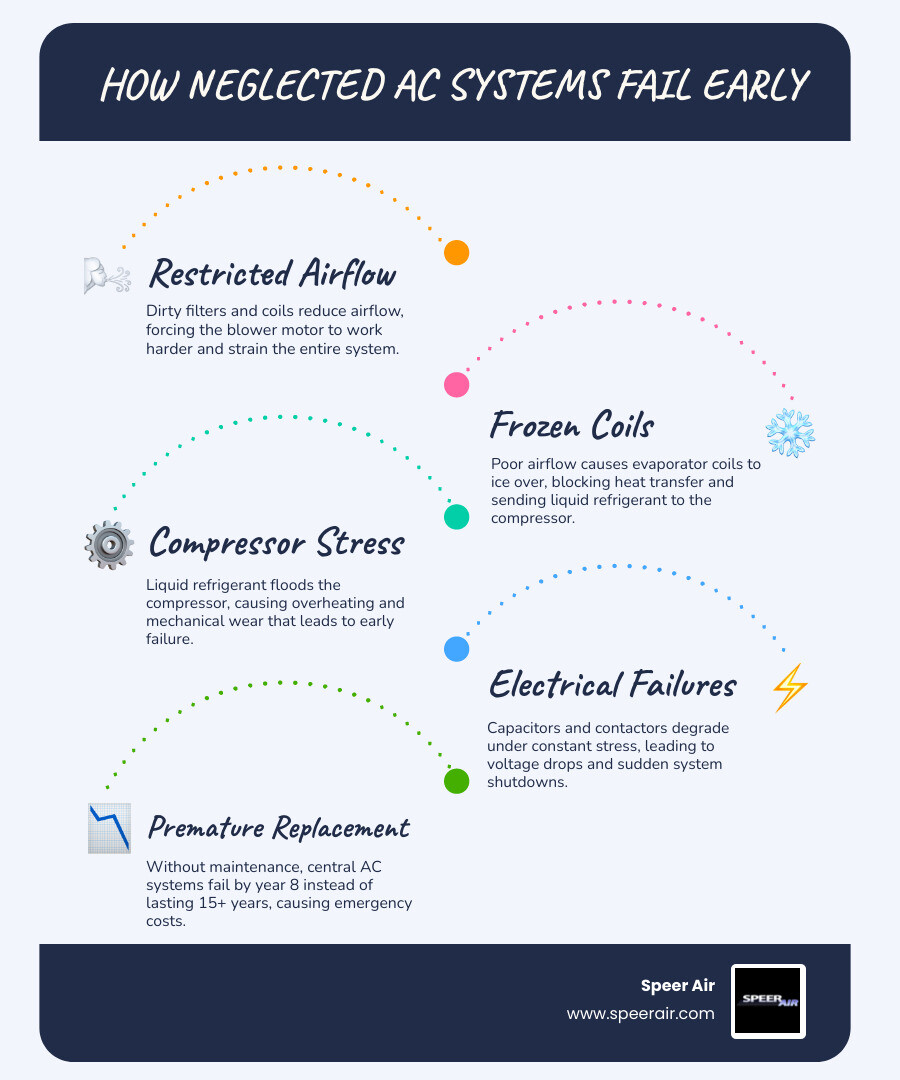
Neglected AC systems fail early because of a chain reaction:
- Dirty filters restrict airflow, forcing the blower to work harder
- Overworked blowers cause evaporator coils to freeze
- Frozen coils send liquid refrigerant back to the compressor
- Compressor stress leads to overheating and early burnout
- Ignored capacitors and contactors fail under heat and electrical load
- Refrigerant leaks go undetected, starving the system of cooling capacity
- The compressor — your most expensive component — fails years too soon
The numbers tell the story clearly. A well-maintained central AC system in a climate like Northern New Jersey can last 15 years or more. Skip the maintenance, and that same system may give out before year 8. That’s nearly a decade of useful life gone — along with the cost of an emergency replacement, higher energy bills, and avoidable repairs along the way.
Research backs this up. A Florida field study tracking residential AC systems found that cooling performance degrades roughly 5% per year on average, with some systems losing capacity at nearly 8 times that rate when problems go unaddressed. The median compressor age at replacement? Just 9 years — well short of what a properly maintained system should deliver.
This isn’t about scare tactics. It’s about understanding that your AC system is a mechanical system under constant stress, and without routine care, that stress compounds quietly until something breaks — usually on the hottest day of the year.
The Lifespan Gap: Maintained vs. Neglected Systems

Most homeowners do not expect an air conditioner to be a short-term appliance. A properly installed, properly maintained system should serve your home for many years. But maintenance history often determines whether that system reaches its expected lifespan or starts limping along halfway through it.
For a deeper comparison, we recommend reading Maintenance vs Neglect: The Battle for Your AC’s Life.
Here is the practical difference:
| HVAC system type | Typical lifespan when neglected | Typical lifespan when maintained |
|---|---|---|
| Central air conditioner | 5 to 8 years | 12 to 15+ years |
| Heat pump | 5 to 7 years | 10 to 15 years |
| Furnace | 10 to 12 years | 15 to 25 years |
Those numbers are not guarantees, because every home is different. Usage, installation quality, ductwork, indoor air quality, humidity, thermostat habits, and local weather all matter. But the pattern is consistent: neglected systems work harder, lose efficiency faster, and suffer major component failures earlier.
In Northern New Jersey, including Morris County, Bergen County, Essex County, Passaic County, Sussex County, Warren County, Somerset County, Union County, Hudson County, Middlesex County, and Hunterdon County, cooling systems face humid summers, pollen, airborne debris, storm season, and long operating hours during heat waves. Homes in nearby Pennsylvania communities such as Easton, Bangor, Milford, Bushkill, Stroudsburg, East Stroudsburg, Dingmans Ferry, and Mount Pocono can see similar seasonal strain.
That means maintenance is not just a nice extra. It is part of keeping the equipment alive.
Understanding How Neglected AC Systems Fail Years Before They Should
The biggest mistake homeowners make is assuming that if the AC turns on, it is fine.
Unfortunately, an air conditioner can be “working” while slowly damaging itself. It may still blow cool air, but the system might be running longer, drawing more power, struggling with airflow, or operating with a weak capacitor. That hidden stress is exactly how neglected AC systems fail years before they should.
Common causes of premature AC failure include:
- Dirty or clogged air filters
- Dirty evaporator and condenser coils
- Low airflow from blocked vents or duct problems
- Refrigerant leaks or improper refrigerant charge
- Weak capacitors
- Worn contactors and loose electrical connections
- Clogged condensate drains
- Poor installation or improper sizing
- Lack of annual inspection and cleaning
- Running the system hard during humid heat without maintenance
As the system loses efficiency, it must run longer to reach the same thermostat setting. Longer run times mean more wear on the compressor, blower motor, condenser fan motor, relays, capacitors, wiring, and controls.
If your system is older and you are wondering whether it is simply aging or heading toward failure, our guide Is Your HVAC Over the Hill? Knowing When to Say Goodbye explains what to watch for.
The Financial Impact of Skipping Routine Service
Neglect creates costs in layers. At first, the impact may be small: slightly higher electric bills, longer cooling cycles, or a room that never feels quite comfortable. Then come repair visits for problems that could have been caught earlier. Eventually, one major failure can push the system toward replacement years sooner than expected.
The hidden costs of neglected HVAC maintenance often include:
- Higher monthly energy use
- More frequent service calls
- Emergency breakdowns during peak heat
- Reduced comfort and uneven temperatures
- Poor humidity control
- Indoor air quality problems
- Water damage from clogged drains
- Major component failure
- Shortened equipment lifespan
- Possible warranty complications
The frustrating part? Many of these problems begin with simple issues: a dirty filter, a clogged drain line, dirty coils, or an electrical part that was weakening for months.
When a system is older or repairs become more frequent, it may be time to compare repair and replacement options. Our resource When to Repair vs Replace Your HVAC System: A Z Guide can help you think through that decision.
How Neglected AC Systems Fail Years Before They Should
AC failure is usually not one single event. It is a domino effect.
A neglected air conditioner starts with reduced airflow or reduced heat transfer. Then the system compensates by running longer. Longer run times create heat, electrical stress, pressure problems, and mechanical wear. The compressor becomes the unlucky final stop in the chain.
This is why routine service matters so much. You are not just cleaning equipment. You are preventing stress from spreading through the system.
For local homeowners, we cover this further in The Importance of Regular AC Service in Rockaway.
The Danger of Restricted Airflow and Clogged Filters
A dirty filter seems harmless. It is not.
Your AC depends on a steady volume of return air moving across the evaporator coil. When the filter is clogged, airflow drops. The blower motor works harder to pull air through the restriction, static pressure rises, and less warm indoor air passes over the coil.
That can cause the evaporator coil to get too cold. Moisture on the coil can freeze. Once ice forms, airflow drops even more. Now the system is in a bad loop:
- Dirty filter restricts airflow
- Evaporator coil gets too cold
- Coil freezes
- Cooling capacity drops
- System runs longer
- Compressor works harder
- Liquid refrigerant may return to the compressor
- Compressor damage becomes more likely
Compressors are designed to compress vapor refrigerant, not liquid refrigerant. When a frozen coil allows liquid refrigerant to return to the compressor, it can wash away oil, damage internal parts, and shorten compressor life.
Dirty filters can also contribute to a 5% to 15% efficiency loss. That may not sound dramatic until you remember your AC may run for hundreds of hours during a humid New Jersey summer.
A good rule of thumb: check filters every month during cooling season. Many homes can replace them every 1 to 3 months, but homes with pets, dust, allergies, remodeling activity, or heavy system use may need more frequent changes.
For more comfort-focused maintenance tips, see Regular AC Maintenance for Your Home Comfort.
Environmental Stressors and Extreme Summer Heat
Extreme summer weather makes neglect more damaging.
During a mild day, a dirty condenser coil or weak capacitor might not cause an obvious issue. During a humid heat wave, that same weakness can push the system over the edge.
Northern New Jersey summers often bring:
- High humidity
- Pollen and airborne debris
- Storm debris around outdoor units
- Long cooling cycles
- Hot attic conditions around air handlers and ductwork
- Increased electrical demand
- Less recovery time between cycles
Humidity is especially important. Your AC is not just cooling the air. It is also removing moisture. When the system is dirty, low on airflow, or improperly charged, it may run longer while doing a worse job of dehumidifying. That makes the home feel sticky even when the thermostat says it should be comfortable.
Outdoor condenser coils also suffer. The condenser coil releases heat outdoors. If it is coated with dirt, grass clippings, cottonwood, leaves, or pollen, heat cannot escape efficiently. The refrigerant pressure rises, the compressor runs hotter, and the condenser fan motor works harder.
During intense heat, neglected systems are more likely to experience:
- Thermal overload
- High refrigerant pressure
- Capacitor failure
- Fan motor failure
- Short cycling
- Breaker trips
- Compressor overheating
- Poor cooling output
That is why pre-season maintenance is so valuable. It gives the system a clean start before summer stress arrives. Read more here: Beat the Heat by Scheduling Your Annual AC Maintenance Early.
The Cascade of Component Failures Caused by Neglect
The most expensive AC failures often begin as small maintenance issues.
A dirty coil raises pressure. A weak capacitor makes a motor struggle to start. A clogged filter freezes a coil. A loose wire creates heat. A small refrigerant leak reduces capacity. Left alone, each one can stress other parts until the system fails.
That is the cascade.
Professional maintenance is designed to catch these problems while they are still manageable. During a tune-up, a qualified technician can inspect and clean critical areas, test electrical components, check refrigerant performance, measure airflow, clear drains, and look for early signs of wear. Learn more about what that involves at Professional AC Maintenance in Rockaway.
Key maintenance tasks that help prevent early failure include:
- Replacing or cleaning air filters
- Cleaning condenser coils
- Inspecting evaporator coils
- Checking refrigerant charge and signs of leaks
- Testing capacitors
- Inspecting contactors and relays
- Tightening electrical connections
- Checking blower components
- Measuring temperature split and airflow
- Clearing condensate drains
- Inspecting thermostat operation
- Checking duct and vent restrictions
- Confirming safe system operation
Small tasks. Big consequences. HVAC is dramatic like that.
The Role of Airflow in How Neglected AC Systems Fail Years Before They Should
Airflow is the bloodstream of your HVAC system. When airflow is poor, everything suffers.
The evaporator coil needs warm indoor air moving across it to absorb heat. If airflow is restricted, the coil temperature can drop below freezing. If airflow is too high or poorly balanced, comfort and humidity control can suffer. If ductwork is leaky, crushed, undersized, or poorly designed, the system may never perform the way it should.
Airflow problems can come from:
- Dirty filters
- Blocked return grilles
- Closed or covered supply vents
- Dirty blower wheels
- Dirty evaporator coils
- Collapsed or disconnected ductwork
- Leaky ducts
- Improperly sized ducts
- Furniture blocking vents
- Poor installation practices
Even clean filters cannot prevent all coil dirt. Over time, dust and residue can bypass the filter or enter during service, renovations, attic leakage, or duct leakage. That is why evaporator coils still need periodic inspection.
The outdoor unit needs airflow too. Keep the area around the condenser clear. As a general practice, maintain about 2 feet of clearance around the outdoor unit where possible, and keep leaves, mulch, weeds, and debris away from the coil.
Spring inspections are especially helpful after winter weather. Our Ultimate Post-Winter HVAC Inspection Checklist is a good place to start.
Electrical Hazards and Weakened Capacitors
Electrical components are some of the most common failure points in neglected AC systems.
Your system relies on capacitors to help motors start and run. Over time, capacitors weaken from heat, age, and electrical load. A weak capacitor may still allow the system to operate, but it can force the compressor or fan motor to struggle. That increases amperage, heat, and wear.
Warning signs of capacitor or electrical trouble can include:
- Humming from the outdoor unit
- Outdoor fan not spinning
- AC starts slowly or inconsistently
- Frequent breaker trips
- Clicking or buzzing sounds
- Short cycling
- Warm air from vents
- Burning smell near equipment
- System shuts off unexpectedly
Contactors are another common issue. A contactor is an electrical switch that controls power to major components. Over time, contacts can pit, burn, or stick. Loose electrical connections can also create resistance and heat, damaging wiring or controls.
During maintenance, technicians commonly inspect:
- Capacitors
- Contactors
- Wiring
- Terminals
- Disconnects
- Relays
- Control boards
- Motors
- Thermostat communication
- Electrical safety conditions
This is one of the biggest reasons not to wait until something breaks. Electrical components often show signs of weakening before total failure. Scheduling service ahead of peak season gives you the best chance to find those issues early. For timing guidance, visit Don’t Wait for a Breakdown: How Often to Schedule Your Tune-Ups.
Warranty Voidance and Manufacturer Requirements
Many homeowners forget that HVAC warranties often come with responsibilities.
Manufacturer warranty coverage may require proper installation, correct use, and documented maintenance. If a major component fails and the system shows signs of neglect, lack of maintenance records can complicate a warranty claim.
To protect your warranty, homeowners should:
- Schedule regular professional maintenance
- Keep service records and invoices
- Change filters as recommended
- Use proper filter sizes and types
- Avoid blocking airflow
- Report problems early
- Avoid unauthorized modifications
- Make sure installation follows manufacturer requirements
- Keep outdoor units accessible and clear
This matters because warranty coverage is not just about the age of the equipment. It is also about whether the system was cared for properly.
If your system is showing multiple signs of decline, our guide Signs HVAC System Is Ready for an Upgrade can help you understand when maintenance may no longer be enough.
Frequently Asked Questions about AC Failure
Below are the questions we hear most often from homeowners trying to understand why an AC system is struggling.
What are the warning signs that my AC is failing from neglect?
Common warning signs include:
- Weak airflow from vents
- Warm air or inconsistent cooling
- Rising energy bills without a clear reason
- Longer run times than usual
- Short cycling
- Ice on refrigerant lines or coils
- Water leaking near the indoor unit
- Musty or burning odors
- Loud humming, buzzing, rattling, grinding, or squealing
- Frequent breaker trips
- Rooms that feel humid or sticky
- Outdoor fan problems
- Repeated need for repairs
- Thermostat setting never seems satisfied
One warning sign does not always mean the system is doomed. But several together, especially on an older system, deserve prompt attention.
Can a dirty filter really destroy my AC compressor?
Yes, indirectly.
A dirty filter usually does not attack the compressor by itself. Instead, it starts a chain reaction:
- The filter restricts airflow.
- The evaporator coil gets too cold.
- Moisture freezes on the coil.
- Ice blocks more airflow.
- Refrigerant may not evaporate properly.
- Liquid refrigerant can return to the compressor.
- The compressor overheats, loses lubrication, or suffers internal damage.
The compressor is one of the hardest-working parts of the AC system. It depends on proper refrigerant flow, correct pressure, clean coils, and proper airflow. A clogged filter disrupts that balance.
So yes, the humble filter matters. It may be cheap and boring, but so are seatbelts. We recommend using both.
How does improper installation compound maintenance neglect?
Poor installation can shorten system life even if the equipment is new.
Common installation problems include:
- Incorrect system sizing
- No proper load calculation
- Oversized equipment
- Undersized equipment
- Poor duct design
- Leaky ducts
- Improper refrigerant charge
- Poor drainage slope
- Weak electrical setup
- Poor airflow balancing
- Outdoor unit placed where airflow is restricted
A properly sized system should be based on the home, not just square footage. Professional load calculations consider insulation, windows, orientation, air leakage, occupancy, ductwork, and other factors.
Oversized systems often short cycle. That means they turn on and off too frequently, causing extra startup wear and poor humidity control. Undersized systems may run constantly, wearing down components faster.
Improper refrigerant charge is another serious issue. Too little refrigerant reduces capacity and can overheat the compressor. Too much refrigerant can cause pressure problems and poor performance. Refrigerant is not “used up” like fuel, so low refrigerant usually means there is a leak or installation issue that needs diagnosis.
When poor installation and poor maintenance combine, the system may fail much earlier than expected.
Conclusion
Neglected AC systems usually do not fail because of bad luck. They fail because small problems are allowed to build into major stress.
Dirty filters restrict airflow. Dirty coils trap heat. Weak capacitors strain motors. Refrigerant leaks reduce cooling capacity. Clogged drains create water problems. Poor airflow freezes coils. Improper installation magnifies all of it. Over time, the compressor pays the price.
The good news is that most of this is preventable.
At Speer Air, we have served homeowners and businesses since 1900. Based in Northern New Jersey, we provide residential and commercial HVAC installation, replacement, repair, and maintenance, along with whole-home Generac generator services. Our team brings deep industry roots, NATE certification, Carrier Factory Authorized Dealer expertise, and 24/7 emergency service availability to the communities we serve.
If you want your AC system to last as long as it should, do not wait for the breakdown. Schedule regular maintenance, keep filters clean, protect airflow, and document service visits.
Ready to protect your cooling system before summer puts it to the test? Schedule professional AC maintenance in Rockaway, NJ today.