

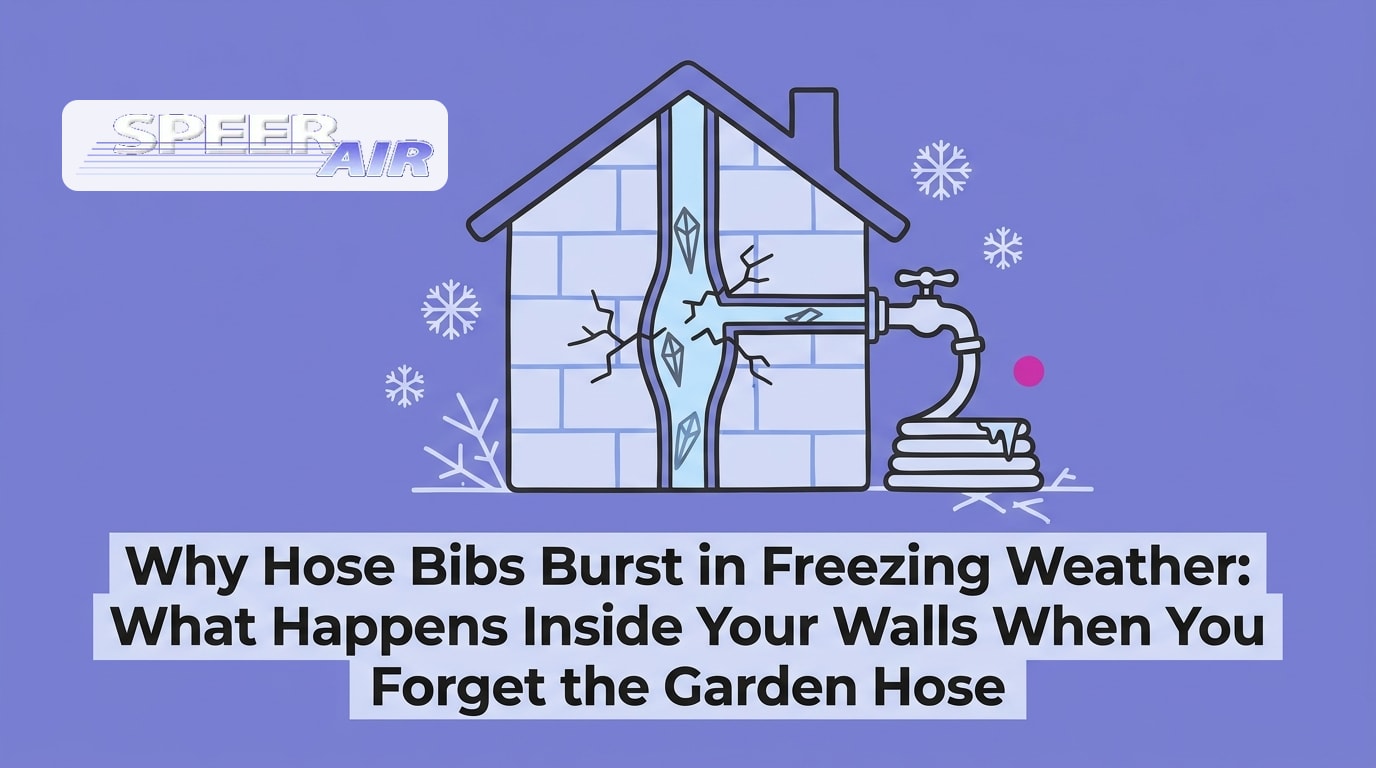
Why Hose Bibs Burst in Freezing Weather: What Happens Inside Your Walls When You Forget the Garden Hose
The Hidden Risk of Leaving Your Garden Hose Attached in Late Fall As the vibrant autumn leaves drop and the first real chill sets in, many homeowners wonder exactly why hose bibs burst in freezing weather, especially when the damage seems to happen without warning. Now is the time to prepare, because late fall and November pre-winter readiness is the critical window for securing your home’s exterior plumbing. You might finish power washing the driveway or giving your fall mums one last drink, and simply forget to unthread the garden hose. It feels like a harmless oversight. However, when the overnight frost hits, that simple forgotten hose transforms into a massive liability that can threaten your home’s entire plumbing infrastructure. If you are already dealing with the disastrous aftermath of a burst pipe flooding your basement, you may need to evaluate your water heater systems or even schedule an emergency water heater replacement to restore your home’s basic comfort. The False Security of Mild Autumn Afternoons One of the biggest traps homeowners fall into is the unpredictable nature of late fall weather. A sunny, sixty-degree afternoon can easily plummet to freezing temperatures overnight. When you leave a garden hose attached to your outdoor faucet (also known as a hose bib or spigot), you are essentially trapping water inside the fixture. Under normal circumstances, turning off the faucet allows the remaining water to drain out harmlessly. But an attached hose acts as a plug, holding that water right at the threshold ...
Why Your Space Heater Keeps Tripping the Breaker During the November Chill
The Hidden Electrical Strain of Early Winter Heating Your bedroom feels unusually drafty, so you plug in your portable space heater to take the edge off. A few minutes later, you hear a sharp click from the hallway, and the room goes completely dark. If you are constantly resetting your electrical panel and wondering whether you need dedicated circuits for heavy winter appliances just to stay warm, you are certainly not alone. This is a common frustration during the shoulder season, when homeowners try to delay turning on their central heating systems. For more comprehensive guidance on navigating Northeast HVAC challenges, our team at Speer Air is always ready to help you evaluate your home’s total comfort profile. With Northeast temperatures regularly dropping into the 30s and 40s during November pre-winter cold snaps, spot heating becomes a daily habit. Instead of firing up the main furnace for the entire house, you might rely on a plug-in heater for the home office or the living room. While this seems like a smart way to manage early winter drafts, it places an immense, invisible strain on your home’s electrical wiring. Standard wall outlets are designed for lamps, televisions, and phone chargers—not heavy, continuous heating elements. Understanding why this happens requires looking beyond the electrical panel. A tripped breaker is rarely just a nuisance; it is a vital safety mechanism doing exactly what it was designed to do. When you repeatedly reset that ...
How to Bleed a Radiator Safely: Why HVAC Professionals Start Every November Boiler Check on the Second Floor
Why Upstairs Radiators Stay Cold During Early Winter Heating Startup Why are the upstairs bedrooms shivering while the downstairs is sweltering during the first cold snap? If you are researching how to bleed a radiator safely to fix this uneven heating, you are experiencing one of the most common early-winter maintenance hurdles we see at Speer Air. Trapped air inside a hydronic heating system acts as a physical barrier, preventing hot boiler water from circulating properly. This leaves the highest points in your home stubbornly cold, even while the boiler runs continuously to compensate. For immediate assistance with your system, learn more about heating repair in Rockaway, or schedule professional boiler repair to ensure your home stays warm. Addressing this issue is a foundational step during any November early-winter heating startup. Here in Rockaway and across Northern NJ, our team recommends using the pre-freeze window before Thanksgiving as the ideal time to ensure your heating system is balanced and ready for the heavy workload ahead. When radiators on the second floor fail to heat up, the decision point for a homeowner is clear: executing a safe radiator bleed to restore heat flow without introducing leaks, dropping water pressure, or risking a scalding injury. The True Cost of Ignoring Cold Radiators Leaving air trapped in your system does more than just make your bedrooms uncomfortable. When hot water cannot fully enter the radiators, those rooms remain below the thermostat’s set temperature. Consequently, the <span class="" data-gt-translate-attributes='[{"attribute":"data-cmtooltip", ...
A/C Filter Replacement: Troubleshooting Early-Season Heating Failures
The Hidden Culprit Behind Early-Season Furnace Shut-Offs You turn your thermostat up during the first major temperature drop of the season, expecting warm air, but instead, you find yourself searching for home maintenance tips and troubleshooting because the furnace shuts down after just five minutes. Your vents are barely blowing, the house still feels chilly, and you are left wondering if your heating system is already broken before winter has even officially begun. At Speer Air, we see this incredibly common frustration firsthand when November late fall temperature drops finally force the heating system to run continuously for the first time in months. Before you panic, the most effective step you can take is to determine whether the issue is a basic airflow restriction or a true mechanical failure. More often than not, early-season heating malfunctions actually stem from neglected summer maintenance rather than broken winter components. Addressing the root cause of poor airflow is the definitive first step before freezing weather hits, ensuring your system operates safely and efficiently. For comprehensive support, scheduling professional heating maintenance establishes a reliable baseline for the cold months ahead. Understanding the Shared HVAC Filter System One of the most frequent misunderstandings our team encounters regarding residential climate control is how the air filtration system actually works. Many homeowners assume that because heating and cooling feel like two entirely ...
Repair vs. Replace: Navigating Heating Options Comparisons for Homeowners Before Winter
Facing a Heating System Crossroads Before Freezing Temperatures Arrive Is your aging furnace actually ready for another harsh winter, or are you suddenly looking at options comparisons for homeowners after a startling late-fall maintenance report? At Speer Air, our technicians see this exact scenario play out every November. Discovering that a major component is failing right before the cold weather sets in puts you in a difficult position. You are forced to make a significant home comfort decision exactly when you feel the most pressure to simply get the heat back on. This late fall / pre-winter window is a critical time for your HVAC system, and making the right choice now determines your comfort for the next several months. Just as you might schedule routine AC maintenance in the spring to prevent summer failures, late fall requires proactive, clear-headed heating decisions. When our team flags a failing blower motor, a weak ignitor, or a compromised heat exchanger, a homeowner’s instinct is often to authorize a quick fix just to check the box. However, a pattern we see often is that ignoring the broader warning signs of systemic wear and tear leads to needing the winter equivalent of emergency air conditioning repair in the dead of January. The core dilemma: Do you invest in a patch for an aging unit, or do you upgrade to a reliable, high-efficiency system? Navigating ...

Heating Options Comparisons for Homeowners: Gas Furnaces vs. Cold-Climate Heat Pumps
Facing Sub-Freezing Temperatures: Evaluating Your Late Fall Heating Upgrades Late November is closing in fast, and relying on an aging, unpredictable heating system is a stressful way to enter the season. When the weather shifts and your current unit struggles to keep up, navigating the various options comparisons for homeowners requires looking past the marketing brochures and focusing on mechanical realities. Making an informed choice between sticking with traditional gas combustion or transitioning to modern cold-climate heat pump technology is a major decision that impacts your daily comfort for years to come. Regardless of the system chosen, establishing a baseline of routine AC tune-ups and professional AC maintenance ensures year-round reliability. The late fall and pre-winter window represents the critical final opportunity to replace an unreliable system before emergency winter failures occur. Operating since 1900, our team at Speer Air has witnessed the full evolution of residential heating throughout Northern New Jersey—from early coal setups to traditional gas models, all the way to today’s advanced heat pumps. That multi-generational perspective means we prioritize trusted, long-term mechanical reliability over passing industry trends. Mechanical Breakdown: Combustion vs. Ambient Heat Transfer The core problem: You need to heat your home efficiently during sub-freezing temperatures. The cause of confusion: Heating systems achieve this goal using completely different physical processes. The solution: In our decades of experience serving the Rockaway area, we’ve found that understanding ...