

Why Learning How to Prepare for the Shift to Low GWP Refrigerants Matters Now
Knowing how to prepare for the shift to low GWP refrigerants could save you from unexpected equipment failures, rising service costs, and compliance headaches — especially if your home or business in Northern New Jersey runs on an older HVAC system. The federal government has already mandated that new air conditioning and heat pump systems meet strict new refrigerant standards, and the window to plan ahead is narrowing fast.
Here is a quick overview of the key steps to prepare:
- Audit your current system — check the data plate for refrigerant type and equipment age
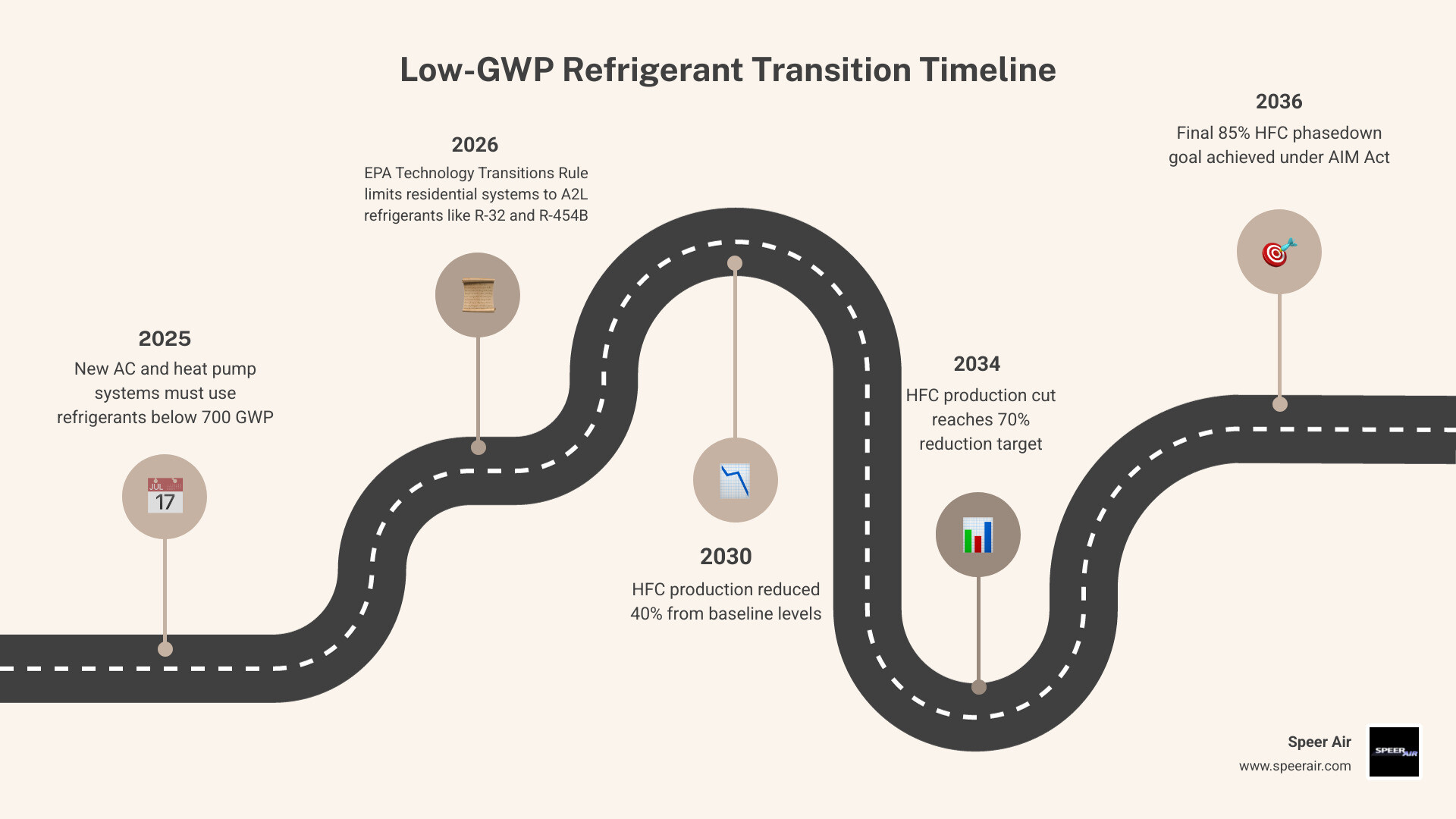
- Understand your timeline — new systems must use refrigerants with a GWP below 700 as of January 1, 2025
- Know your options — R-32 and R-454B are the leading replacements for R-410A in residential and light commercial systems
- Plan for replacement, not retrofit — low-GWP refrigerants are not drop-in substitutes for R-410A
- Upgrade leak detection — new A2L refrigerants require safety sensors and updated monitoring
- Work with a qualified HVAC professional — handling mildly flammable A2L refrigerants requires proper training and equipment
The refrigerant your HVAC system uses today — most likely R-410A, which carries a global warming potential of 2,088 — is being phased down under the American Innovation and Manufacturing (AIM) Act. Under this law, the EPA is targeting an 85% reduction in high-GWP hydrofluorocarbon (HFC) production by 2036. That phasedown is already underway, and it is already pushing up the cost of servicing older equipment.
For homeowners and business owners in Morris County and across Northern New Jersey, this is not a distant regulatory concern. It is a practical decision that affects your next HVAC purchase, your current maintenance costs, and your long-term energy bills.
How to prepare for the shift to low gwp refrigerants glossary:
Understanding the Regulatory Drivers Behind the Refrigerant Transition
The HVAC industry is undergoing one of its most significant transformations in decades. This shift is not voluntary; it is mandated by federal and state regulations designed to curb the environmental impact of synthetic cooling gases.
At the center of this transition is the American Innovation and Manufacturing (AIM) Act, enacted by Congress to phase down the production and consumption of high-GWP hydrofluorocarbons (HFCs). The ultimate goal is an 85% reduction in HFC baseline levels by 2036. To achieve this, the Environmental Protection Agency (EPA) has rolled out specific rules, including the Technology Transitions Rule.
Under these rules, newly manufactured residential and light commercial air conditioning and heat pump systems must utilize refrigerants with a GWP below 700. This phase-out timeline represents a major step forward from the global Kigali Amendment to the Montreal Protocol, which initiated the international phasedown of HFCs.
For local property owners, understanding Everything Homeowners Need to Know About the 2026 Refrigerant Rules is essential. As production quotas for legacy gases tighten, the supply of older refrigerants like R-410A will continue to shrink. This supply squeeze naturally leads to higher maintenance costs for legacy equipment. By looking ahead, you can make strategic decisions rather than waiting for an emergency breakdown during a hot New Jersey summer.
Comparing Legacy HFCs and New Low-GWP Alternatives
For the past two decades, R-410A has been the standard refrigerant for residential and light commercial cooling systems in Northern New Jersey. While highly effective at transferring heat, its high GWP of 2,088 means that any leak contributes significantly to greenhouse gas emissions.
To meet the new EPA threshold of 700 GWP, manufacturers have shifted to next-generation alternatives. The two primary replacements dominating the residential and light commercial markets are R-32 and R-454B. Additionally, natural alternatives like carbon dioxide (CO₂) are increasingly utilized in specialized industrial and commercial applications.
Understanding the differences between these options helps clarify why the industry is moving in this direction:
| Refrigerant | GWP (Global Warming Potential) | ASHRAE Safety Class | Relative Charge Size | Primary Use Case |
|---|---|---|---|---|
| R-410A | 2,088 | A1 (Non-flammable) | 100% | Legacy residential & commercial AC |
| R-32 | 675 | A2L (Mildly Flammable) | ~70% | Mini-splits, window units, some heat pumps |
| R-454B | 466 | A2L (Mildly Flammable) | ~90% | Ducted residential & commercial systems |
| CO₂ (R-744) | 1 | A1 (Non-flammable) | Varies | Specialized commercial refrigeration |
When looking at R410A vs R454B Refrigerant: What You Need to Know, the thermodynamic performance of these new options is highly encouraging. R-32, for example, can use up to 30% less charge weight compared to R-410A while maintaining excellent high-pressure performance. This smaller charge size means less refrigerant is required to achieve the same cooling capacity, resulting in more compact equipment designs and improved system efficiency.
What A2L “Mildly Flammable” Classification Means for Homeowners

One of the most common questions we receive about the transition is: “Are these new refrigerants safe?”
The short answer is yes. Both R-32 and R-454B carry an ASHRAE safety classification of A2L. To understand what this means, it helps to look at how safety groups are defined:
- “A” stands for lower toxicity, meaning they are safe for standard occupied spaces.
- “2L” indicates mild flammability with a slow burning velocity.
A2L refrigerants are fundamentally different from highly flammable A3 hydrocarbon gases like propane (R-290). An A2L refrigerant is incredibly difficult to ignite. It requires a very high-energy ignition source (such as an open flame, not a simple static spark) and a highly concentrated mixture in the air to catch fire. Even if it does ignite, its burning velocity is extremely slow—roughly equivalent to a slow-burning candle.
To ensure absolute safety, modern HVAC equipment designed for A2L refrigerants includes built-in safety mitigation features. These systems are equipped with mandatory leak sensors. If a leak is detected, the system automatically shuts down the compressor and activates the indoor blower fan to safely disperse the concentration of gas, keeping it well below any flammable threshold.
How to Prepare for the Shift to Low GWP Refrigerants in Your Home
Preparing for this transition does not mean you need to run out and replace a perfectly functioning air conditioner today. However, taking a proactive approach will prevent you from being caught off guard when your current system eventually reaches the end of its lifespan.
A strategic preparation plan begins with a simple assessment of your current home comfort systems. By understanding what you have, you can align future upgrades with your household budget and long-term home improvement goals. Knowing The Secret to Lower Energy Bills and Zero Summer Breakdowns often comes down to early planning and routine maintenance.
Here are the two essential steps every homeowner in Morris, Bergen, or Sussex County should take:
Step 1: Audit Your Current System to Prepare for the Shift to Low GWP Refrigerants
The first step is to locate the metal data plate on your outdoor air conditioning condenser or heat pump. This plate contains vital information, including the manufacture date and the specific type of refrigerant your system uses.
- If your system uses R-22: Your equipment is likely over 15 years old. Virgin R-22 production was completely phased out in 2020. If your system develops a major leak, repairing it will be highly impractical due to the extreme scarcity of reclaimed R-22. You should prioritize planning for a system replacement.
- If your system uses R-410A: Your system is likely under 10 years old. While R-410A is being phased down, it will remain available in reclaimed form for servicing existing systems for years to come. However, as supply tightens, expect the cost of servicing leaks to rise.
Taking the time to audit your system now is a smart way to learn How to Lower AC Bills in Rockaway This Summer while identifying potential maintenance risks before the peak cooling season arrives.
Step 2: Plan Upgrades to Prepare for the Shift to Low GWP Refrigerants
It is critical to understand that low-GWP A2L refrigerants cannot be retrofitted into existing R-410A systems. Because R-32 and R-454B operate under different pressures, require different compressor lubricants, and necessitate specialized safety controls like leak dissipation sensors, they must only be used in systems specifically designed for them.
When your existing system does require replacement, upgrading to a modern, low-GWP system is an excellent opportunity to improve your home’s comfort and lower your utility bills. New systems designed for R-32 or R-454B are engineered for maximum efficiency.
To explore your options for upgrading, you can research modern solutions such as:
- Installing an Energy Efficient HVAC System Rockaway
- Investing in eco-friendly Green HVAC Solutions Northern NJ
- Discovering why High Efficiency HVAC Systems Are Not Just Full of Hot Air
- Reading our resource on Efficiency Ratings Explained So You Can Stop Guessing and Start Saving
Best Practices for Leak Prevention and Refrigerant Management
Refrigerant leaks are bad for the environment and bad for your wallet. Statistics show that residential heat pumps lose approximately 5% of their charge annually, but nearly 150% of their total charge can be lost over the lifetime of the equipment if microscopic leaks are left unaddressed.
To prevent these losses, we recommend a few simple best practices:
- Schedule Annual Maintenance: Professional tune-ups allow technicians to inspect flare joints, monitor operating pressures, and catch minor issues before they turn into major leaks.
- Utilize Electronic Leak Detection: Modern electronic leak sensors can detect microscopic pinholes that are invisible to the naked eye, allowing for precise, lasting repairs.
- Insist on Reclaimed Gas for Repairs: If your R-410A system does require service, ensure your HVAC contractor uses high-quality, certified reclaimed refrigerant to keep your system operating efficiently while minimizing environmental impact.
Frequently Asked Questions About the Low-GWP Transition
Can I use R-32 or R-454B in my existing R-410A system?
No. You cannot use low-GWP A2L refrigerants in a system designed for R-410A. A2L refrigerants require specific compressor oils, operate under different physical properties, and require built-in safety controls, such as leak sensors and mitigation circuits, that legacy systems do not possess. Doing so would void your warranty, compromise system performance, and create safety hazards.
What happens if my current R-410A system leaks?
If your current system develops a leak, it can still be legally repaired and recharged. The EPA’s regulations do not force you to replace functioning R-410A equipment. However, because the production of virgin R-410A is being phased down under the AIM Act, the cost of this refrigerant is expected to rise significantly as supplies tighten. Over time, replacing an aging, leaky system will become far more cost-effective than repeatedly recharging it.
Are low-GWP A2L refrigerants safe for residential use?
Yes, they are exceptionally safe. While classified as “mildly flammable,” they have a very high ignition threshold and a very slow burning velocity. They require a direct, high-energy flame to ignite and will not sustain a flame on their own. Additionally, HVAC systems designed for A2Ls feature built-in safety sensors that automatically shut down the system and circulate indoor air to dilute any potential gas concentration long before it can reach a hazardous level.
Conclusion
The transition to low-GWP refrigerants represents a positive step forward for both environmental sustainability and home energy efficiency. By understanding how these changes affect your home comfort systems, you can make informed, proactive decisions that protect your comfort and your budget.
At Speer Air, we have been helping families across Northern New Jersey stay comfortable in their homes since 1900. As a family-owned business with NATE-certified technicians and a proud history as a Carrier Factory Authorized Dealer, we possess the specialized training and expertise required to navigate these new safety standards and equipment designs. Whether you live in Morris, Bergen, or Sussex County, we are here to help you prepare for a cooler, greener future.
If you have questions about your current system’s refrigerant or want to schedule a professional inspection, contact us today to book an expert ac-repair or maintenance service.