

Why Your AC Runs Longer Than It Should — And What You Can Do About It
If you want to know how to reduce your AC runtime without sacrificing comfort, here are the most effective steps you can take right now:
- Set your thermostat consistently — aim for 78°F when home, 82–85°F when away
- Use ceiling fans — set counterclockwise in summer to feel cooler without lowering the thermostat
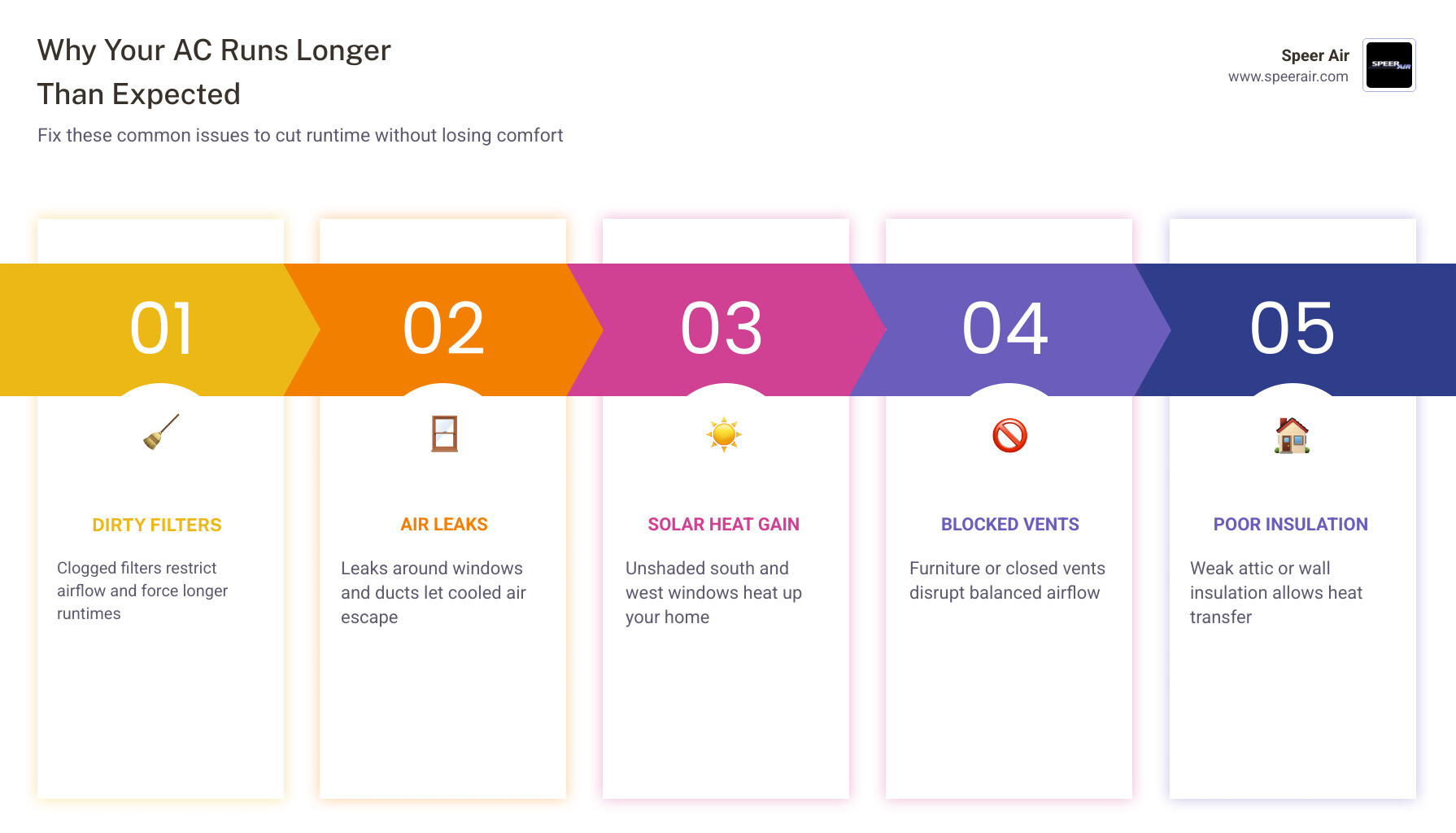
- Change air filters every 1–3 months — dirty filters force your system to run longer
- Close blinds on south- and west-facing windows during peak afternoon sun
- Seal air leaks around windows, doors, and ductwork to keep cooled air inside
- Keep vents open and unblocked throughout your home for balanced airflow
- Schedule professional maintenance to catch hidden issues like duct leaks or refrigerant problems
When your air conditioner runs for long stretches on a hot New Jersey summer day, it’s tempting to blame the heat. But in many homes, the real culprits are closer to home — things like a clogged filter, blocked vents, sun-soaked windows, or small air leaks that quietly bleed cooled air out of the house. These everyday issues quietly chip away at your system’s efficiency, forcing it to work harder and longer to reach the temperature you set.
The good news is that most of the fixes are straightforward. A combination of smarter thermostat habits, basic maintenance, and a few simple home improvements can meaningfully cut down how long your AC runs — without making your home any less comfortable. And when DIY steps aren’t enough, a professional inspection can uncover hidden problems that no amount of filter changes will solve.
Important how to reduce your ac runtime without sacrificing comfort terms:
Smart Thermostat Strategies: How to Reduce Your AC Runtime Without Sacrificing Comfort
Your thermostat is the brain of your home’s cooling system. How you interact with it directly dictates how long your compressor remains active. Many homeowners fall into the trap of micromanaging their thermostats—frequently lowering the temperature in hopes of cooling the house faster, or turning the system completely off when they leave, only to force it to run for hours on end to recover later.
By establishing consistent thermostat habits, you can take immediate control of your energy consumption. To maximize your savings, it helps to pair these habits with modern technology. Upgrading to Smart Thermostats Enhance Comfort and Efficiency, allowing you to automate setbacks and monitor your home’s climate remotely. If you are looking for localized guidance, learning How to Lower AC Bills in Rockaway This Summer is a great way to align your thermostat habits with local climate patterns in Northern New Jersey.
Programming Setbacks to Discover How to Reduce Your AC Runtime Without Sacrificing Comfort
The Department of Energy recommends a baseline temperature of 78°F (26°C) when you are at home and awake during the summer. While this might sound high to some, every degree you raise your thermostat can reduce your cooling energy use by about 3%. If you normally keep your home at 72°F, raising it to 78°F could slash your AC’s cooling load by up to 18%.
To reduce runtime without feeling the heat, we recommend implementing strategic temperature setbacks:
- Away Mode (82°F – 85°F): When you leave for work or head out for the day, set your thermostat 7 to 10 degrees higher than your occupied setpoint. Doing this for eight hours a day can save you roughly 10% a year on your cooling costs.
- Sleep Schedules (75°F – 77°F): During the night, outdoor temperatures naturally drop, reducing the workload on your AC. You can comfortably set the thermostat a bit higher, especially if you use bedroom fans to maintain a gentle breeze.
- Avoid “Chill” Overcorrections: Setting your thermostat to 65°F when you walk into a warm house will not make the system cool any faster. It simply ensures the system will run continuously for a much longer period, often overshooting your actual comfort level and wasting energy.
Implementing a smart thermostat provides several distinct advantages for managing these setbacks:
- Custom Scheduling: Program precise daily routines so you never forget to adjust the temperature before leaving.
- Energy Tracking: View real-time reports of your daily and monthly AC runtime to see exactly when your system is working hardest.
- Automated Reminders: Receive alerts when it is time to change your air filter or schedule seasonal maintenance.
- Time-of-Use Integration: If your utility provider charges higher rates during peak afternoon hours, you can program your system to pre-cool your home earlier in the day when electricity is cheaper.
Leveraging Smart Features and Geofencing
Modern smart thermostats offer advanced automation tools that take the guesswork out of efficiency. Geofencing is one of the most powerful features available; it uses your smartphone’s location to detect when the last person has left the house. Once you cross a designated boundary, the thermostat automatically enters an energy-saving “away” mode, raising the target temperature by 4°F to 5°F. As you head back home, the system detects your approach and begins cooling the house back down to your preferred comfort level.
Additionally, some smart thermostats can integrate with external temperature and humidity sensors. In places like Morris County or Sussex County, summer humidity can make a room feel much warmer than the thermometer suggests. By pairing your AC with humidity sensors, you can program the system to run only when the relative humidity exceeds a comfortable threshold (usually 50% to 55%), rather than running constantly based on temperature alone. This prevents unnecessary runtime while keeping your indoor air feeling crisp and dry.
Optimizing Airflow and Controlling Indoor Heat Gain

Reducing your air conditioner’s runtime is not just about managing the system itself—it is also about managing the environment it operates in. If your home is constantly absorbing heat from the sun or trapping stagnant air, your AC will have to run longer to keep up. Understanding How Airflow Affects Your Air Conditioner’s Performance is essential for diagnosing why certain rooms stay warm while your system works overtime.
Simple Airflow Improvements for Your Home
To help your air conditioner distribute cool air efficiently, you must ensure that air can move freely throughout your living spaces.
- Keep Vents Open and Clear: A common myth is that closing vents in unused rooms saves energy. In reality, modern central AC systems are balanced for the entire volume of the home. Closing vents increases pressure within the ductwork, which can lead to duct leaks, reduced system airflow, and even a frozen evaporator coil. Keep all supply and return registers open and clear of furniture, drapes, or toys.
- Run Ceiling Fans Counterclockwise: In the summer, your ceiling fans should rotate counterclockwise at medium to high speed. This creates a wind-chill effect, blowing air straight down and making the room feel up to 4°F cooler than it actually is. This allows you to raise your thermostat setpoint without sacrificing personal comfort.
- Turn Fans Off When Leaving: Fans cool people, not rooms. They do not lower the actual air temperature; they only cool your skin through evaporation. Turn ceiling fans off when you leave a room to avoid wasting electricity.
- Position Interior Doors Strategically: Keeping bedroom doors slightly open allows air to circulate back to the central return vents. If you must close a door, ensure there is a sufficient gap at the bottom (at least an inch) to prevent air from becoming trapped, which creates localized hot spots and forces your AC to run longer.
Blocking Solar Heat and Managing Appliances
Controlling indoor heat gain is one of the easiest, zero-cost ways to reduce your AC’s daily workload. Solar radiation pouring through your windows can rapidly raise your home’s temperature, turning your living room into a greenhouse.
- Utilize Strategic Window Coverings: Keep blinds, shades, or heavy drapes closed on south- and west-facing windows during the peak heat of the afternoon. Highly reflective window treatments can reduce solar heat gain by up to 77%.
- Audit Heat-Generating Appliances: Large appliances like ovens, stoves, clothes dryers, and dishwashers dump significant amounts of heat and humidity directly into your home. Try to cook outdoors on a grill or delay running your dishwasher and dryer until the cooler evening hours.
- Switch to LED Lighting: Traditional incandescent light bulbs are incredibly inefficient, converting about 90% of their energy into heat rather than light. Replacing them with energy-efficient LED bulbs keeps your rooms cooler and lowers your electric bill.
- Understand Thermal Mass: Materials like brick, concrete, and heavy plaster have high thermal mass, meaning they absorb heat slowly during the day and radiate it back into your home long after sunset. By keeping your home shaded during the day, you prevent these materials from storing heat, which keeps your evening cooling loads much lighter.
The Role of Regular Maintenance and Air Sealing
A well-maintained air conditioner runs shorter, more efficient cycles. When components are dirty or worn, the system must work twice as hard to transfer heat out of your home. Combining routine DIY maintenance with professional care is The Secret to Lower Energy Bills and Zero Summer Breakdowns.
DIY Maintenance: Filters and Coils
You do not need to be an HVAC expert to handle the basic maintenance tasks that keep your system running smoothly.
- Change Air Filters Regularly: Dirty air filters are the single most common cause of extended AC runtime. When a filter is clogged with dust, pet dander, and pollen, it severely restricts airflow. This forces the blower motor to run longer and work harder to circulate air, driving up your energy bills and risking system damage. Inspect your filter monthly and replace or clean it every 1 to 3 months.
- Maintain Outdoor Condenser Clearance: Your outdoor unit needs to breathe to reject the heat it gathers from inside your home. Ensure there is at least two feet of clear space around the condenser. Regularly trim back shrubs, tall grass, and weeds, and clear away fallen leaves or grass clippings that may have accumulated against the metal fins.
- Inspect Condenser Coils: If the outdoor coils are coated in dirt or pollen, they act as an insulating blanket, preventing the refrigerant from releasing heat efficiently. You can gently wash off loose debris using a garden hose on a low-pressure setting (never use a pressure washer, as it can easily bend the delicate aluminum fins).
Sealing Leaks and Upgrading Insulation
Even the most efficient air conditioner will struggle if your home is constantly leaking conditioned air. Air sealing and insulating act as a protective barrier, keeping the cool air inside and the humid summer air out.
- Apply Weatherstripping and Caulk: Inspect the seals around your exterior doors and windows. If you can feel warm air seeping in or see daylight around the frames, apply fresh caulk or replace worn weatherstripping.
- Seal Ductwork Leaks: In typical homes, about 20% to 30% of the air that moves through the duct system is lost due to leaks, holes, and poorly connected ducts. This means your AC has to run much longer to deliver the target temperature to your living spaces. Applying foil tape or mastic sealant to visible duct joints in your attic or basement can instantly improve delivery efficiency.
- Evaluate Attic Insulation: Heat from your roof can reach scorching temperatures in July and August, radiating down through your ceiling if your attic is poorly insulated. Upgrading your attic insulation to recommended R-values keeps that heat out of your living space, drastically reducing the thermal load on your air conditioning system.
When to Call a Professional for Extended AC Runtime
While DIY strategies and habit adjustments can go a long way, some runtime issues require specialized technical expertise. If your air conditioner continues to run endlessly despite clean filters and shaded windows, there may be an underlying mechanical or design issue. Investing in Energy Saving HVAC Northern NJ services ensures your system is calibrated by certified professionals who know how to maximize seasonal efficiency.
Identifying Hidden Efficiency Issues and How to Reduce Your AC Runtime Without Sacrificing Comfort
An experienced HVAC technician uses specialized diagnostic tools to locate and resolve hidden efficiency drains that homeowners cannot see or fix on their own.
- Refrigerant Charge Imbalances: An air conditioner relies on a precise volume of refrigerant to absorb and release heat. If your system has a slow leak, a low refrigerant charge will prevent the evaporator coil from getting cold enough to cool your home efficiently. The system will run continuously, struggling to lower the temperature even a single degree. A professional must locate the leak, repair it, and recharge the system to factory specifications.
- Duct Work Inspection: Technicians can perform pressure testing to identify major duct leaks hidden behind drywall or in unconditioned crawlspaces. Sealing these hidden leaks ensures that 100% of the air you pay to cool actually reaches your living areas.
- Electrical and Motor Calibration: Over time, blower motors and outdoor fan motors can lose lubrication or experience electrical degradation, drawing more power and running slower than designed. Regular professional calibration keeps these components running at peak performance.
If your current system is constantly breaking down or simply too old to run efficiently, it may be time to discuss a High Efficiency HVAC Installation Northern NJ to permanently lower your summer utility costs.
Addressing System Sizing and Aging Equipment
If your air conditioner was improperly sized when it was installed, it will never run efficient cycles. An undersized unit will run constantly throughout the hottest parts of the day, unable to satisfy the thermostat. Conversely, an oversized unit will cool the home too quickly and shut off (a process called “short cycling”). Because it does not run long enough to dehumidify the air, your home will feel sticky and warm, tempting you to lower the thermostat even further.
As systems age, their mechanical efficiency naturally declines. Upgrading to a modern variable-speed system can completely transform your home’s comfort. To understand how these systems save you money, it helps to review Efficiency Ratings Explained So You Can Stop Guessing and Start Saving.
| System Type | Operation Style | Comfort Level | Energy Efficiency |
|---|---|---|---|
| Single-Stage System | Runs at 100% capacity (fully “on” or “off”). Cycles frequently. | Can create temperature swings and leaves higher humidity. | Low to Moderate (standard startup energy surges). |
| Variable-Speed System | Adjusts capacity dynamically (from 20% to 100%) to match real-time cooling loads. | Extremely consistent temperatures and superior dehumidification. | High to Outstanding (minimizes high-energy startup cycles). |
Frequently Asked Questions about AC Runtime
Why does my AC run longer than expected?
Your AC may run longer due to restricted airflow from a dirty air filter, blocked return vents, or dirty evaporator and condenser coils. High outdoor temperatures also force your system to work harder to reject heat, while high indoor humidity requires the AC to spend more time removing moisture before it can effectively lower the air temperature.
Is it cheaper to run the AC all day or turn it off and on?
It is generally more cost-effective to leave your AC on but raise the thermostat by 5 to 7 degrees when you are away, rather than turning the system completely off. Turning the system off allows your home’s walls, furniture, and air to absorb massive amounts of heat and humidity. When you turn the system back on, it must run continuously for hours under extreme strain to recover. Additionally, starting up a compressor draws up to six times its normal running amperage, so minimizing frequent “off-to-on” power cycles saves energy and reduces component wear.
How often should I change my AC air filter to reduce runtime?
We recommend inspecting your air filter every 30 days during peak summer use. For standard 1-inch pleated filters, replace them every 1 to 3 months. If you have pets, allergies, or a dusty home environment, you may need to change them closer to the 30-day mark to prevent restricted airflow and unnecessary system strain.
Conclusion
Reducing your air conditioner’s runtime does not mean you have to sweat through the New Jersey summer. By implementing smart thermostat setbacks, maximizing indoor airflow, blocking solar heat gain, and keeping up with basic filter changes, you can enjoy a perfectly cool home while giving your cooling system a much-needed break.
At Speer Air, we have been keeping families in Northern New Jersey and neighboring Pennsylvania communities comfortable since 1900. Whether you need a seasonal system tune-up to prepare for peak summer heat or are ready to explore high-efficiency cooling upgrades, our NATE-certified technicians are here to help.
Ready to optimize your home’s cooling efficiency? Schedule professional air conditioning service in Rockaway with us today!