

What an AC Circuit Breaker Keeps Tripping What It Means for Your Home
AC circuit breaker keeps tripping what it means is straightforward: your home’s electrical system is detecting more current than the circuit can safely handle, so it shuts off automatically to prevent overheating, equipment damage, or a fire.
Here are the most common reasons it happens:
- Dirty air filter – restricted airflow forces the blower motor to work harder and draw more amps
- Dirty condenser coils – trapped heat raises system pressure and electrical load
- Failing capacitor – causes the compressor to pull excessive current on startup
- Hard-starting or grounded compressor – draws far more power than the circuit is rated for
- Shorted motor windings – create an internal electrical fault that instantly overloads the breaker
- Loose wiring or bad breaker – corroded connections or a worn breaker that trips too easily
The key point: a tripping breaker is not the problem itself. It is a safety device doing its job. The problem is whatever is causing your AC to draw too much power in the first place.
If your breaker trips repeatedly, do not keep resetting it. Reset it once, wait 30 minutes, and monitor. If it trips again, turn the system off and call a licensed HVAC technician. Repeated resets into an active fault can overheat wiring and create a serious fire risk.
At Speer Air, we have served homeowners across Rockaway, Denville, Morris County, and Northern New Jersey for over 120 years. We know exactly what to look for when an AC breaker won’t stay on — and how to fix it safely.
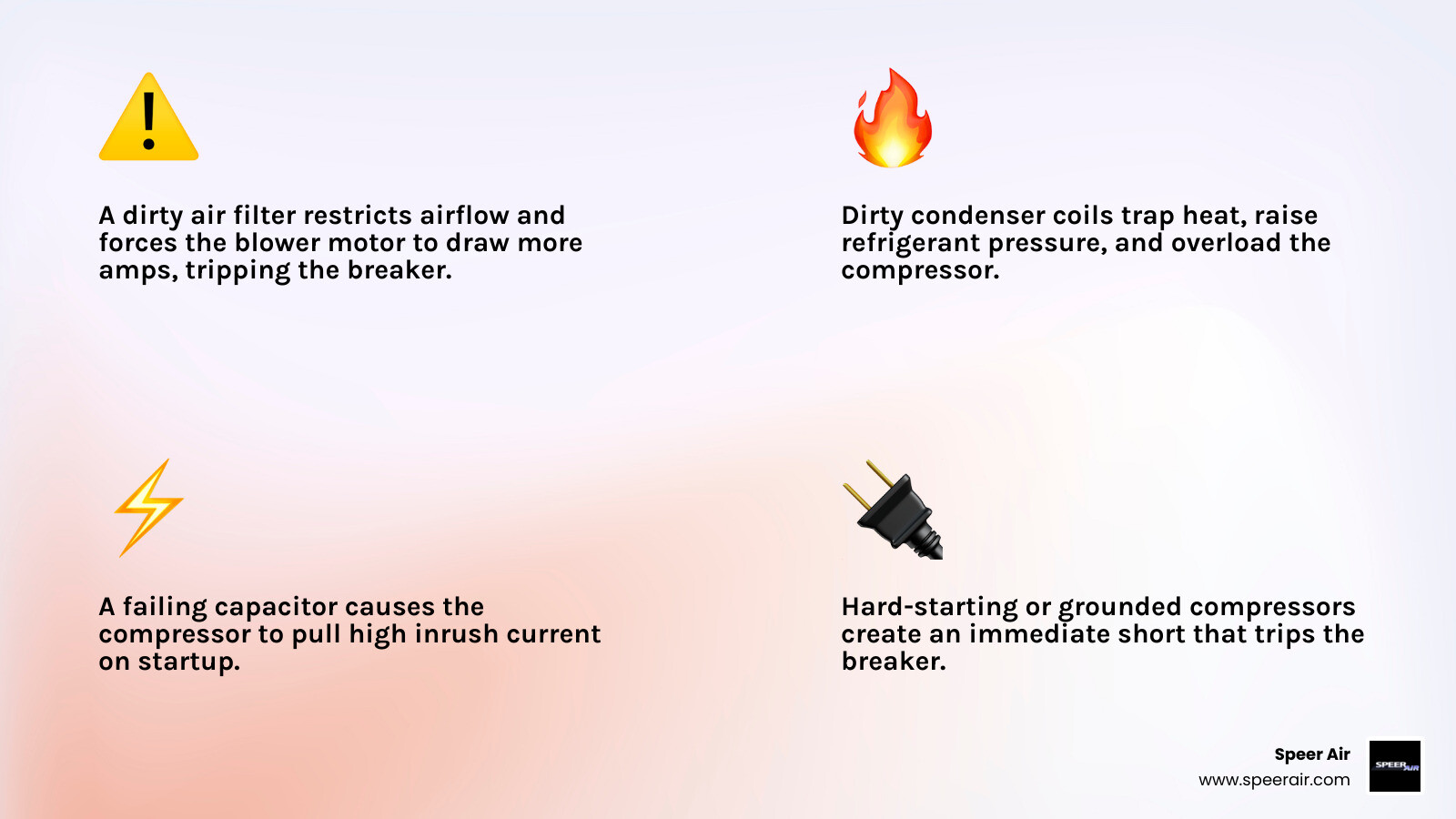
Quick look at ac circuit breaker keeps tripping what it means:
AC Circuit Breaker Keeps Tripping What It Means
To understand why your air conditioner is suddenly throwing a tantrum at the electrical panel, it helps to understand how your home’s electrical system manages heavy appliances. Your central air conditioner is typically powered by a dedicated double-pole circuit breaker. Unlike standard single-pole breakers that power smaller household electronics at 120 volts, a double-pole breaker occupies two slots in your electrical panel to deliver 240 volts of electricity directly to your cooling system.
When your ac circuit breaker keeps tripping what it means is that the safety mechanism inside the panel has detected an electrical hazard. Specifically, breakers are engineered to trip under three primary conditions:
- Overcurrent / Electrical Overload: This occurs when the system demands slightly more electrical current than the circuit is rated to handle over a sustained period. For example, if your AC is on a 40-amp circuit but starts pulling 42 amps because a motor is struggling, the breaker will heat up and eventually click off to protect the wires from melting.
- Short Circuit: A short circuit is a sudden, dramatic event. It happens when an active “hot” wire directly touches a neutral wire or another hot wire. Because there is almost no resistance, the electrical flow spikes instantly to hundreds of amps. The breaker trips immediately and violently to prevent an electrical fire.
- Ground Fault: Similar to a short circuit, a ground fault occurs when a hot wire comes into direct contact with a ground wire or the metal casing of the AC unit itself. This creates an immediate bypass path for the current, triggering an instant shutdown.
When your cooling system repeatedly shuts down the power, you are dealing with a clear warning sign. To learn more about how these electrical hazards manifest in your cooling system, read our detailed guide on Why AC Might Be Tripping Your Circuit Breaker.
Common Mechanical Causes of a Tripping AC Breaker
It might surprise you to learn that many electrical trips actually start as mechanical problems. When physical parts of your air conditioner cannot perform their jobs smoothly, the system must work much harder to keep your home cool. This extra physical effort translates directly into higher electrical demand, causing the system to exceed its safe amperage limits.
If your system is struggling mechanically, it also impacts overall cooling efficiency. If you are noticing that your home isn’t reaching the set temperature, check out our resource on Why Is My AC Not Cooling My Rockaway Home to see how mechanical strain affects indoor comfort.
How a Dirty Air Filter Forces Blower Motor Strain
A heavily clogged air filter is the single most common culprit behind a tripping breaker. Think of your air conditioner as trying to breathe; a dirty filter is like trying to draw a deep breath through a thick pillow.
When dust, pet dander, and debris block the airflow, it creates high static pressure within your ductwork. The indoor blower motor has to fight against this resistance to circulate air. To overcome the static pressure, the motor draws more and more electrical current (amps). If the filter remains unchanged, the continuous amp draw will eventually exceed the breaker’s safety threshold, causing it to trip. Simply replacing your dirty filter with a fresh one regularly is the easiest way to prevent this unnecessary strain.
Why Dirty Condenser Coils Lead to System Overload
Your air conditioner does not actually “create” cold air; instead, it absorbs heat from inside your home and releases it outdoors. The outdoor unit contains condenser coils that are responsible for this heat dissipation.
Over time, the outdoor unit is exposed to pollen, grass clippings, dirt, and outdoor debris. When a thick layer of grime coats the condenser coils, it acts as an insulating blanket. The heat becomes trapped inside the unit, preventing proper heat transfer. As a result, the refrigerant pressure inside the lines spikes dramatically. To pump refrigerant through these high-pressure lines, the compressor must work under immense physical stress, drawing excessive electricity until the circuit breaker cuts the power to protect the system.
Electrical Component Failures and System Stress
As your air conditioner ages, its internal electrical components undergo natural wear and tear. When key parts begin to fail, they generate electrical noise, high startup surges, and physical heat that will quickly trip your electrical panel.
Paying attention to how your system sounds can give you an early warning before a full breakdown occurs. If you have noticed unusual clicks, hums, or buzzes, you can read more about What Your AC Is Trying to Tell You With Those Weird Noises to identify potential component failures.
Failing Capacitor and AC Circuit Breaker Keeps Tripping What It Means
Your outdoor unit relies on capacitors—which act like temporary storage batteries—to provide the electrical boost needed to start and run the motors. The start capacitor provides a massive burst of energy to get the heavy compressor spinning, while the run capacitor delivers continuous, smooth power to keep the compressor and fan motor running efficiently.
When a capacitor begins to degrade or fail, the compressor loses its startup support. Instead of starting smoothly, the compressor struggles to turn over, drawing a massive spike of “inrush current” known as locked rotor amps (LRA). Because the compressor is pulling three to five times its normal running amperage trying to start without the capacitor’s help, the circuit breaker will instantly trip to prevent the compressor motor from burning up.
Failing Compressor and AC Circuit Breaker Keeps Tripping What It Means
The compressor is the heart of your air conditioning system. Because it is a highly complex, sealed motor, mechanical or electrical issues inside the compressor are serious.
A compressor can develop a “hard starting” condition as it ages, meaning it requires far too much electrical current to begin its cooling cycle. In the worst-case scenario, the electrical windings inside the compressor can break down and make direct contact with the metal housing of the unit. This is known as a grounded compressor. A grounded compressor creates a direct path to the earth, causing an immediate, high-amperage short circuit that will trip your breaker the split-second the system tries to turn on.
If your compressor is running continuously or struggling to cycle properly, it can put a massive tax on your electrical panel. Discover how to identify these patterns in our guide on How to Diagnose Constant AC Running Issues.
Outdoor Fan Motor and Wiring Issues
The outdoor unit also houses a condenser fan motor that draws air across the coils to assist in heat transfer. If the bearings inside this fan motor wear out, or if debris blocks the fan blades, the motor will seize. A seized fan motor draws excessive current, quickly tripping the breaker.
Additionally, loose electrical connections, corroded terminals, or wires damaged by pests can create localized resistance. This resistance generates intense heat and electrical arcing, which can cause standard breakers or Arc-Fault Circuit Interrupter (AFCI) breakers to trip instantly. For a step-by-step approach to diagnosing a system that refuses to power up, read our article on How to Troubleshoot AC Not Turning On in 5 Steps.
Safe Troubleshooting Steps and the One-Reset Rule
When your air conditioner trips the circuit breaker, it can be tempting to simply flip the switch back on and hope for the best. However, repeatedly resetting a tripped breaker without addressing the underlying cause is highly dangerous. Every time you force a reset into an active electrical fault, you risk permanently damaging your compressor, melting your home’s wiring, or starting an electrical fire.
To protect your home and your HVAC equipment, we recommend practicing the One-Reset Rule:
- Turn the System Off: Go to your thermostat and set the system to “Off.”
- Reset the Breaker: Locate your main electrical panel. Find the double-pole breaker labeled “AC” or “HVAC.” If it is tripped, it will be resting in the middle position. Flip it completely to the “Off” position first, then flip it firmly back to “On.”
- Wait 30 Minutes: Let the system rest for half an hour. This allows the internal refrigerant pressures to equalize and gives any hot components time to cool down.
- Turn the Thermostat On: Switch your thermostat back to “Cool” and set it a few degrees below the room temperature.
- Monitor: If the system starts up and runs smoothly, keep a close eye on it. If the breaker trips a second time—either immediately or later in the day—do not reset it again. Keep the breaker off and call a professional.
To help you understand what might be happening when your breaker trips, here is a quick comparison of the three primary electrical faults:
| Fault Type | Description | Common Symptoms in AC Systems | Risk Level |
|---|---|---|---|
| Electrical Overload | System draws slightly more current than rated due to mechanical friction or restricted airflow. | Breaker trips after running for 10 to 30 minutes; unit feels hot. | Medium (Can damage motors over time) |
| Short Circuit | Two hot wires or a hot and neutral wire touch directly, bypassing resistance. | Breaker trips instantly the moment the outdoor unit attempts to start. | High (Severe fire and equipment damage risk) |
| Ground Fault | An active electrical wire makes direct contact with the metal frame of the unit. | Breaker trips violently and immediately upon startup; potential shock hazard. | Critical (Immediate shock and fire hazard) |
Frequently Asked Questions About Tripping AC Breakers
Why does my AC breaker trip immediately after I reset it?
If your breaker trips the exact millisecond you flip it back on or as soon as the outdoor unit tries to kick on, you are dealing with a direct short circuit or a grounded compressor. In this scenario, there is a direct, zero-resistance path for electricity to flow to the ground.
Do not attempt to reset the breaker again. This is a severe electrical fault that requires immediate professional attention to prevent damage to your electrical panel and unit. Learn more about identifying these urgent system warnings by reading about Signs You Need HVAC Repair in Rockaway.
Can a refrigerant leak cause my circuit breaker to trip?
Yes, a refrigerant leak can indirectly cause your breaker to trip. When your system is low on refrigerant, it cannot cool your home efficiently. The compressor must run continuously for hours on end to try and meet the thermostat’s demands.
This continuous operation causes the compressor to overheat. As the compressor’s temperature rises, its electrical resistance increases, forcing it to draw more amperage until it eventually overloads the circuit breaker.
Why does my AC only trip the breaker on extremely hot days?
On peak summer afternoons in Northern New Jersey, several factors combine to stress your electrical system. First, high outdoor temperatures increase the pressure inside your refrigerant lines, forcing your compressor to work harder and draw more power. Second, during regional heatwaves, heavy grid demand can cause minor voltage drops (voltage sag). When voltage drops, your AC must draw more current (amps) to maintain the same level of cooling power. If your circuit breaker or capacitor is already weakened by age, this extra demand is often the tipping point that causes a trip.
Conclusion
A tripping circuit breaker is your home’s way of sounding an alarm. While it can be frustrating to lose your cooling on a hot day, the breaker is successfully protecting your property from serious electrical hazards. Whether the root cause is a simple airflow restriction like a clogged filter or a complex electrical issue like a failing capacitor or grounded compressor, ignoring the warning signs can lead to costly system damage.
For over a century, Speer Air has been the trusted name for home comfort throughout Morris County, Sussex County, Passaic County, and the surrounding Northern New Jersey communities. As a Carrier Factory Authorized Dealer with NATE-certified technicians, we have the specialized diagnostic tools and expertise to pinpoint exactly why your circuit breaker is struggling and resolve the issue safely.
Do not risk your home’s safety with repeated manual resets. If you are ready to restore safe, reliable cooling to your home, check out our AC Repair Rockaway NJ Guide or contact us today to Schedule Professional Air Conditioning Service.