

Your AC Won’t Last Forever — But These Steps Can Add Years to Its Life
Knowing how to extend the life of your AC unit can mean the difference between a system that runs strong for 15 to 20 years and one that gives out after 10. For homeowners in Northern New Jersey — where summers bring real heat and humidity — that gap adds up to thousands of dollars and years of reliable comfort.
Here’s a quick answer to get you started:
How to extend the life of your AC unit:
- Change air filters every 1–3 months — dirty filters restrict airflow and strain the compressor
- Keep the outdoor unit clear — maintain at least 2 feet of clearance around the condenser
- Use smart thermostat settings — set to 78°F when home, raise it when away
- Schedule professional maintenance — once or twice a year, before peak season
- Seal leaky ductwork — the typical home loses 25% of cool air through duct leaks
- Address repairs early — small problems become expensive breakdowns fast
- Improve home insulation — a well-insulated home puts less strain on your AC
The average central air conditioner lasts 15 to 20 years with proper care. Without it, that lifespan can drop to 10 to 12 years. The good news? Most of what determines which end of that range your system lands on comes down to simple, consistent habits — and knowing when to call in a professional.
The sections below walk you through everything, from quick DIY steps to what a professional tune-up actually covers, so your system stays efficient and lasts as long as possible.
Understanding AC Lifespan: Northeast vs. Hot Climates
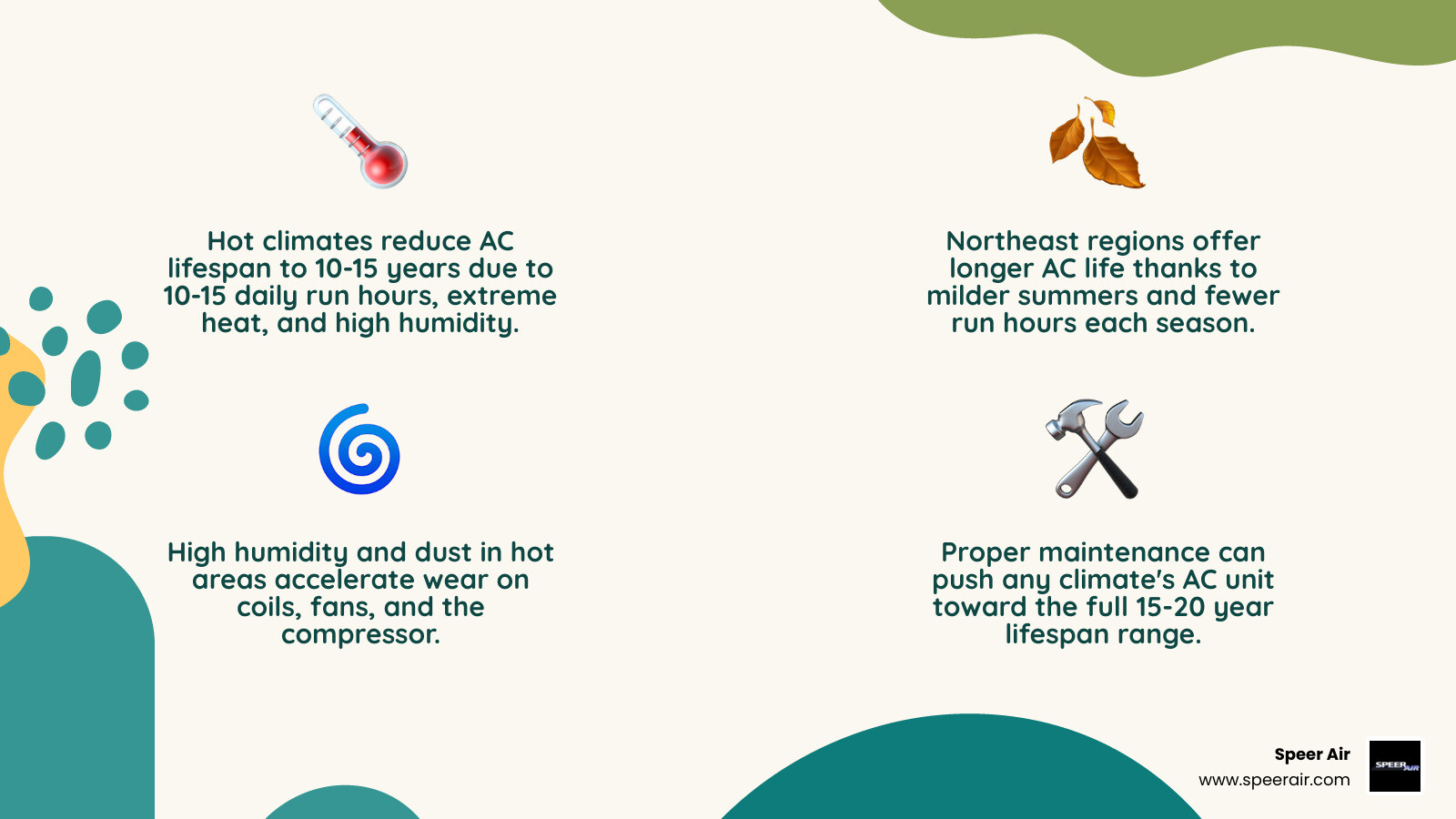
When we talk about the average lifespan of an air conditioner, geography plays a massive role. If you live in a region with scorching, year-round heat like Texas or Florida, your cooling system is going to work overtime. In those ultra-hot climates, an AC unit might only last 10 to 15 years because it runs for 10 to 15 hours a day, battling extreme heat, heavy dust, and relentless humidity.
Here in Northern New Jersey, our climate is a bit different, but it presents its own unique set of challenges.

Our systems get a much-needed break during our freezing winters, which naturally reduces the total annual runtime hours. However, our summers are incredibly humid, and our spring and autumn seasons bring heavy pollen, falling leaves, and debris that can quickly clog up outdoor equipment. If you want to know how our local weather patterns impact your system, check out our guide on Will Your AC Survive the Northeast? A Guide to Equipment Longevity.
To give you an idea of how geography and climate impact your system’s operational stress, take a look at this comparison:
| Climate Region | Average Lifespan (Maintained) | Peak Summer Run Hours Per Day | Primary Environmental Stressors |
|---|---|---|---|
| Hot/Humid South (e.g., Texas) | 10 to 15 Years | 12 to 16 Hours | Extreme heat, high dust/pollen, prolonged humidity |
| Milder Northeast (e.g., New Jersey) | 15 to 20 Years | 6 to 10 Hours | High summer humidity, seasonal debris (leaves/pollen), winter freezing |
While we benefit from fewer operational hours in the Northeast, the high humidity forces our systems to work twice as hard to pull moisture out of the air. When an AC is neglected in a humid climate, moisture builds up, leading to frozen coils, rusted components, and mold growth. That is why proactive care is just as critical here as it is down south.
The Ultimate Guide on How to Extend the Life of Your AC Unit
The secret to a long-lasting air conditioner isn’t a mystery: it all comes down to reducing mechanical strain and maintaining unrestricted airflow.
Think of your air conditioner like a car. If you drive your car with low oil, flat tires, and a clogged engine filter, it is going to break down long before it hits 100,000 miles. Your AC behaves the exact same way. When airflow is restricted, or when the outdoor condenser coils are caked in dirt, the system has to run longer and work harder to cool your home. This extra strain directly degrades the compressor — the expensive “heart” of your system.
To understand the long-term impact of skipping basic care, read our detailed comparison of Maintenance vs. Neglect: The Battle for Your AC’s Life.
DIY Steps: How to Extend the Life of Your AC Unit Today
You don’t need a tool belt or a degree in thermodynamics to perform some of the most effective maintenance tasks. In fact, the single most important thing you can do to protect your system is to manage your air filters.
A dirty, clogged air filter is the number one cause of premature AC failure. When the filter is packed with dust, pet dander, and hair, the blower motor has to work twice as hard to pull air through it. This starves the evaporator coil of warm indoor air, causing the coil temperature to drop below freezing. Before you know it, you have a frozen solid evaporator coil, a burned-out blower motor, and a highly stressed compressor.
To prevent this nightmare scenario, follow these filter best practices:
- Check the filter monthly: During peak summer, pull the filter out and hold it up to a light source. If you can’t see light passing through it, it is time for a replacement.
- Choose the right MERV rating: For most residential systems, a filter with a MERV rating between 8 and 11 is the sweet spot. It captures dust, pollen, and mold spores without restricting airflow. Avoid ultra-high MERV filters (MERV 13+) unless your system was specifically designed for them, as they can act like a brick wall to your system’s airflow.
- Replace regularly: Change your filters every 30 to 90 days. If you have pets, allergies, or live in a dusty area, lean toward the 30-day mark.
Neglecting these simple steps can trigger a domino effect of component failures. Learn exactly how this happens in The Ultimate Guide to How Neglected AC Systems Fail.
Keeping the Outdoor Condenser Clear
Your outdoor unit (the condenser) has a big job: it takes the heat collected from inside your home and releases it into the outdoor air. To do this efficiently, the condenser needs to “breathe.”
When the metal fins of the outdoor unit are blocked by overgrown shrubs, weeds, tall grass, or piles of leaves, the heat gets trapped. This forces the compressor to run at dangerously high temperatures and pressures to dump the heat, which rapidly degrades the system’s internal lubricants.
Here is how you can keep your condenser happy:
- Maintain a 2-foot clearance zone: Trim back any bushes, flowers, or trees so there is at least 24 inches of clear space on all sides of the unit.
- Clear away seasonal debris: Regularly check the top and sides of the unit for fallen leaves, twigs, and grass clippings.
- Gently rinse the coils: Once or twice a year, use a standard garden hose (never a pressure washer, which will instantly bend and ruin the delicate aluminum fins) to gently wash away accumulated dirt and pollen from the exterior coils.
Keeping this area clean prevents the compressor from working itself to death. For a deeper look at how outdoor cleanliness protects your system’s most expensive parts, see The Complete Guide to How Maintenance Prevents Compressor and Coil Damage.
Smart Thermostat Habits: How to Extend the Life of Your AC Unit Efficiently
How you operate your thermostat has a direct impact on how many years of service you get out of your cooling system. One of the most common mistakes homeowners make is “cranking” the thermostat down to 65°F in the middle of a hot day, thinking it will cool the house faster.
Air conditioners do not work like a gas pedal; they deliver cool air at a constant rate. Setting an extremely low temperature simply forces the system to run continuously for hours on end, accelerating wear and tear.
Instead, adopt these smart thermostat habits:
- Use the “Auto” fan setting: Always set your thermostat fan to “Auto” rather than “On.” The “On” setting runs the blower fan continuously, even when the system isn’t actively cooling. This not only wastes energy but also blows moisture off the wet evaporator coil back into your home, raising indoor humidity.
- Implement a setback strategy: When you are away from home for more than 4 hours, raise the thermostat by 5 to 7 degrees (e.g., from 72°F to 78°F). This reduces the total runtime and gives your system a well-deserved break without letting the house get so hot that it takes hours to recover.
- Upgrade to a smart thermostat: A smart thermostat can automate these setbacks, learning your daily schedule and optimizing cooling cycles to prevent short-cycling (when the system turns on and off too frequently).
By optimizing your daily usage habits, you can drastically reduce system strain while keeping your utility bills under control. Discover more about this balance in The Secret to Lower Energy Bills and Zero Summer Breakdowns.
Why Professional Annual Tune-Ups Are Non-Negotiable
While DIY care is incredibly valuable, there are critical components of your air conditioner that require professional diagnostic tools and training to service. Think of a professional tune-up as preventative medicine. It allows a trained eyes-on technician to spot and correct minor issues before they turn into major, system-killing breakdowns.
During a professional visit, a technician will inspect the electrical connections, measure the amp draw of the motors, test the capacitors, and verify that the refrigerant charge is exactly where it needs to be. Operating a system with even a slightly incorrect refrigerant charge can destroy the compressor over time.
If you’re wondering how often you should schedule these visits, read our guide on Don’t Wait for a Breakdown: How Often to Schedule Your Tune-Ups. And if you’re tempted to skip a year to save a quick buck, check out How Skipping Your Annual Tune-Up Costs You More Long-Term.
What Happens During a Professional AC Tune-Up
When you hire a reputable HVAC company, you should expect a comprehensive, multi-point inspection. A true professional tune-up is much more than just a quick glance at your outdoor unit and a filter change.
To make sure you get your money’s worth, look for a technician who follows a rigorous checklist, including:
- Testing the capacitors: Capacitors store electrical energy and help start the motors. If a capacitor is failing, the motor will struggle to start, overheat, and eventually burn out.
- Clearing the condensate drain line: Algae and dust can clog the drain line, leading to water backups that can cause severe water damage to your home or trigger a safety switch that shuts your system down entirely.
- Cleaning the evaporator and condenser coils: Removing dirt and grime restores optimal heat transfer.
- Checking electrical connections: Tightening loose wires prevents electrical shorts and component damage.
- Measuring refrigerant levels: Ensuring the system has the correct charge for maximum efficiency.
For a detailed walkthrough of what to expect, read What Happens During an AC Tune-Up: Step-by-Step Guide and protect yourself from subpar service by reviewing this Don’t Get Scammed: A 20-Point AC Tune-Up Checklist.
Boosting Longevity Through Home Efficiency and Airflow
Your air conditioner doesn’t operate in a vacuum; it is part of a larger home ecosystem. The harder your home is to keep cool, the harder your AC has to work, and the shorter its lifespan will be.
One of the most overlooked factors in AC longevity is ductwork. According to the EPA, the typical home loses roughly 25% of its cool air through leaky, unsealed ductwork. This means your AC has to run 25% longer just to deliver the amount of cooling your thermostat is asking for. By having a professional seal and insulate your air ducts, you can save up to 20% on your cooling bills and significantly reduce the wear and tear on your system.
Additionally, upgrading your attic insulation and sealing air leaks around windows and doors prevents hot, humid outdoor air from infiltrating your living spaces. When your home holds onto its cool air, your AC gets to rest more often, extending its operational life. Learn more about how proper system airflow and home efficiency go hand in hand in our article on How a Tune-Up Extends the Life of Your AC System.
Warning Signs Your Cooling System Is Struggling
Just like a car that starts making a strange noise before the engine fails, your air conditioner will usually give you several warning signs when it is struggling. Ignoring these signs is the fastest way to turn a simple, inexpensive repair into a catastrophic system failure.
Keep an eye (and ear) out for these common warning signs:
- Unusual noises: Squealing, grinding, rattling, or loud banging noises are clear indicators of loose components, failing motor bearings, or a struggling compressor.
- Weak or warm airflow: If the air coming out of your vents feels weak or isn’t as cold as it used to be, you could be dealing with a blower motor issue, clogged coils, or a refrigerant leak.
- Short-cycling: If your system turns on, runs for a few minutes, and then shuts off again repeatedly, it is short-cycling. This places immense strain on the compressor and electrical components.
- Water leaks: Puddles of water around your indoor furnace or air handler indicate a clogged condensate drain line or frozen coils.
If you notice any of these red flags, it is time to take action. Read more about identifying these indicators in our guide on Signs HVAC System Is Ready for an Upgrade.
Knowing When to Repair vs. Replace Your System
Even with the best maintenance, every air conditioner will eventually reach the end of its reliable lifespan. When your system starts acting up, you will face a tough decision: do you keep patching it up with repairs, or is it time to invest in a replacement?
A good rule of thumb is the 50% rule: if the cost of a single repair exceeds 50% of the total value of the system, or if the system is over 15 years old and requires frequent repairs, replacement is usually the smarter, more cost-effective long-term choice.
Modern air conditioners are incredibly energy-efficient compared to systems built 10 to 15 years ago. Upgrading can slash your monthly utility bills and eliminate the constant worry of a summer breakdown.
If you are trying to decide if your system is past its prime, check out Is Your HVAC Over the Hill? Knowing When to Say Goodbye and consult our comprehensive When to Repair vs. Replace Your HVAC System: A-Z Guide.
Frequently Asked Questions about AC Longevity
How long does a central AC unit typically last?
On average, a well-maintained central air conditioner in Northern New Jersey will last between 15 and 20 years. However, without regular professional maintenance and timely filter changes, that lifespan can easily drop to 10 to 12 years due to accumulated strain on the compressor and fan motors.
Can a dirty air filter actually damage my AC compressor?
Yes, absolutely. A dirty filter severely restricts indoor airflow. This lack of warm air causes the evaporator coil to freeze. When the coil freezes, liquid refrigerant can flow backward down the line into the compressor. Since compressors are designed to compress gas, not liquid, this “liquid slugging” can instantly destroy the compressor, resulting in an expensive, system-ending repair.
Is it better to turn the AC off or use a thermostat setback when away?
It is almost always better to use a setback strategy (raising the temperature by 5 to 7 degrees) rather than turning the system completely off. Turning the system off allows heat and humidity to build up inside your home’s walls, furniture, and flooring. When you return and turn the system back on, it has to run continuously for hours to remove that massive moisture load, putting incredible strain on the equipment.
Conclusion
Taking care of your air conditioner doesn’t have to be overwhelming. By implementing a few simple DIY habits — like changing your filters, keeping your outdoor unit clear, and using smart thermostat settings — you can easily protect your investment and add years to your system’s life.
When it comes to the technical, specialized care your system needs to run at peak efficiency, we are here to help. Based in Northern New Jersey, Speer Air has been keeping local families comfortable since 1900. Our deep industry roots, NATE-certified technicians, and status as a Carrier Factory Authorized Dealer mean you get the highest level of expertise and reliable service every single time.
Whether you live in Rockaway, Denville, or anywhere else in Morris County, don’t wait for a summer breakdown to show your AC some love. Contact us today to schedule your professional tune-up on our Air Conditioning Service Page and keep your home cool and comfortable for years to come!